
Jobchapter 37
24 verses · unknown · 10th century BC · Wisdom and poetry
He seals up the hand of every man, so that all men may know His work.
Introduction
unknown, Wisdom and poetry, Job Overview.
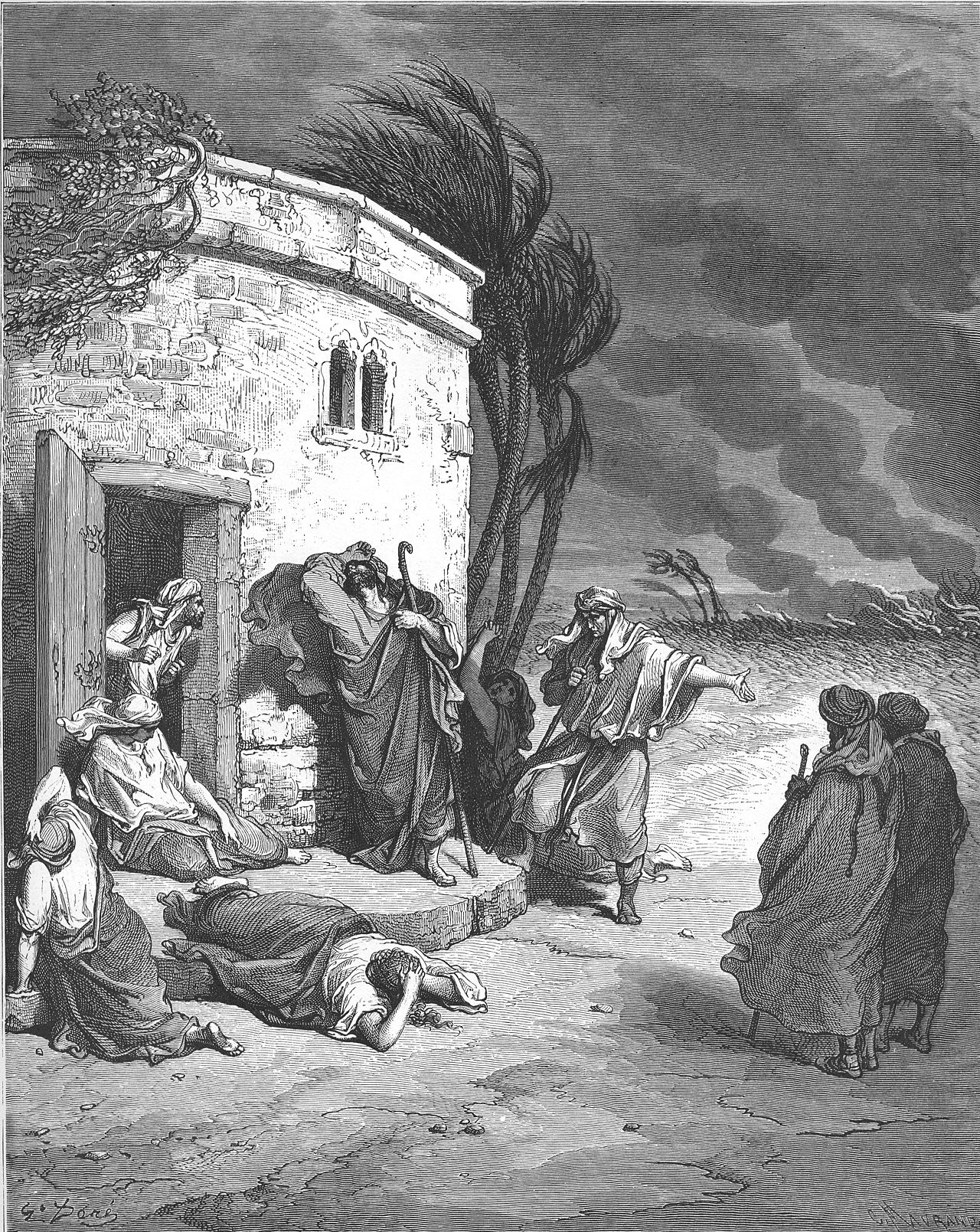
This chapter ends Elihu's last speech, and with it the last human words before God speaks. Elihu describes a storm as it breaks around him, and he says his own heart shakes. His hearers had sheltered from such storms and knew the fear he names. The chapter walks through thunder, lightning, snow, rain, wind and ice as commands of God. Listen for the questions Elihu puts to Job about the sky, since God will soon ask questions of the same kind. The whirlwind of the next chapter comes out of this weather.
Context
- Who
- Hearers who had sheltered from a storm and known exactly this fear
- What
- The close of Elihu's last speech, a description of God's power in thunder, winter weather and the bright sky.
- Where
- The ash heap, in wind, thunder and driving weather.
- When
- The book sets Job in the age of the patriarchs, commonly placed about 2000 to 1800 BC, and it gives no date.
- Why
- To bring Job to stand still before the works of God and to fear Him.
Historical context
This chapter is a weather description from inside the weather. Elihu's own heart trembles and is moved out of its place; hear attentively the noise of his voice, and the sound that goes out of his mouth. Thunder as the voice of God is how the ancient world heard it, and Elihu says the lightning goes to the ends of the earth and God thunders marvellously with a voice we cannot comprehend.
Show the rest of the historical context, 3 more paragraphs
Then he runs through the seasons as commands. God says to the snow, be thou on the earth, and to the small rain and the great rain of his strength. He seals up the hand of every man, so that all men may know his work, winter storms stopped outdoor labour, and everyone in an agricultural society understood being shut indoors by the weather. The beasts go into their dens and remain in their places.
The winds come next, and the directions are exact for that region. The whirlwind comes out of the south and the cold out of the north; by the breath of God frost is given, and the breadth of the waters is frozen. When the south wind quiets the earth, the heat becomes unbearable and a man's garments are warm on him.
His last image is the sky itself: hast thou with him spread out the sky, which is strong, and as a molten mirror? Mirrors in that world were sheets of polished bronze, cast and burnished, hard, bright, and blinding in sunlight. A white, hazy, glaring sky after a storm looks exactly like that, and every hearer had squinted at one. Elihu ends by saying men cannot look on the bright light in the clouds, that with God is terrible majesty, and that he will not afflict, and then his voice stops.
Significance
Four men have now spoken about God for thirty-five chapters. The last word from any of them is that the Almighty cannot be found out, and is great in power and judgment, and will not afflict.
Show the rest of the significance, 1 more paragraph
Then the storm Elihu has been describing opens and God speaks out of it. The first hearers had been waiting since chapter 3 for that, and the timing tells them something before a word is said: the answer is not going to be another explanation.
This chapter in Jewish lifeWhat this chapter is in Jewish life and reading.
What is done
This chapter has no place in the synagogue year. The site's own table in src/lib/hebraic/readings.ts printed parashot total 0 and haftarah uses total 0 for the book of Job, and no festival reading.
The corpus joins it to the study of the Torah portions through the Midrash arranged by them. Under the first verse it carries Midrash Tanchuma Buber, Achrei Mot 11:1. Under the first verse it carries Midrash Tanchuma Buber, Achrei Mot 5:1.
How it is read
Rashi and Malbim are the two commentators on this chapter whose English the corpus carries. Rashi is quoted from The Judaica Press complete Tanach with Rashi, translated by A. J. Rosenberg, which Sefaria reports as CC-BY. Malbim is quoted from Malbim's Job, trans. Jeremy I. Pfeffer. Ktav, 2003, which Sefaria reports as CC-BY.
Elihu is still speaking, and Rashi reads his storm as the voice of God. The springing heart of the first verse he reads as astonishment (Rashi on Job 37:1:1). The thunder in the sky is like a sound from God's mouth (Rashi on Job 37:2:1).
The weather is God's instrument of judgment in Rashi's reading. At the seventh verse a man who sins signs his own signature on the day of his death to the sins written before him (Rashi on Job 37:7:1). The Omnipresent has many more agents of punishment, among them wild beasts, the tempest and the cold (Rashi on Job 37:8:1). Aph Beri is the name of the angel appointed over the clouds (Rashi on Job 37:11:1).
Malbim frames the fourteenth verse as an argument from the lesser to the greater. "If a full comprehension of the physical earthly world is beyond man’s grasp, how can he possibly hope to understand the wonders of the metaphysical heavenly world" (Malbim on Job 37:14:1). Rashi reads the nineteenth and twentieth verses to the same end. No one can set up a case with God because of the darkness around Him (Rashi on Job 37:19:1). He has no need to be told what we say (Rashi on Job 37:20:1).
At the twenty-first verse Rashi has Elihu turn back to chide the three companions. They are like stillborn babies who did not see wisdom (Rashi on Job 37:21:1). The twenty-second verse carries two readings. Rashi first reads it as a return to Elihu's previous statement. He then reports the homily of the Sages in Taanith 7b, of a wind that clears the rain clouds away. "This is a homily of the Sages, but it does not fit the sequence of the verses" (Rashi on Job 37:22:1).
God judges with clemency in the twenty-third verse. He asks atonement by small things, such as a handful of meal offering or a half shekel, and did not burden them to seek a wild ox or an antelope (Rashi on Job 37:23:1). At the last verse Rashi reports that the Sages in Rosh Hashanah 17a read it of Job. In their reading Elihu tells him that he did not merit to keep his wise-hearted sons alive, because he imposed excessive fear upon his generation (Rashi on Job 37:24:1).
The corpus carries one further note on this chapter without an English text, marked linked because Sefaria holds no English version of the ref. It stands cited by ref and unquoted. One stands at Metzudat David on Job 37:5:1.
What the rabbis say
The corpus carries forty rabbinic locators on this chapter and the text of none, so each is cited and linked here rather than quoted. On the first verse it holds Midrash Lekach Tov, Numbers 17:23:1, Midrash Tanchuma Buber, Achrei Mot 11:1 and Midrash Tanchuma Buber, Achrei Mot 5:1. On the second verse it holds Bereshit Rabbah 49:1, Bereshit Rabbah 49:2 and Bereshit Rabbah 64:4. On the third verse it holds Bereshit Rabbah 11:2 and Bereshit Rabbah 12:6. On the fourth verse it holds Midrash Sekhel Tov, Bereshit 26:5:1.
On the fifth verse it holds Avot DeRabbi Natan 33:2 and Bamidbar Rabbah 14:22. On the sixth verse it holds Bereshit Rabbah 1:6 and Bereshit Rabbah 12:11. On the seventh verse it holds Ein Yaakov (Glick Edition), Taanit 1:46 and Ein Yaakov, Taanit 1:51. On the ninth verse it holds Bereshit Rabbah 52:4 and Ein Yaakov (Glick Edition), Bava Batra 2:5. On the tenth verse it holds Bava Batra 25b:3 and Otzar Midrashim, Midrash Temurah 1:5. On the eleventh verse it holds Ein Yaakov (Glick Edition), Taanit 1:26 and Ein Yaakov, Taanit 1:27.
On the thirteenth verse it holds Ein Yaakov, Taanit 1:32 and Jerusalem Talmud Taanit 3:3:3. On the fifteenth verse it holds Midrash Tehillim 50:1. On the sixteenth verse it holds Introductions to Amoraic Literature, Part II (Notes and Interpretations for Chapters of the Talmud), Baba Batra, Chapter I 381. It also holds Otzar Midrashim, Midrash on Psalms, Midrash on Psalm 118 3. On the seventeenth verse it holds Ein Yaakov (Glick Edition), Gittin 3:1 and Ein Yaakov, Gittin 3:2. On the eighteenth verse it holds Bereshit Rabbah 12:13 and Jerusalem Talmud Berakhot 1:1:24.
On the nineteenth verse it holds Midrash Tehillim 104:1. On the twentieth verse it holds Ein Yaakov (Glick Edition), Megillah 2:3 and Jerusalem Talmud Berakhot 9:1:6. On the twenty-first verse it holds Ein Yaakov (Glick Edition), Taanit 1:25 and Ein Yaakov, Taanit 1:26. On the twenty-second verse it holds Bava Batra 25b:5. On the twenty-third verse it holds Avodah Zarah 4a:4 and Bamidbar Rabbah 21:22. On the twenty-fourth verse it holds Berakhot 58a:6 and Ein Yaakov (Glick Edition), Berakhot 9:8. What each of them teaches is a saying of the rabbis, and is reported as theirs wherever this site quotes one. The quotations wait on a fetch that carries the text.
Sources: Rashi, Rashi on Job 37:1:1 to 37:24:1, The Judaica Press complete Tanach with Rashi, translated by A. J. Rosenberg, reported CC-BY; Malbim, Malbim on Job 37:14:1, Malbim's Job, trans. Jeremy I. Pfeffer. Ktav, 2003, reported CC-BY; Metzudat David, Metzudat David on Job 37:5:1, cited by ref because the corpus carries no English text; The Sefaria corpus, scripts/data/sources/sefaria/job/37.json, the 40 Talmud and Midrash locators of this chapter; The site's own files, src/lib/hebraic/readings.ts, printing no portion, no Haftarah and no festival reading for this book.
The heads below are this chapter's scenes. The numbered points under each are its verses.
Elihu: God Thundereth Marvellously With His Voice
Job 37:1-5
Elihu describes the storm arriving as he speaks: “Listen closely to the thunder of His voice”. Delitzsch reads this as the thunder Elihu names becoming audible in the scene. Henry takes verse 5, “He does great things we cannot comprehend”, as Elihu's summary confession ahead of the catalogue that follows.
Job 37:1
“At this my heart trembled, and was moved from its place. Because, while fear strikes the mind, it estranges it from itself, the Latin translations sometimes call an ecstasy fear, as is said by the Psalmist, I said in my fear, I am cast out from the sight of Thine eyes; [Ps. 31, 22] Where, namely, it could have been called not fear, but a transport ['excessus']. But fear is in that place used for transport, because the mind is estranged from itself in fear, as it is a transport.”
Gregory the Dialogist · written before 604 · Morals on the Book of Job, Book XXVIIpatristic
the thunder of His voice: Albert Barnes gives the Hebrew as hear in hearing, a call to listen closely to the thunder. Adam Clarke thinks a real storm was breaking as Elihu spoke, the lightning flashing before their eyes. Out of that storm the Almighty speaks in chapter 38.
Job 37:2
“It will hear a hearing in the terror of His voice, and a sound going out of His mouth. It is the habit of Holy Scripture, that, when it informs us that any thing is heard with the hearing, it says that this hearing is heard. As Habakkuk says, O Lord, I have heard Thy hearing, and was afraid. [Hab. 3, 1] Whence it is said here also, It will hear a hearing in the terror of His voice. But we must observe that the voice of God is said to be heard, not in joy, but in terror.”
Gregory the Dialogist · written before 604 · Morals on the Book of Job, Book XXVIIpatristic
1 more voice on this verse
Job 37:2
“Hear attentively - “Hear with hearing.” The words seem to intimate that there was actually at that time a violent storm of thunder and lightning, and that the successive peals were now breaking over the house, and the lightning flashing before their eyes. The storm continued till Elihu had finished, and out of that storm the Almighty spoke. See the beginning of the succeeding chapter, Job 38 (note). The noise of his voice - The sudden clap. And the sound that goeth out - The peal or continued rattling, pounding, and thumping, to the end of the peal.”
Adam Clarke · Commentary on the Bible (1810-1826)evangelical
to the ends of the earth: The Hebrew for ends is wings, says Albert Barnes, the earth pictured as spread out. Adam Clarke notes that the flash crosses the whole sky in an instant. John Gill adds that God directs where each bolt will strike.
Job 37:3
“He directeth it under the whole heaven,.... His voice of thunder, which rolls from one end of the heaven to the other: he charges the clouds with it, and directs both it and them where they shall go and discharge; what tree, house, or man, it shall strike; and where the rain shall fall when the clouds burst: yet Pliny (x) atheistically calls thunder and lightning chance matters.”
Then there comes a roaring sound: The lightning comes first and the roaring sound after, as Albert Barnes and Matthew Henry note. The gap depends on how far off the thunder is. Henry compares it to seeing a great gun fire far off before its sound comes.
Job 37:4
“After Him a sound will roar. He will thunder with the voice of His greatness. And He will not be enquired into, when His Voice hath been heard. For the Lord doubtless turns into sorrow the life of him whom He has filled with His illumination; and the more He suggests to the enlightened mind eternal punishments, the more cruelly does He weary it with sorrow for its past wickedness; and a man grieves at what he was, because he now begins to discern the good which he was not. He hates himself, as he remembers himself to have been.”
Gregory the Dialogist · written before 604 · Morals on the Book of Job, Book XXVIIpatristic
2 more voices on this verse
Job 37:4
“After it a voice roareth - After the flash has been seen, the peal is heard; and this will be more or fewer seconds after the peal, in proportion to the distance of the thunder cloud from the ear. Lightning traverses any space without any perceivable succession of time; nothing seems to be any obstacle to its progress.”
Adam Clarke · Commentary on the Bible (1810-1826)evangelical
Job 37:4
“The thunderclap follows at an interval after the flash. stay them--He will not hold back the lightnings (Job 37:3), when the thunder is heard [MAURER]. Rather, take "them" as the usual concomitants of thunder, namely, rain and hail [UMBREIT] (Job 40:9).”
Jamieson, Fausset & Brown · Commentary Critical and Explanatory on the Whole Bible (1871)reformed
He does great things we cannot comprehend: Albert Barnes marks this as the end of the thunder. From here Elihu turns to other great things men cannot comprehend. Jamieson, Fausset and Brown compare Psalm 29, where the voice of God sounds again and again.
Job 37:5
“God thundereth marvelously - He thunders in a wonderful manner. The idea is, that the voice of his thunder is an amazing exhibition of his majesty and power. Great things doeth he, which we cannot comprehend - That is, not only in regard to the thunder and the tempest, but in other things. The description of the storm properly ends here, and in the subsequent verses Elihu proceeds to specify various other phenomena, which were wholly incomprehensible by man.”
2 more voices on this verse
Job 37:5
“God will thunder marvellously with His voice. Who doeth great things and inscrutable. God thunders marvellously with His voice, because He penetrates our hearts incomprehensibly with His secret might. For while with its secret motions it overpowers us with fear, and fashions us in love, it proclaims in some silent manner how eagerly He is to be followed, and a violent impulse arises in the mind, though nothing sounds in the voice. And it sounds the more loudly within us, the more completely it deadens the ear of our heart to every outward sound.”
Gregory the Dialogist · written before 604 · Morals on the Book of Job, Book XXVIIpatristic
Job 37:5
“The sublimity of the description lies in this, that God is everywhere in the storm, directing it whither He will [BARNES]. See Ps 29:1-11, where, as here, the "voice" of God is repeated with grand effect. The thunder in Arabia is sublimely terrible.”
Jamieson, Fausset & Brown · Commentary Critical and Explanatory on the Whole Bible (1871)reformed
Job 37:6-13
He says to the snow: Snow, rain, ice and wind come under one command: “He says to the snow”, and “By the breath of God the ice is formed”. Gill reads “He seals up the hand of every man” as winter halting labor by God's decree, “so that all men may know His work”.
Job 37:6
“Who ordereth the snow to descend on the earth, and the rains of the winter, and the showers of His strength. Because the Psalmist says, Thou shalt wash me, and I shall be whiter than snow; [Ps. 51, 7] what do we understand by snow in this place, but the hearts of the Saints made white by the light of righteousness? But waters are taken up, and congealed above, in order to become snow. But when this snow descends to the earth, it is changed again into liquid waters.”
Gregory the Dialogist · written before 604 · Morals on the Book of Job, Book XXVIIpatristic
3 more voices on this verse
Job 37:6
“Be--more forcible than "fall," as UMBREIT translates Ge 1:3. to the small rain, &c.--He saith, Be on the earth. The shower increasing from "small" to "great," is expressed by the plural "showers" (Margin), following the singular "shower." Winter rain (So 2:11).”
Jamieson, Fausset & Brown · Commentary Critical and Explanatory on the Whole Bible (1871)reformed
Job 37:6
“Saying and doing are not two things with God, though they are with us. When he speaks the word the small rain distils and the great rain pours down as he pleases-- the winter-rain (so the LXX.), for in those countries, when the winter was past, the rain was over and gone, Cant. ii.”
Matthew Henry · Commentary on the Whole Bible (1707-1721)puritan
Job 37:6
“For he saith to the snow, be thou on the earth,.... In the original it is, be thou earth: hence one of the Rabbins formed a notion, that the earth was created from snow under the throne of glory, which is justly censured by Maimonides (f); for there is a defect of the letter ב, as in 2Ch 34:30; as Aben Ezra observes; and therefore rightly supplied by us, on the earth. This is one of the great and incomprehensible things of God.”
seals up the hand of every man: Charles Spurgeon preached this verse as a winter sermon. When men cannot do their own work, they are meant to look at the work of God. Jamieson, Fausset and Brown add that man's work at other times makes him forget his need of God.
Job 37:7
“When the Lord seals up a man's hand, he is unable to perform his labor. The Lord has an objective in this, namely, "that all men may know His work." When they cannot do their own work, they are intended to observe the works of God. This is a fact which I fear many of us have never noticed. When the ground is hardened into iron by the frost. When the land lies deep beneath the snow. When the ox rests in the stall and the servants warm their hands at the fire, then the farmer's hand is sealed up.”
Charles Spurgeon · written before 1892 · The Metropolitan Tabernacle Pulpit, Sermon No. 3289: “The Sealed Hand—a Winter Sermon” (lightly modernized text, CCEL edition)Particular Baptist
2 more voices on this verse
Job 37:7
“Who sealeth the hand of all men, that every one may know his works. For men scorn to think of the sins they commit. But when they hear the power of heavenly severity, they discern this burden of misdeeds which weighs them down. For being roused by the words of preaching, they keep on the watch, in order to consider to what punishments the merit of their former doings is leading them.”
Gregory the Dialogist · written before 604 · Morals on the Book of Job, Book XXVIIpatristic
Job 37:7
“He sealeth up the hand of every man - That is, in the winter, when the snow is on the ground, when the streams are frozen, and when the labors of the husbandman cease. The idea of “sealing up the hand” is derived from the common purpose of a seal, to make fast, to close up, to secure (compare Job 9:7, note; Job 33:16, note), and the sense is, that the hands can no more be used in ordinary toil.”
The wild animals enter their lairs: Albert Barnes notes that in the cold many wild animals lie still in their dens, needing no food while none can be found. He takes this as a sign of God's care. Matthew Henry sets the wild animals, who find their lairs by instinct, beside the tame ones men keep.
Job 37:8
“Then the beasts go into dens - In the winter. This fact appears to have been early observed, that in the season of cold the wild animals withdrew into caves, and that many of them became torpid. This fact Elihu adverts to as an illustration of the wisdom and greatness of God. The proof of his superintending care was seen in the fact that they withdrew from the cold in which they would perish, and that provision is made for their continuance in life at a time when they cannot obtain the food by which they ordinarily subsist.”
The tempest comes from its chamber: The Hebrew word, cheder, means an inner room or chamber, as Albert Barnes explains. Jamieson, Fausset and Brown picture God keeping the tempest in His chambers of the south until He sends it out. The cold comes from the north.
Job 37:9
“A tempest will come forth from the inner parts, and cold from Arcturus. When Holy Scripture mentions the inner parts, in opposition to Arcturus, it designates the quarter of the South, opposite to the parts of the North.”
Gregory the Dialogist · written before 604 · Morals on the Book of Job, Book XXVIIpatristic
By the breath of God: Albert Barnes pictures frost formed on a still night with no tempest, as if God only breathed on the earth. Adam Clarke still found the freezing of water a mystery. He counts it among the great things of verse 5 that men cannot comprehend.
Job 37:10
“By the breath of God frost is given - The freezing of water, though it is generally allowed to be the effect of cold, and has been carefully examined by the most eminent philosophers, is still involved in much mystery; and is a very proper subject to be produced among the great things which God doeth, and which we cannot comprehend, Job 37:5. Water, when frozen, becomes solid, and increases considerably in bulk. The expansive power in freezing is so great, that, if water be confined in a gun-barrel, it will split the solid metal throughout its whole length.”
Adam Clarke · Commentary on the Bible (1810-1826)evangelical
He loads the clouds with moisture: John Wesley pictures the clouds loaded with moisture until they are weary, pouring it out over the earth. Matthew Henry sees them pour out rain until they can pour no more. The clouds spend all they carry.
Job 37:11
“Also by watering - Very various interpretations have been given of this phrase. Herder renders it, “His brightness rendeth the clouds.” Umbreit, Und Heiterkeit vertreibt die Wolke - “and serenity or clearness drives away the clouds.” Prof. Lee, “For irrigation is the thick cloud stretched out.” Rosenmuller, “Splendor dispels the clouds.” Luther, “The thick clouds divide themselves that it may be clear.” Coverdale, “The clouds do their labor in giving moistness.” The Vulgate, “The grain desires the clouds,” and the Septuagint, “The cloud forms the chosen” - ἐκλεκτον eklekton.”
1 more voice on this verse
Job 37:11
“UMBREIT for "watering," &c., translates; "Brightness drives away the clouds, His light scattereth the thick clouds"; the parallelism is thus good, but the Hebrew hardly sanctions it.”
Jamieson, Fausset & Brown · Commentary Critical and Explanatory on the Whole Bible (1871)reformed
whirling at His direction: The Hebrew for direction means steering, say Jamieson, Fausset and Brown. The clouds swirl at God's direction as a ship turns at the helmsman's hand. John Wesley adds that clouds seem to move by chance, yet they move by His command.
Job 37:12
“Thus his will is done upon the face of the world in the earth, that is, among the children of men, to whom God has an eye in all these things, of whom it is said that he made them to dwell on the face of the earth, Acts xvii.”
Matthew Henry · Commentary on the Whole Bible (1707-1721)puritan
2 more voices on this verse
Job 37:12
“And it is turned round about by his counsels - The original is difficult: והוא מסבות מתהפך בתחבולתו vehu mesibboth mithhappech bethachbulothav; which has been thus paraphrased: And he - the sun, makes revolutions - causes the heavenly bodies to revolve round him, turning round himself - turning round his own axis, by his attachments - his attractive and repulsive influences, by which the heavenly bodies revolve round him, and by which, as if strongly tied to their center, בחבל bechebel, with a cable or rope, they are projected to their proper distances, and prevented from coming too near, or…”
Adam Clarke · Commentary on the Bible (1810-1826)evangelical
Job 37:12
“Turned - The clouds are carried about to this or that place. Not by chance (though nothing seems to be more casual than the motions of the clouds) but by his order and governance.”
John Wesley · Explanatory Notes upon the Old Testament (1765)evangelical
Whether for punishment or for His land: The Hebrew for punishment is a rod, says Albert Barnes. Matthew Henry recalls that rain once destroyed the whole world and still spoils harvests in correction. Jamieson, Fausset and Brown read His land as the inhabited earth, set against the empty places of Job 38:26-27.
Job 37:13
“He causeth it to come - That is, the rain, or the storm. It is entirely under the hand of God, like the lightning Job 36:30, and designed to accomplish his purposes of mercy and of justice. Whether for correction - Margin, as in Hebrew “a rod.” The rod is often used as an emblem of punishment. The idea is, that God, when he pleases, can send the rain upon the earth for the purpose of executing punishment.”
2 more voices on this verse
Job 37:13
“Whether in one tribe, or in His own land, or in whatsoever place of His mercy He shall order them to be found. The one tribe of Judah is certainly meant, which is mentioned in Holy Scripture plainly and repeatedly above the rest. For it received a special gift above them all, in that it brought forth from itself the flesh of our Redeemer.”
Gregory the Dialogist · written before 604 · Morals on the Book of Job, Book XXVIIpatristic
Job 37:13
“Literally, "He maketh it (the rain-cloud) find place," whether for correction, if (it be destined) for His land (that is, for the part inhabited by man, with whom God deals, as opposed to the parts uninhabited, on which rain is at other times appointed to fall, Job 38:26, 27) or for mercy. "If it be destined for His land" is a parenthetical supposition [MAURER].”
Jamieson, Fausset & Brown · Commentary Critical and Explanatory on the Whole Bible (1871)reformed
Elihu: Stand Still and Consider the Wondrous Works of God
Job 37:14-18
Listen to this, O Job: Elihu turns the catalogue into a direct challenge, “Listen to this, O Job”, then presses questions he cannot answer. Clarke reads the “mirror of bronze” as an image drawn from a cast metal mirror. Barnes notes that the pattern anticipates the whirlwind's method, unanswerable questions in place of argument.
Job 37:14
“Hearken unto these things, O Job, stand, and consider the wondrous works of God. He saw him to be lying down, as it were, in comparison with himself, whom he directed to stand at the words of so great preaching. Although even by this word, 'Listen' which he uses, he inflicts a grievous insult upon Job: because, as we have already said of him also before, it is arrogance for an inferior, to wish to extort for himself a hearing from his superior.”
Gregory the Dialogist · written before 604 · Morals on the Book of Job, Book XXVIIpatristic
how God dispatches the clouds: The older English asked when God dispatches the clouds. Albert Barnes and Jamieson, Fausset and Brown read how, as the Berean does, since Job is asked to understand how God makes the lightning flash. Adam Clarke reports that most critics took this light as the rainbow of Genesis 9:13.
Job 37:15
“That all is done by determination and with design we are sure; but what is determined, and what designed, and when the plan was laid, we know not. God often causes the light of his cloud to shine, in the rainbow (so some), in the lightning (so others); but did we foresee, or could we foretel, when he would to it?”
Matthew Henry · Commentary on the Whole Bible (1707-1721)puritan
1 more voice on this verse
Job 37:15
“Dost thou know when God disposed them? - That is, the winds, the clouds, the cold, the snow, the sky, etc. The question refers to the manner in which God arranges and governs them, rather than to the time when it was done. So the Hebrew implies, and so the connection demands. The question was not whether Job knew “when” all this was done, but whether he could explain “how” it was that God thus arranged and ordered the things referred to.”
how the clouds float: Jamieson, Fausset and Brown give the Hebrew as balancings, how the clouds are poised in the air. Albert Barnes states the puzzle. Clouds full of water float and never fall, and Adam Clarke asks whether Job knows the laws that hold them.
Job 37:16
“Dost thou know the balancings of the clouds - How are the clouds suspended in the atmosphere? Art thou so well acquainted with the nature of evaporation, and the gravity of the air at different heights, to support different weights of aqueous vapor, so as to keep them floating for a certain portion of time, and then let them down to water the earth; dost thou know these things so as to determine the laws by which they are regulated? Wondrous works of him which is perfect in knowledge - This is a paraphrase.”
Adam Clarke · Commentary on the Bible (1810-1826)evangelical
1 more voice on this verse
Job 37:16
“Hebrew, "Hast thou understanding of the balancings," &c., how the clouds are poised in the air, so that their watery gravity does not bring them to the earth?”
Jamieson, Fausset & Brown · Commentary Critical and Explanatory on the Whole Bible (1871)reformed
under the south wind: Albert Barnes calls hot clothes a hard question of that age. Jamieson, Fausset and Brown read the hushed land as still, sultry air under the south wind. Matthew Henry suggests Elihu saw the whirlwind cloud rising in the south.
Job 37:17
“How thy garments are warm - What is the reason that the garments which we wear produce warmth? This, it would seem, was one of the philosophical questions which were asked at that time, and which it was difficult to explain.”
like a mirror of bronze?: John Wesley notes that a mirror of that age was polished brass or steel. In the bright skies, he says, men may see the glory of God. Matthew Henry marvels that the skies stand firm.
Job 37:18
“Hast thou with him spread out the sky - Wert thou with him when he made the expanse; fitted the weight to the winds; proportioned the aqueous to the terrene surface of the globe; the solar attraction to the quantum of vapours necessary; to be stored up in the clouds, in order to be occasionally deposited in fertilizing showers upon the earth? and then dost thou know how gravity and elasticity should be such essential properties of atmospheric air, that without them and their due proportions, we should neither have animal nor vegetable life?”
Adam Clarke · Commentary on the Bible (1810-1826)evangelical
1 more voice on this verse
Job 37:18
“Looking glass - Made of brass and steel, as the manner then was. Smooth and polished, without the least flaw. In this, as in a glass, we may behold the glory of God and the wisdom of his handy- work.”
John Wesley · Explanatory Notes upon the Old Testament (1765)evangelical
Job 37:19-22
Teach us what we should say to Him: Elihu confesses his speech has failed, “Teach us what we should say to Him”. The older commentators divide over “Out of the north He comes in golden splendor”. Delitzsch and Jamieson, Fausset and Brown note that the verse sits just before the Lord answers Job out of the whirlwind.
Job 37:19
“Teach us what we shall say unto him - This seems to be addressed to Job. It is the language of Elihu, implying that he was overawed with a sense of the majesty and glory of such a God. He knew not in what manner, or with what words to approach such a Being, and he asks Job to inform him, if he knew. We cannot order our speech by reason of darkness - Job had repeatedly professed a desire to bring his cause directly before God, and to argue it in his presence.”
1 more voice on this verse
Job 37:19
“Men cannot explain God's wonders; we ought, therefore, to be dumb and not contend with God. If Job thinks we ought, "let him teach us, what we shall say." order--frame. darkness--of mind; ignorance. "The eyes are bewilderingly blinded, when turned in bold controversy with God towards the sunny heavens" (Job 37:18) [UMBREIT].”
Jamieson, Fausset & Brown · Commentary Critical and Explanatory on the Whole Bible (1871)reformed
ask to be swallowed up?: Jamieson, Fausset and Brown set this against Job's wish to speak before God at Job 13:3. John Gill notes that God already knows every word men speak. Elihu counts his own words too poor to be told to Him.
Job 37:20
What I a mortal say against God's dealings is not worthy of being told HIM. In opposition to Job's wish to "speak" before God (Job 13:3, 18-22). if . . . surely he shall be swallowed up--The parallelism more favors UMBREIT, "Durst a man speak (before Him, complaining) that he is (without cause) being destroyed?"
Jamieson, Fausset & Brown · Commentary Critical and Explanatory on the Whole Bible (1871)reformed
1 more voice on this verse
Job 37:20
“Shall it be told him that I speak?.... And what I speak? there is no need of it, since he is omniscient, and knows every word that is spoken by men; or is anything I have said concerning him, his ways, and his works, worthy relating, or worthy of his hearing, being so very imperfect? nor can the things I have spoken of, though common things, be fully explained to any; or should it be told him, the Lord, that he, Elihu, had spoke as Job had done, and arraigned his justice, and complained of his dealings?”
no one can gaze at the sun: John Wesley draws the lesson. If no one can look at the sun in a clear sky, no one should wonder that God cannot be seen. Umbreit, cited by Jamieson, Fausset and Brown, adds that God's majesty revealed at once would darken Job's eyes.
Job 37:21
“And now men see not the bright light which is in the clouds - Either the lightning that plays on the clouds in an approaching tempest, or a glorious light spread over the sky on the approach of God. There is reason to believe that as Elihu delivered the sentiments recorded in the close of this chapter, he meant to describe God as if he were seen to be approaching, and that the symbols of his presence were discovered in the gathering tempest and storm.”
2 more voices on this verse
Job 37:21
“But now they see not the light. The air will suddenly be gathered into clouds. And the wind passing over will drive them away. Of which light doubtless it is said even by the Prophet, The people which was sitting in darkness, saw a great light. [Is. 9, 2] But he shews how this light is seen by men, when he immediately adds; The air will suddenly be gathered into clouds. For the air is so diffused by its own tenuity, as not to be consolidated with any firmness. But clouds are firmer, the denser they are.”
Gregory the Dialogist · written before 604 · Morals on the Book of Job, Book XXVIIpatristic
Job 37:21
“And now men see not the bright light which is in the clouds,.... Here Elihu returns to his subject, it may be, occasioned by black clouds gathering in the heavens, as a preparation for the whirlwind, storm, and tempest, out of which the Lord is said to speak in the next chapter.”
He comes in golden splendor: Adam Clarke gives the Hebrew as from the north comes gold, as nearly every version reads it. Calmet notes that gold then came from the north. Matthew Henry hears awesome majesty as praise that strikes fear.
Job 37:22
“Fair weather cometh out of the north - Is this any version of the original מצפון זהב יאתה mitstsaphon zahab yeetheh? which is rendered by almost every version, ancient and modern, thus, or to this effect: “From the north cometh gold.” Calmet justly remarks, that in the time of Moses, Job, and Solomon, and for a long time after, gold was obtained from Colchis, Armenia, Phasis, and the land of Ophir, which were all north of Judea and Idumea; and are in the Scriptures ordinarily termed the north country.”
Adam Clarke · Commentary on the Bible (1810-1826)evangelical
3 more voices on this verse
Job 37:22
“Gold will come from the north. And from God fearful praise. What is designated by the 'north,' but the Gentile world, fast bound in the cold of sin? Which he held under the yoke of his tyranny, who proudly said, I will sit in the mount of the covenant, in the sides of the north, I will ascend above the height of the clouds, I will be like the Most High. [Is. 14, 13. 14.] And what is expressed by 'gold,' but faithful souls?”
Gregory the Dialogist · written before 604 · Morals on the Book of Job, Book XXVIIpatristic
Job 37:22
“North - From the northern winds which scatter the clouds, and clear the sky. Elihu concludes with some short, but great sayings, concerning the glory of God. He speaks abruptly and in haste, because it should seem, he perceived God was approaching, and presumed he was about to take the work into his own hands.”
John Wesley · Explanatory Notes upon the Old Testament (1765)evangelical
Job 37:22
“But God cannot be "found out," because of His "Majesty" (Job 37:23). Thus the twenty-eighth chapter corresponds; English Version is simpler. the north--Brightness is chiefly associated with it (see on Job 23:9).”
Jamieson, Fausset & Brown · Commentary Critical and Explanatory on the Whole Bible (1871)reformed
Job 37:23-24
The Almighty is beyond our reach: Elihu ends with a confession: “The Almighty is beyond our reach”. Henry reads this as sound doctrine even where Elihu's application to Job has been harsh. The Lord answers out of the whirlwind in the next verse, so Elihu's word is the last human word before God speaks.
Job 37:23
“We cannot worthily find Him out. He is great in power, and judgment, and justice, and cannot be spoken of. Even if we can now find Him out, yet not worthily. For whatever we perceive in Him, is of faith, and not of sight. But yet he adds that which he considers he has found, saying; He is great in power, and judgment, and justice, and cannot be spoken of.”
Gregory the Dialogist · written before 604 · Morals on the Book of Job, Book XXVIIpatristic
1 more voice on this verse
Job 37:23
“Touching the Almighty, we cannot find him out - See the notes at Job 11:7-9. This sentiment accords with all that Elihu had said, and indeed is what he designed particularly to enforce. But it has a special emphasis here, where God is seen approaching in visible splendor, encompassed with clouds and tempests, and seated on a throne of burnished gold. Such a God, Elihu says, it was impossible to comprehend.”
Gregory the Dialogist reads the wise in heart as those who only seem wise to themselves. Adam Clarke adds that whatever good is in a man comes from God alone. With this verse Elihu's speech ends.
Job 37:24
“Therefore men will fear Him, and all who seem to themselves to be wise, will not dare to contemplate Him. Eliu in this place calls those who are strong of understanding 'men.' And we must note that he says not, 'And wise men will not dare to contemplate Him,' but, They who seem to themselves to be wise. By which words, namely, he implies those who are skilful, but arrogant.”
Gregory the Dialogist · written before 604 · Morals on the Book of Job, Book XXVIIpatristic
2 more voices on this verse
Job 37:24
“Men do therefore - Therefore men, אנשים anashim, wretched, miserable, ignorant, sinful men, should fear him. He respecteth not any - No man is valuable in his sight on account of his wisdom; for what is his wisdom when compared with that of the Omniscient? Whatever good is in man, God alone is the author of it. Let him, therefore, that glorieth, glory in the Lord. Thus ends the speech of Elihu; a speech of a widely different description, on the whole, from that of the three friends of Job who had spoken so largely before him.”
Adam Clarke · Commentary on the Bible (1810-1826)evangelical
Job 37:24
“He regards the prayer of the humble, but not the policies of the crafty. No, the foolishness of God is wiser than men, 1 Cor. i. (7.) From all this it is easy to infer that, since God is great, he is greatly to be feared; nay, because he is gracious and will not afflict, men do therefore fear him, for there is forgiveness with him, that he may be feared, Ps. cxxx.”
Matthew Henry · Commentary on the Whole Bible (1707-1721)puritan
Keep studying
Studies1
People and groups1
Sources for this chapter
The summary
Jamieson, Fausset & Brown, Commentary Critical and Explanatory; John Wesley, Notes on the Old Testament and Matthew Henry, Complete Commentary.
The exposition
Adam Clarke, Commentary on the Bible; Albert Barnes; Charles Spurgeon, The Metropolitan Tabernacle Pulpit, Sermon No. 3289: “The Sealed Hand—a Winter Sermon” (lightly modernized text, CCEL edition); Franz Delitzsch, Biblical Commentary on the Book of Job; Gregory the Dialogist, Morals on the Book of Job, Book XXVII; Jamieson, Fausset & Brown, Commentary Critical and Explanatory on the Whole Bible; Jamieson, Fausset and Brown, Commentary Critical and Explanatory on the Whole Bible; John Gill; John Wesley, Explanatory Notes upon the Old Testament and Matthew Henry, Commentary on the Whole Bible.