
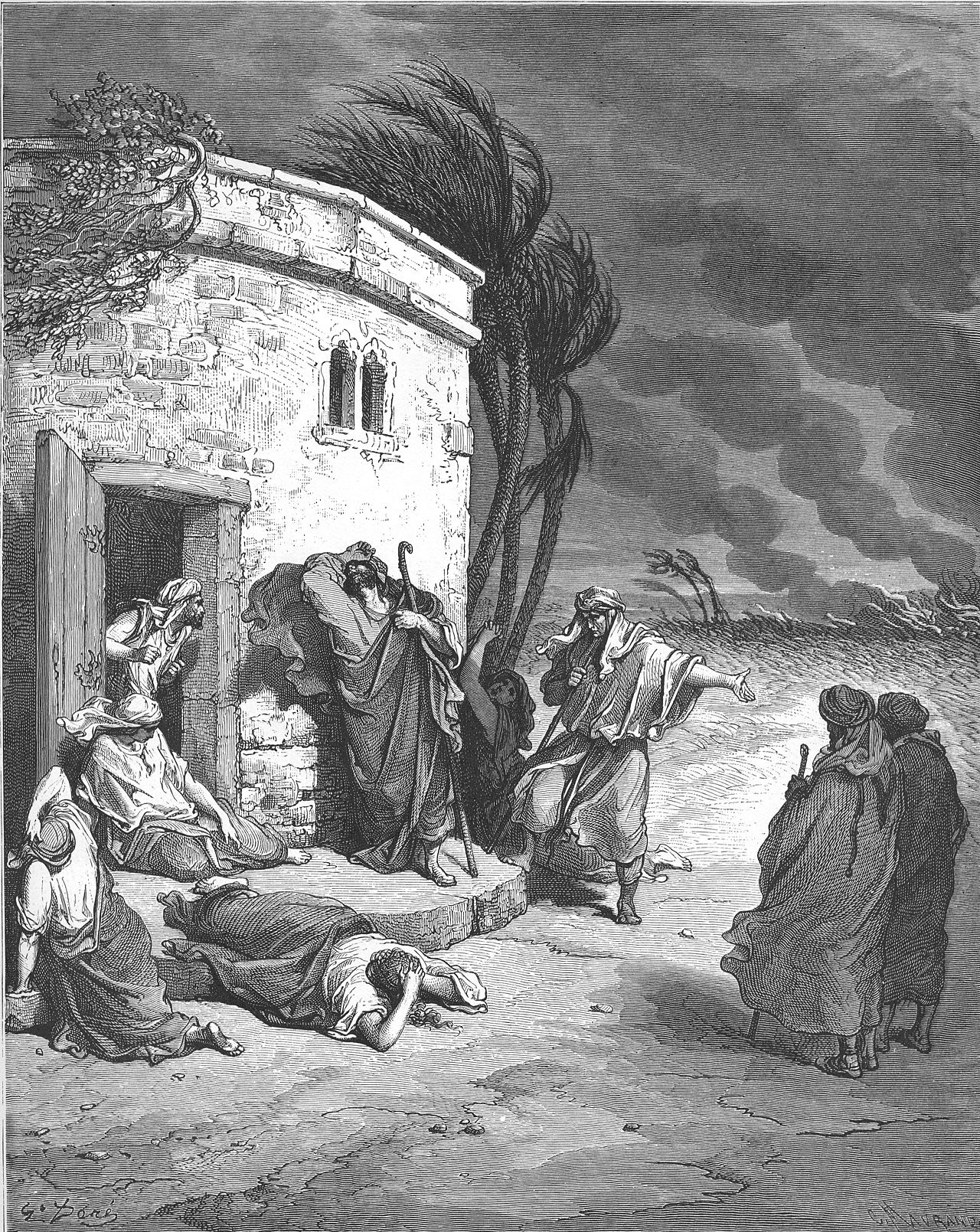
Jobchapter 32
22 verses · unknown · 10th century BC · Wisdom and poetry
This kindled the anger of Elihu son of Barachel the Buzite, of the family of Ram. He burned with anger against Job for justifying himself rather than God,
Introduction
unknown, Wisdom and poetry, Job Overview.
A fourth man enters the book in this chapter, and the writer gives him a full family line. Elihu is younger than the three friends and has listened to the whole debate from its edge. His hearers were raised to keep quiet while their elders spoke, so his first task is to explain why he speaks at all. The chapter opens with a short prose introduction and then gives his first words. Listen for his claim about where understanding comes from, and for the picture he uses of his own need to speak. His speeches run to the end of chapter 37.
Context
- Who
- Hearers raised to keep quiet while their elders were speaking
- What
- The introduction of Elihu, his anger at Job and at the three friends, and his reasons for speaking.
- Where
- The ash heap, where Elihu has stood among the listeners through the whole debate.
- When
- The book sets Job in the age of the patriarchs, commonly placed about 2000 to 1800 BC, and it gives no date.
- Why
- To bring in a new voice after the friends have given up, and to set out his right to be heard.
Historical context
A fourth man has been present all along and the book has not mentioned him. Elihu is introduced with an unusually full pedigree, son of Barachel the Buzite, of the family of Ram. Buz was a son of Nahor, Abraham's brother, and Assyrian records name a north Arabian region called Bazu, which puts Elihu on the same tribal map as the other three.
Show the rest of the historical context, 4 more paragraphs
The reason he waited is stated plainly and it is a matter of manners, not modesty: they were older than he, and in that world age carried authority absolutely. Younger men in a village council listened. He says he was afraid and did not dare show his opinion, expecting that days should speak and multitude of years should teach wisdom.
His argument for speaking is the one that lets him past his own rule. There is a spirit in man, and the breath of the Almighty gives him understanding, great men are not always wise, and the aged do not always understand judgment. That claim, that insight comes from God's breath rather than accumulated years, is what gives a young man a hearing.
His description of his own pressure to speak is a wineskin image every hearer knew: his belly is like wine that has no vent, ready to burst like new bottles. Wine was stored and carried in sewn animal skins, and fermenting wine in a skin with no way to release the gas really did split the seams.
He is angry at all four men, at Job for justifying himself rather than God, and at the three friends because they had found no answer and yet condemned Job. He also promises what none of them managed: no flattering titles, and no taking sides by respect of persons.
Significance
Elihu is the book's most argued-over figure. God neither commends him nor rebukes him at the end, and readers have long divided over whether he is a windy young man or the last honest voice before God speaks.
Show the rest of the significance, 1 more paragraph
What the first hearers could not miss is the timing. The old wisdom has run out, and the answer that finally comes will not come from the elders' tradition at all, it will come out of a storm.
This chapter in Jewish lifeWhat this chapter is in Jewish life and reading.
What is done
This chapter has no place in the synagogue year. The site's own table in src/lib/hebraic/readings.ts printed parashot total 0 and haftarah uses total 0 for the book of Job, and no festival reading.
The corpus joins it to the study of the Torah portions through the Midrash arranged by them. Under the third verse it carries Midrash Tanchuma, Beshalach 16:2. Under the fifth verse it carries Midrash Tanchuma Buber, Miketz 9:1. Under the seventh verse it carries Midrash Tanchuma, Vayakhel 5:4. Under the eighth verse it carries Midrash Tanchuma Buber, Miketz 9:2.
How it is read
Rashi and Malbim are the two commentators on this chapter whose English the corpus carries. Rashi is quoted from The Judaica Press complete Tanach with Rashi, translated by A. J. Rosenberg, which Sefaria reports as CC-BY. Malbim is quoted from Malbim's Job, trans. Jeremy I. Pfeffer. Ktav, 2003, which Sefaria reports as CC-BY. Malbim titles the chapter the Eighteenth Oration, Elihu's speech (Malbim on Job 32:1:1).
In his introduction Malbim frames the whole round of speeches. The three companions were left without words at the end of Job's oration. None of them had thought that Job was undergoing a trial, and each had tried to justify God at the expense of Job's innocence (Malbim on Job 32:1:2). Eliphaz had charged Job with open sin, Zophar with secret sin, and Bildad with being less than he seemed (Malbim on Job 32:1:2).
Elihu enters as a new warrior, and Malbim writes him in phrases taken from Samuel, Isaiah and the Psalms. At the end of his speech Elihu discloses what happened when the Sons of God assembled before the Lord in the first chapter. "Thus, the conclusion of the debate is to be found in the book’s Prologue." (Malbim on Job 32:1:2).
Rashi begins with Elihu's family. He reads Ram as Abraham, citing Joshua 14:15, which names Abraham the greatest man among the Anakim (Rashi on Job 32:2:1). At the third verse Rashi reports that this is one of the verses where the Scribes rectified the language of Scripture. The friends' silence condemned the Omnipresent, and Scripture wrote Job in His place as a euphemism. Rashi sets Numbers 11:15 beside it and points to more instances in Sifrei and the Great Masorah (Rashi on Job 32:3:1). Elihu held back because the others were older than he (Rashi on Job 32:4:2).
Both commentators read Elihu's claim to speak. Malbim says Elihu had thought wisdom came from sense and experience, so the old were wiser. He now finds its fundamentals embedded in the soul of young and old alike, an inheritance from its Divine Source (Malbim on Job 32:7:1). Rashi makes wisdom a spirit in man from the Omnipresent, apart from days or old age (Rashi on Job 32:8:1). Elihu saw that no one had convinced Job (Rashi on Job 32:12:1).
At the twenty-first verse Elihu will reprove Job explicitly and will use no euphemism for Job's honour, and Rashi ties this back to the third verse (Rashi on Job 32:21:1). At the last verse he gives two readings. His Maker would take him away from the world, or, as others read the verb by Nahum 1:5, it means to raise up (Rashi on Job 32:22:1).
The corpus carries nine further notes on this chapter without an English text, each marked linked because Sefaria holds no English version of the ref. They stand cited by ref and unquoted. Six stand at Metzudat David on Job 32:5:1, 32:10:1, 32:16:1, 32:17:1, 32:18:1 and 32:20:1. One stands at Rashi on Job 32:6:1. Two stand at Ibn Ezra on Job 32:9:1 and 32:11:1.
What the rabbis say
The corpus carries twenty-four rabbinic locators on this chapter and the text of none, so each is cited and linked here rather than quoted. On the second verse it holds Avodah Zarah 3a:9, Bava Batra 15b:2, Jerusalem Talmud Sotah 5:6:3 and Shir HaShirim Rabbah 1:4:6. On the third verse it holds Midrash Tanchuma, Beshalach 16:2. On the fifth verse it holds Midrash Tanchuma Buber, Miketz 9:1. On the sixth verse it holds Avot DeRabbi Natan 37:13, Ein Yaakov (Glick Edition), Eiruvin 6:1, Ein Yaakov, Eiruvin 6:1 and Eruvin 63a:20.
On the seventh verse it holds Jerusalem Talmud Nedarim 9:1:4 and Midrash Tanchuma, Vayakhel 5:4. On the eighth verse it holds Aggadat Bereshit 56:1, Midrash Tanchuma Buber, Miketz 9:2 and Shemot Rabbah 48:4. On the fifteenth verse it holds Midrash Sekhel Tov, Bereshit 29:35:3, Midrash Tehillim 20:1 and Pirkei DeRabbi Eliezer 46:4. On the sixteenth verse it holds Ein Yaakov (Glick Edition), Sotah 7:27, Ein Yaakov, Sotah 7:30, Midrash Lekach Tov, Deuteronomy 31:11:1, Ruth Rabbah (Lerner) 1:1:2 and Ruth Rabbah, Petichta 1. It also holds Sotah 39a:2. What each of them teaches is a saying of the rabbis, and is reported as theirs wherever this site quotes one. The quotations wait on a fetch that carries the text.
Sources: Malbim, Malbim on Job 32:1:1 to 32:7:1, Malbim's Job, trans. Jeremy I. Pfeffer. Ktav, 2003, reported CC-BY; Rashi, Rashi on Job 32:2:1 to 32:22:1, The Judaica Press complete Tanach with Rashi, translated by A. J. Rosenberg, reported CC-BY; Metzudat David, Metzudat David on Job 32:5:1, 32:10:1, 32:16:1, 32:17:1, 32:18:1 and 32:20:1, cited by ref because the corpus carries no English text; Rashi, Rashi on Job 32:6:1, cited by ref because the corpus carries no English text; Ibn Ezra, Ibn Ezra on Job 32:9:1 and 32:11:1, cited by ref because the corpus carries no English text; The Sefaria corpus, scripts/data/sources/sefaria/job/32.json, the 24 Talmud and Midrash locators of this chapter; The site's own files, src/lib/hebraic/readings.ts, printing no portion, no Haftarah and no festival reading for this book.
The heads below are this chapter's scenes. The numbered points under each are its verses.
Elihu the Younger Man, and His Kindled Wrath
Job 32:1-3
these three men stopped answering Job: When “these three men stopped answering Job”, Elihu “burned with anger against Job for justifying himself rather than God” and at the friends. Henry reads this double anger as the narrator's judgment closing the debate. Readings of Elihu, who enters unannounced, divide here, Davidson notes.
Job 32:1
“These three men ceased to answer Job, because he seemed just in his own eyes. In the expression, because he seemed to be just in his own eyes, the author of this sacred history intended to refer to the opinion of Job's friends, and did not himself accuse him of being puffed up with pride.”
Gregory the Dialogist · written before 604 · Morals on the Book of Job, Book XXIIIpatristic
2 more voices on this verseWhat preachers and commentators have said about this verse, in their own words.
Job 32:1
“So these three men ceased to answer Job - Each had had three opportunities of replying to him, though in the last series of the controversy Zophar had been silent. Now all were silent; and though they do not appear in the least to have been convinced, or to have changed their opinion, yet they found no arguments with which to sustain their views. It was this, among other things, which induced Elihu to take up the subject.”
Job 32:1
“But they did not judge fairly concerning Job: he was really righteous before God, and not righteous in his own eyes only; so that it was only to save their own credit that they made this the reason of their silence, as peevish disputants commonly do when they find themselves run a-ground and are not willing to own themselves unable to make their part good.”
Matthew Henry · Commentary on the Whole Bible (1707-1721)puritan
Elihu son of Barachel the Buzite: Wesley reads the pedigree, son of Barachel of the family of Ram, as a mark of honor and a proof that the history is true. Jamieson, Fausset and Brown give the name Elihu as God is Jehovah. Clarke traces Buz to a son of Nahor.
Job 32:2
“Then was kindled the wrath - This means no more than that Elihu was greatly excited, and felt a strong and zealous desire to vindicate the justice and providence of God, against the aspersions of Job and his friends. Elihu the son of Barachel the Buzite - Buz was the second son of Nahor, the brother of Abram, Gen 22:21. Of the kindred of Ram - Kemuel was the third son of Nahor; and is called in Genesis (see above) the father of Aram, which is the same as Ram.”
Adam Clarke · Commentary on the Bible (1810-1826)evangelical
3 more voices on this verse
Job 32:2
“His pedigree is thus particularly described, partly for his honour, as being both a wise and good man, and principally to evidence the truth of this history. He justified - Himself not without reflection upon God, as dealing severely with him, he took more care to maintain his own innocency, than God's glory. The word Elihu signifies, my God is he.”
John Wesley · Explanatory Notes upon the Old Testament (1765)evangelical
Job 32:2
“Elihu--meaning "God is Jehovah." In his name and character as messenger between God and Job, he foreshadows Jesus Christ (Job 33:23-26). Barachel--meaning "God blesses." Both names indicate the piety of the family and their separation from idolaters. Buzite--Buz was son of Nahor, brother of Abraham.”
Jamieson, Fausset & Brown · Commentary Critical and Explanatory on the Whole Bible (1871)reformed
Job 32:2
“Note, A gracious heart is jealous for the honour of God, and cannot but be angry when that is neglected or postponed, or when any injury is done it. Nor is it any breach of the law of meekness to be angry at our friends when they are offensive to God. Get thee behind me, Satan, says Christ to Simon.”
Matthew Henry · Commentary on the Whole Bible (1707-1721)puritan
had failed to refute Job: The three friends condemned Job yet failed to refute him, Barnes explains, and they kept their verdict after they were silenced. Henry draws the lesson. A judge of a dispute keeps what is true on either side.
Job 32:3
“Because they had found no answer, and yet had condemned Job - They held Job to be guilty, and yet they were unable to adduce the proof of it, and to reply to what he had said. They still maintained their opinion, though silenced in the argument. They were in that state of mind, not uncommon, in which they obstinately held on to an opinion which they could not vindicate, and believed another to be guilty, though they could not prove it.”
1 more voice on this verse
Job 32:3
“Those that in good earnest seek for truth must thus be impartial in their judgments concerning the contenders, and not reject what is true and good on either side for the sake of what is amiss, nor approve or defend what is amiss for the sake of what is true and good, but must learn to separate between the precious and the vile.”
Matthew Henry · Commentary on the Whole Bible (1707-1721)puritan
Job 32:4-5
Now Elihu had waited to speak to Job: “Elihu had waited to speak to Job because the others were older than he”. Clarke reads it as the mark of a man who kept the custom of age until it produced nothing. Wesley notes that the anger was aimed at an unanswered case, more than at any word spoken.
Job 32:4
“Elihu therefore waited while Job was speaking, because they who were speaking were his elders. But when he had seen that the three were not able to answer, he was very wroth. Though Holy Church is unquestionably older than her adversaries, (for they went forth from her, not she from them, as is said of them by John, They went out from us, but they were not of us,) yet Eliu is properly described as having been younger than these same adversaries.”
Gregory the Dialogist · written before 604 · Morals on the Book of Job, Book XXIIIpatristic
1 more voice on this verse
Job 32:4
“Now Elihu had waited - Margin, as in Hebrew, expected Job in words. The meaning is plain, that he had waited until all who were older than himself had spoken. Because they were elder than he - Margin, as in Hebrew, older for days. It appears that they were all older than he was. We have no means of determining their respective ages, though it would seem probable that Eliphaz was the oldest of the three friends, as he uniformly spoke first.”
had no further reply: Gill stresses that the three were men of years, reputed wise, and still had no further reply. Aquinas finds Elihu's rule here. Respect for age must give way when it would harm the truth.
Job 32:5
“When Elihu saw that there was no answer in the mouth of these three men,.... That could be called an answer; nay, when he perceived they were quite nonplussed and silenced, though men of years and experience, and reputed wise and knowing: then his wrath was kindled; his spirit was stirred up; his heart was hot within him; he burned with anger against those men; he was all on fire, as it were, and wanted to vent his resentment.”
Elihu: Great Men Are Not Always Wise: I Am Full of Words
Job 32:6-9
“I am young in years, while you are old” opens Elihu's apology. He states the rule he held, that “age should speak”, and overturns it. Henry reads the conclusion of verse 9 as true in itself and dangerous in Elihu's mouth, since it licenses the speech that follows.
Job 32:6
“And Eliu the son of Barachel, the Buzite, answered and said, I am younger in age, but ye are more ancient. I therefore held down my head, and feared to shew you my opinion. For I was hoping that greater age would speak, and that a multitude of years would teach wisdom. All these words, which are uttered by him through swelling pride, must be rather glanced at by the way than expounded more attentively. For whatsoever is deficient in solid gravity, needs not any elaborate exposition.”
Gregory the Dialogist · written before 604 · Morals on the Book of Job, Book XXIIIpatristic
1 more voice on this verse
Job 32:6
“I am young - How young he was, or how old they were, we cannot tell; but there was no doubt a great disparity in their ages; and among the Asiatics the youth never spoke in the presence of the elders, especially on any subject of controversy.”
Adam Clarke · Commentary on the Bible (1810-1826)evangelical
age should speak: Clarke notes that the wisdom of the East was stored in proverbs and maxims, so age and many years meant a larger store. Spurgeon counts Elihu the wisest man in the debate. He kept quiet, and a still tongue can prove a wise head.
Job 32:7
In the discussion between Job and his three friends, Elihu was present, but though by far the wisest man, he remained quiet. Sometimes a still tongue proves a wise head. In our text he gives his reason for refraining from speech. He felt inclined to deliver his mind, but being the younger man he modestly said, "These gray-headed men ought to know better than I. Perhaps if I speak, I shall display my ignorance and they will say, "Be silent, boy, and let your fathers teach you."
Charles Spurgeon · written before 1892 · The Metropolitan Tabernacle Pulpit, Sermon No. 3283: “The Voices of Our Days” (lightly modernized text, CCEL edition)Particular Baptist
1 more voice on this verse
Job 32:7
“I said, Days should speak - The aged ought to speak. They have had the advantage of long observation of the course of events; they are acquainted with the sentiments of past times; they may have had an opportunity of conversing with distinguished sages, and it is to them that we look up for counsel. This was eminently in accordance with the ancient Oriental views of what is right; and it is a sentiment which accords with what is obviously proper, however little it is regarded in modern times.”
the breath of the Almighty: Jamieson, Fausset and Brown hear Elihu claiming inspiration, the breath of the Almighty given to a messenger to Job. Henry replies that such a claim needed proof. A spirit in a man that gives him understanding no one could deny.
Job 32:8
“But, as I see, there is a spirit in man, and the inspiration of the Almighty giveth understanding. He would be right in saying this, did he not arrogate to himself this same wisdom above all others. For it is no slight condemnation for a man to boast within himself of that advantage which is given to him in common with others, to know whence he has received a good gift, and to know not how to use the good he has received.”
Gregory the Dialogist · written before 604 · Morals on the Book of Job, Book XXIIIpatristic
1 more voice on this verse
Job 32:8
“But there is a spirit in man - Mr. Good translates: - “But surely there is an afflation in mankind, And the inspiration of the Almighty actuateth them.” Coverdale, thus: - Every man (no doute) hath a mynde; but it is the inspyracion of the Almightie that geveth understondinge.”
Adam Clarke · Commentary on the Bible (1810-1826)evangelical
the elderly who understand justice: Older versions read great men here. Jamieson, Fausset and Brown render the Hebrew as old, the reading the Berean follows, and Barnes takes the word to cover rank, age and authority. Clarke says the three friends had many wise sayings yet did not understand justice.
Job 32:9
“Great men are not always wise - Though wisdom may in general be looked for in them, yet it is not universally true. Great men here denote those who are distinguished for rank, age, authority. Neither do the aged understand judgment - That is, they do not always understand it. The word judgment here means right, truth. They do not always understand what is the exact truth in regard to the divine administration. This is an apology for what he was about to say, and for the fact that one so young should speak.”
1 more voice on this verse
Job 32:9
“Great--rather, "old" (Job 32:6). "Greater, less" for the older, the younger. judgment--what is right.”
Jamieson, Fausset & Brown · Commentary Critical and Explanatory on the Whole Bible (1871)reformed
Job 32:10-14
Elihu's “Listen to me” comes after he says “I listened to your reasoning”. Barnes reads the friends' fallback, “let God, not man, refute him”, as silencing the question with authority in place of argument. Elihu refuses that shortcut, which claims a different method before any different conclusion.
Job 32:10
“Therefore I said, hearken to me,.... Thou O Job, and every one of you his friends, for the word is singular; though I am but a young man, yet if I have the Spirit of God, and am under the inspiration of the Almighty, I may be able to say something to you worth your hearing: I also will show mine opinion; for though for a while he was timorous and fearful of doing it, lest he should mistake and expose himself, yet having duly weighed and considered the above things, he was determined to do it.”
1 more voice on this verse
Job 32:10
“We must be willing to hear reason from those that are every way inferior to us, and to yield to it. He that has a good eye can see further upon level ground than he that is purblind can from the top of the highest mountain. Better is a poor and wise child then an old and foolish king, Eccl. iv.”
Matthew Henry · Commentary on the Whole Bible (1707-1721)puritan
I listened to your reasoning: Jamieson, Fausset and Brown take the verse as proof that Elihu was present from the first. He waited while the friends spoke and searched for words. Clarke records a manuscript variant, your arguments for your reasoning, with nearly the same sense.
Job 32:11
“I gave ear to your reasons - Margin, “understandings.” The meaning is, that he had given the most respectful attention to the views which they had expressed, implying that he had been all along present, and had listened to the debate. Whilst ye searched out what to say - Margin, as in Hebrew, words. It is implied here that they had bestowed much attention on what they had said. They had carefully sought out all the arguments at their command to confute Job, and still had been unsuccessful.”
1 more voice on this verse
Job 32:11
“Therefore Elihu was present from the first. reasons--literally, "understandings," that is, the meaning intended by words. whilst--I waited until you should discover a suitable reply to Job.”
Jamieson, Fausset & Brown · Commentary Critical and Explanatory on the Whole Bible (1871)reformed
no one proved Job wrong: Barnes gives the Hebrew as no one to reprove him by answering. The friends were completely silenced. Clarke notes that the Syriac, Arabic and Septuagint read full attention as attention to your testimonies.
Job 32:12
“Yea, I attended unto you - Instead of ועדיכם veadeychem, and unto you, one MS. reads the above letters with points that cause it to signify and your testimonies; which is the reading of the Syriac, Arabic, and Septuagint. Behold, there was none of you that convinced Job - Confuted Job. They spoke multitudes of words, but were unable to overthrow his arguments.”
Adam Clarke · Commentary on the Bible (1810-1826)evangelical
Barnes reads the verse as God's plan. The friends were left with no answer so they could never claim that their own wisdom had refuted Job. Clarke says they would have triumphed over him had they found the words.
Job 32:13
“Lest ye should say, We have found out wisdom - That is, this has been permitted and ordered in such a manner that it might be manifest that the truths which are to convince him come from God and not from man. You were not permitted to refute or convince him, for if you had been you would have been lifted up with pride, and would have attributed to yourselves what belongs to God. This is in accordance with the entire drift of the book, which is to introduce the Almighty himself to settle the controversy when human wisdom failed.”
1 more voice on this verse
Job 32:13
“It is time to speak when God's judgments are vouched for the patronizing of men's pride and passion and their unjust uncharitable censures of their brethren; then we must speak on God's behalf.”
Matthew Henry · Commentary on the Whole Bible (1707-1721)puritan
has not directed his words against me: Clarke hears a man with no quarrel of his own. Job had directed no words against Elihu, so Elihu had no cause for irritation. Barnes calls it a claim to approach the subject calmly, free of the provocations the friends had felt.
Job 32:14
“He hath not directed - I am no party in this controversy; I have no party feeling in it: he has not spoken a word against me, therefore I have no cause of irritation. I shall speak for truth; not for conquest or revenge. Neither will I answer him with your speeches; your passions have been inflamed by contradiction, and you have spoken foolishly with your lips.”
Adam Clarke · Commentary on the Bible (1810-1826)evangelical
Job 32:15-17
friends are dismayed, with no more to say: “Job’s friends are dismayed, with no more to say” marks their silence as final. He takes that silence as his opening: “I too will answer; yes, I will declare what I know”. Delitzsch reads the repeated waiting and declaring as Elihu building his standing on the debate's exhaustion.
Job 32:15
“They were amazed - There also are the words of Elihu, and are designed to express his astonishment that the three friends of Job did not answer him. He says that they were completely silenced, and he repeats this to call attention to the remarkable fact that men who began so confidently, and who still held on to their opinion, had not one word more to say.”
now that they are silent: Clarke says Elihu waited to hear whether the friends had any reply for Job. They stand in silence. Gill adds that Elihu also waited for any objection to his joining the debate, and none came.
Job 32:16
“When one had waited,.... To observe whether they would make any reply to what he had said, or any objection to his engaging in the controversy: for they spake not; were as mute as fishes: but stood still; like statues, had no power to move, neither to sit down nor to depart, but were as if all life, sense, and motion, were gone from them: and answered no more; or not at all; for it does not appear that they had given him any answer before, as well as not now.”
1 more voice on this verse
Job 32:16
“When I had waited - I waited to hear if they had any thing to reply to Job; and when I found them in effect speechless, then I ventured to come forward.”
Adam Clarke · Commentary on the Bible (1810-1826)evangelical
I will declare what I know: Barnes hears modesty in the Hebrew behind I too will answer, which means even one so young. Clarke gives answer as recite a portion. He reads the book of Job as a drama in which each speaker will answer in his turn and declare what he knows.
Job 32:17
“I will also answer my part, and I will display my knowledge. For every proud man considers this to be his part, if he does not so much possess, as make a show of, knowledge. For all proud men are anxious not to possess knowledge, but to make a display of it: against whom Moses well says, Every vessel which hath not a cover nor binding over it shall be unclean. For the covering or the binding is the reproof of discipline, and every one who is not kept under by it is rejected as an unclean and polluted vessel.”
Gregory the Dialogist · written before 604 · Morals on the Book of Job, Book XXIIIpatristic
1 more voice on this verse
Job 32:17
“I also will show mine opinion - In this language, as in Job 32:6, there is a delicate expression of modesty in the Hebrew which does not appear in our translation. It is אף־אני 'aph 'ănı̂y - even I. “Even one so young, and so humble as I, may be permitted to express my sentiments, when the aged and the great have nothing more to say.”
Job 32:18-22
For I am full of words: “For I am full of words, and my spirit within me compels me” explains why Elihu must speak. He pledges, “I will be partial to no one, nor will I flatter any man”. Gill reads it as a promise to speak plainly, and Clarke notes that it anticipates Elihu's directness.
Job 32:18
“I am full of matter - מלים millim, “I am full of Words,” or sayings; i.e., wise sentences, and ancient opinions. The spirit within me constraineth me - How similar to the words of St. Paul! The love of Christ constraineth us. Elihu considered himself under the influence of that Spirit of God which gives understanding, and felt anxiously concerned for the welfare both of Job and his friends.”
Adam Clarke · Commentary on the Bible (1810-1826)evangelical
1 more voice on this verse
Job 32:18
“I am full of words, the spirit of my womb constraineth me. Behold, my belly is as new wine without a vent, which bursts in sunder new vessels. I will speak, and will take breath awhile; I will open my lips and answer. When boastful men observe that holy preachers speak eloquently, and are reverenced for their eloquence, they frequently imitate the loftiness of their language, and not their useful intention. They are far from loving what the others desire, but are especially anxious to gain great renown amongst men.”
Gregory the Dialogist · written before 604 · Morals on the Book of Job, Book XXIIIpatristic
like unvented wine: Barnes gives unvented as not opened, a skin with no outlet for fermenting wine. Jamieson, Fausset and Brown note that new wine was kept in new goatskins. The fresh skin of Elihu's figure is about to burst.
Job 32:19
“Behold, my belly is as wine which hath no vent - Margin, as in Hebrew, “is not opened” - לאיפתח lo' yipâthach. The repherence is to a bottle, in which there is no opening, or no vent phor the phermenting wine to work itselph ophph. It is usual to leave a small hole in barrels and casks when wine, cider, or beer is phermenting. This is necessary in order to prevent the cask phrom bursting.”
I must speak and find relief: Barnes gives find relief as room to breathe. Clarke follows the wineskin of Job 32:19, which must be opened before it bursts, as Elihu must open his lips. Ephrem the Syrian compares a woman relieved of the pain of labor.
Job 32:20
“I will open my lips and answer - In the preceding verse Elihu compares himself to a skin-bottle, in which the wine was in a state of fermentation, and the bottle ready to burst for want of vent. He carries on the metaphor in this verse: the bottle must be opened to save it from bursting; I will Open my mouth.”
Adam Clarke · Commentary on the Bible (1810-1826)evangelical
I will be partial to no one: Gill names the two temptations Elihu refuses. He will favor neither Job out of pity for his poverty and affliction nor the three friends. Barnes reads the verse as a settled resolve.
Job 32:21
“I will not accept the person of man, I will not equal God to man; for I know not how long I shall continue, or whether after a while my Maker may take me away. Most judiciously he does not make God equal to man, since he knows not how long he may continue, or when in the judgment of God be taken away. And he well says, After a while my Maker may take me away; for however long is the period of the present life, it is short, from the very fact, that it is not enduring.”
Gregory the Dialogist · written before 604 · Morals on the Book of Job, Book XXIIIpatristic
1 more voice on this verse
Job 32:21
“Let me not, I pray you - This is not to be regarded as an address to them, or a prayer to God, but as an expression of his determination. It is similar to the phrase which we use when we say, “may I never do this;” implying the strongest possible purpose not to do it. Elihu means to say that on no account would he use partiality or flattery in what he said. Accept any man’s person - Treat any with partiality.”
my Maker would remove me: Barnes notes that older versions add the words in so doing, which the Hebrew lacks and which spoil the sense. Wesley draws the lesson. The more a man fears his Maker, the less danger he stands in of flattering men.
Job 32:22
“I know not - The more closely we eye the majesty of God as our maker, the more we dread his wrath and justice, the less danger shall we be in of a sinful fearing or flattering of men.”
John Wesley · Explanatory Notes upon the Old Testament (1765)evangelical
1 more voice on this verse
Job 32:22
“My Maker would soon take me away - Were I to copy this conduct while under the influence which I now feel, God might justly consume me as in a moment. He is my Maker; he made me to know truth, to tell truth, and to live according to truth; for he is the God of truth: I shall, therefore through his help, speak the Truth, the Whole Truth, and Nothing but the Truth.”
Adam Clarke · Commentary on the Bible (1810-1826)evangelical
Keep studying
Studies1
People and groups1
Sources for this chapter
The summary
Jamieson, Fausset & Brown, Commentary Critical and Explanatory; John Wesley, Notes on the Old Testament and Matthew Henry, Complete Commentary.
The exposition
A. B. Davidson, The Book of Job, Cambridge Bible; Adam Clarke, Commentary on the Bible; Albert Barnes; Charles Spurgeon, The Metropolitan Tabernacle Pulpit, Sermon No. 3283: “The Voices of Our Days” (lightly modernized text, CCEL edition); Ephrem the Syrian, COMMENTARY ON JOB 32:20; Franz Delitzsch, Biblical Commentary on the Book of Job; Jamieson, Fausset & Brown, Commentary Critical and Explanatory on the Whole Bible; John Gill; John Wesley, Explanatory Notes upon the Old Testament; Matthew Henry, Commentary on the Whole Bible and Thomas Aquinas, Commentary on Job.