
Psalm 54
7 verses · Psalm of lament
Save me, O God, by Your name, and vindicate me by Your might!
Introduction
David, the Betrayal at Ziph, Book 2: The Elohistic Psalter, Poetry, Psalms Overview.
David wrote this in the dry country south of Hebron, after men of his own tribe told Saul where he was hiding. It is one of the shortest prayers in the Psalter, and it was written for anyone handed over to an enemy by neighbours. Listen for the two things he leans on, who God is and what God can do, and for the promise of a gift nobody required of him. The prayer is made before any rescue has come, and it ends as though the rescue has already happened.
Context
- Who
- People whose danger came from their own neighbours
- What
- A short prayer for rescue by a man betrayed to his enemies by people of his own tribe.
- Where
- The wilderness of Ziph, the dry chalk hills south-east of Hebron
- When
- David's years as a fugitive from Saul. About 1013 BC, from the event the heading names
- Why
- To show a betrayed person how to appeal to God's name and promise thanks before the rescue comes.
Historical context
The heading gives the psalm to David and names its occasion, the day the Ziphites went to Saul and told him where David was hiding. Ziph was a town on the southern edge of the Judean highlands, and the wilderness named after it is bare steppe falling away toward the Dead Sea. It was good country to disappear in and hard country to live in. The men who turned him in were Judahites, since Ziph stood in David's own tribal territory, and its people sent word to Saul twice. The freewill offering promised at verse 6 came out of gratitude and surplus, the offering a man brings when nobody has made him bring it. A name in that world carried a person's reputation and record, so being saved by God's name means being saved by everything God has already shown Himself to be.
Significance
This is a short prayer for people betrayed by neighbours, and it teaches a pattern anyone could copy. Name the trouble plainly, appeal to who God is, and promise thanks before the rescue has arrived.
This chapter in Jewish lifeWhat this chapter is in Jewish life and reading.
How it is read
The corpus holds three English comments of Rashi on this chapter, which is the thinnest showing in the range, and all three are about the psalm's plea for vengeance. He reads the might of the third line as a plea for judgment, citing Deuteronomy 32:36:
and with Your might, avenge me Heb. תדינני, Wreak my vengeance, as (Deut. 32:36): “When the Lord will avenge (ידין) His people.” (Rashi on Psalms 54:3:1)
He reads the men who lie in wait as men who keep the psalmist in their eye, at Rashi on Psalms 54:7:1, and the appeal to God's truth as an appeal to a promise already made:
with Your truth Since You are truthful, and You said that You would wreak vengeance upon talebearers and those who pursue to kill, therefore, cut them off. (Rashi on Psalms 54:7:2)
The four commentators the corpus carries as references stand more fully on this chapter than Rashi does. Ibn Ezra stands at Ibn Ezra on Psalms 54:1:1, 54:3:1, 54:4:1, 54:5:1, 54:6:1, 54:7:1 and 54:8:1, Radak at Radak on Psalms 54:2:1, 54:3:1, 54:4:1, 54:5:1, 54:6:1, 54:8:1 and 54:9:1, Metzudat David at Metzudat David on Psalms 54:2:1, 54:3:1, 54:5:1, 54:6:1, 54:8:1 and 54:9:1 and Malbim at Malbim on Psalms 54:4:1. Sefaria holds no English version of those references, so this card cites them without quotation, and the reading each gives stands at its reference.
What the rabbis say
The corpus records 15 places where the rabbinic literature takes up a line of this psalm, 13 of them in the Midrash. The Midrash on the Psalms treats it at Midrash Tehillim 54:1, 63:1, 7:8, 54:2 and 54:3, Midrash Tanchuma at Midrash Tanchuma, Chukat 4:1 and Toldot 5:3 and Vayikra Rabbah at Vayikra Rabbah 26:2. The Talmud takes up a line at Jerusalem Talmud Peah 1:1:46 and Sotah 48b:18. Each is a locator, so the saying stands at its reference and is read there.
Sources: Rashi, Rashi on Psalms, in The Judaica Press complete Tanach with Rashi, translated by A. J. Rosenberg, under a CC-BY licence; Ibn Ezra, Ibn Ezra on Psalms, cited at Ibn Ezra on Psalms 54:1:1, 54:3:1, 54:4:1, 54:5:1, 54:6:1, 54:7:1 and 54:8:1; Radak, Radak on Psalms, cited at Radak on Psalms 54:2:1, 54:3:1, 54:4:1, 54:5:1, 54:6:1, 54:8:1 and 54:9:1; Metzudat David, Metzudat David on Psalms, cited at Metzudat David on Psalms 54:2:1, 54:3:1, 54:5:1, 54:6:1, 54:8:1 and 54:9:1; Malbim, Malbim on Psalms, cited at Malbim on Psalms 54:4:1; Midrash Tehillim, the Midrash on the Psalms, cited at Midrash Tehillim 54:1, 63:1, 7:8, 54:2 and 54:3; The Talmud, cited at Jerusalem Talmud Peah 1:1:46 and Sotah 48b:18; MannaFest, the Sefaria corpus at scripts/data/sources/sefaria/psalms/54.json, fetched 2026-09-19, 2026.
Psalms 54:1-2
vindicate me by Your might!: David asks on two grounds, God's name and God's might, and he asks for rescue and for vindication. Verse 2 asks only to be heard, the prayer and the words of the mouth. The heading names the Ziphites' betrayal at 1 Samuel 23:19.
Psalms 54:1
“Save me, O God. Thou art my Saviour; all around me are my foes and their eager helpers. No shelter is permitted me. Every land rejects me and denies me rest. But thou, O God, wilt give me refuge, and deliver me from all my enemies. By thy name, by thy great and glorious nature. Employ all thine attributes for me. Let every one of the perfections which are blended in thy divine name work for me. Is not thine honour pledged for my defence? And judge me by thy strength.”
Charles Spurgeon · The Treasury of David, Vol. 3 (1872)Particular Baptist
1 more voice on this verseWhat preachers and commentators have said about this verse, in their own words.
Psalms 54:1
“He appeals to God's strength, by which he was able to help him, and to his name, by which he was engaged to help him, and begs he would save him from his enemies and judge him, that is, plead his cause and judge for him.”
Matthew Henry · Commentary on the Whole Bible (1707-1721)puritan
listen to the words of my mouth: The prayer asks only to be heard, since everything else rests on that. Charles Spurgeon called prayer the one weapon no enemy can spike, and he held that praying aloud keeps the mind awake. Hilary of Poitiers heard Christ praying through David here.
Psalms 54:2
“Hear my prayer, O God. This has ever been the defence of saints. As long as God hath an open ear we cannot be shut up in trouble. All other weapons may be useless, but all prayer is evermore available. No enemy can spike this gun. Give ear to the words of my mouth. Vocal prayer helps the supplicant, and we keep our minds more fully awake when we can use our tongues as well as our hearts. But what is prayer if God hear not?”
Charles Spurgeon · The Treasury of David, Vol. 3 (1872)Particular Baptist
1 more voice on this verse
Psalms 54:2
“The obvious thing for the Prophet to say was, O God, hear me. But because he is speaking as the mouthpiece of Him, Who alone knew how to pray, we are given a constantly reiterated demand that prayer shall be heard. The words of St. Paul teach us that no man knows how he ought to pray: For we know not how to pray as we ought.”
Hilary of Poitiers · written before 367 · Homily on Psalm 54patristic
strangers rise up against me: Ziph was a town of Judah at Joshua 15:55, so these strangers were men of David's own tribe. Ruthless men rise up and seek his life. The verse gives the root under the betrayal, men with no regard for God.
Psalms 54:3
“For strangers are risen up against me. Those who had no cause for ill will had gone against him; persons to whom he could have given no offence, for they were strangers to him. They were aliens to his God also, and should these be allowed to worry and destroy him. A child may well complain to his father when strangers come in to molest him. What right have they to interfere? Let them leave off meddling and mind their own concerns. And oppressors seek after my soul. Saul, that persecuting tyrant, had stamped his own image on many more.”
Charles Spurgeon · The Treasury of David, Vol. 3 (1872)Particular Baptist
Psalms 54:4-5
Surely God is my helper: Surely marks the turn from complaint to confidence, and God takes two titles here, helper and sustainer of my soul. Verse 5 says He will reward the enemies with evil. David asks God to destroy them, and asks it in Your faithfulness.
Psalms 54:4
“The introduction of a pause marks a change of person. He no longer speaks but is addressed. For now the prophetic utterance assumes a general character. Thus immediately after the prayer addressed to God, he has added, in order that the confidence of the speaker might be understood to have obtained what He was asking even in the very moment of asking: Behold, God is My helper and the Lord is the upholder of My soul. He has requited evil unto Mine enemies.”
Hilary of Poitiers · written before 367 · Homily on Psalm 54patristic
1 more voice on this verse
Psalms 54:4
“He means, "The Lord is he that upholds my soul, and keeps me from tiring in my work and sinking under my burdens." He that by his providence upholds all things by his grace upholds the souls of his people.”
Matthew Henry · Commentary on the Whole Bible (1707-1721)puritan
In Your faithfulness, destroy them: The request rests on God's faithfulness, meaning His word already given. Matthew Henry called it a prayer of faith rather than of malice, asking only that God's threatenings be carried out. Charles Spurgeon heard an Amen to the sentence of the just Judge.
Psalms 54:5
“He shall reward evil unto mine enemies,.... That eyed him as Saul did; that observed his haunts, where he resorted, and who were with him, as the Ziphites did under Saul's direction; as the Word (m) here used for "enemies" signifies: the mischief they had devised for him, he believed, would be returned upon their own heads; the pit they digged they would fall into themselves; and the net they had spread for others their own feet would be taken in.”
3 more voices on this verse
Psalms 54:5
“He shall reward evil unto mine enemies. They worked for evil, and they shall have their wages. It cannot be that malice should go unavenged. It were cruelty to the good to be lenient to their persecutors. It is appointed, and so it must ever be, that those who shoot upward the arrows of malice shall find them fall upon themselves. The recoil of their own gun has often killed oppressors. Cut them off in thy truth. Not in ferocious revenge is this spoken, but as an Amen to the sure sentence of the just Judge.”
Charles Spurgeon · The Treasury of David, Vol. 3 (1872)Particular Baptist
Psalms 54:5
“After this there is a return to the Person of God, to Whom the petition was at the first addressed: Destroy them by Your truth. Truth confounds falsehood, and lying is destroyed by truth. We have shown that the whole of the foregoing prayer is the utterance of that human nature in which the Son of God was born; so here it is the voice of human nature calling upon God the Father to destroy His enemies in His truth.”
Hilary of Poitiers · written before 367 · Homily on Psalm 54patristic
Psalms 54:5
“But he prays, Cut them off in thy truth. This is not a prayer of malice, but a prayer of faith; for it has an eye to the word of God, and only desires the performance of that. There is truth in God's threatenings as well as in his promises, and sinners that repent not will find it so to their cost.”
Matthew Henry · Commentary on the Whole Bible (1707-1721)puritan
Psalms 54:6-7
Freely I will sacrifice to You: The sacrifice is freely given, and the name praised at verse 6 is the name David asked to be saved by at verse 1. Verse 7 turns to the past tense, delivered from every trouble, and his eyes have stared the foes down. The psalm opened asking for that rescue.
Psalms 54:6
“I will freely sacrifice unto thee. Spontaneously will I bring my freewill offerings. So certain is he of deliverance that he offers a vow by anticipation. His overflowing gratitude would load the altars of God with victims cheerfully presented. The more we receive, the more we ought to render. The spontaneousness of our gifts is a great element in their acceptance; the Lord loveth a cheerful giver. I will praise thy name, O Lord. As if no amount of sacrifice could express his joyful feelings, he resolves to be much in vocal thanksgiving.”
Charles Spurgeon · The Treasury of David, Vol. 3 (1872)Particular Baptist
2 more voices on this verse
Psalms 54:6
“I will freely sacrifice unto thee,.... Not legal sacrifices; no, nor freewill offerings the law gives directions about, though the allusion is to them; but the freewill offerings of his mouth, Psa 119:108; the sacrifices of praise and thanksgiving, on account of help, salvation, and deliverance, as appears from the following clause; which he determines to offer, not by constraint, but willingly; not by force, but of a ready mind; freely, and with all his heart.”
Psalms 54:6
“For next there follows: I will sacrifice unto You freely. The sacrifices of the Law, which consisted of whole burnt-offerings and oblations of goats and of bulls, did not involve an expression of free will, because the sentence of a curse was pronounced on all who broke the Law. Whoever failed to sacrifice laid himself open to the curse. And it was always necessary to go through the whole sacrificial action because the addition of a curse to the commandment forbad any trifling with the obligation of offering.”
Hilary of Poitiers · written before 367 · Homilies on Psalm 53 (54).13patristic
my eyes have stared down my foes: Delivered is in the past tense, said of a man the heading still places in danger from Saul. Charles Spurgeon read it as the record of a life of narrow escapes in which David was always kept safe. His eyes now face the enemies he fled.
Psalms 54:7
“For he hath delivered me out of all trouble. Up to that time deliverance had come, and for that danger also he felt that rescue was near. David lived a life of dangers and hair breadth escapes, yet he was always safe.”
Charles Spurgeon · The Treasury of David, Vol. 3 (1872)Particular Baptist
How this psalm is built
The form: A brief lament that turns at one word and ends in thanksgiving, as Barnes classes it.
The patterns in this chapter
| Device | What it does | Where to see it |
|---|---|---|
| Saved by the name | Verse 1 asks to be saved by God's name, and verse 6 praises that same name for being good. Clarke reads the name as God Himself, since the name of God often stands for God in Hebrew. Henry reads the two grounds of the prayer as the strength by which God is able to help and the name by which He is engaged to help.Adam Clarke, Commentary on the Bible, 1832, on Psalm 54:1. | Psalm 54:1, Psalm 54:6 |
| The turn at Surely | Verse 4 opens with a word that marks the change from complaint to confidence, and God takes two titles in the same line, helper and sustainer of my soul. The site's exposition note for verse 4 records the turn, and everything after it is stated rather than asked.Albert Barnes, Notes, Explanatory and Practical, on the Old and New Testaments, 1832 to 1869, on Psalm 54:4. | Psalm 54:3, Psalm 54:4 |
| The vow made before the rescue | Verse 6 promises a freewill sacrifice, and verse 7 speaks of the deliverance in the past tense while the danger of verse 3 is still standing. Spurgeon reads the vow as offered by anticipation, out of a certainty of deliverance rather than after it.Charles Spurgeon, The Treasury of David, Vol. 2, 1870, on Psalm 54:6. | Psalm 54:6, Psalm 54:7 |
The pattern is the shape of the lament itself, and the psalm runs it cleanly from the first line to the last.
6 more paragraphs on the patterns
The New Testament's use
The psalm is not quoted in the New Testament. Its language of being saved by the name carries forward into the way the apostles speak of the name in which a man is saved. The freewill offering of verse 6 stands behind the sacrifice of praise the letter to the Hebrews describes.
Where it stands
It belongs with the psalms whose headings come from David's years as a fugitive, Psalms 52, 56, 57, 59 and 60. Its nearest neighbour in subject is Psalm 56, where the danger comes from foreigners rather than from kinsmen, and the same confidence is stated in the same order.
The insight
Verse 6 names a specific kind of offering. A vow was owed and a sin offering was required, and the freewill offering came out of gratitude and surplus. Clarke reads it as sacrificing nobly, with a liberal hand as well as a willing mind. The psalm's point is that the free gift is promised while the man is still in danger.
Keep studying
Studies1
Sources for this chapter
The summary
Jamieson, Fausset & Brown, Commentary Critical and Explanatory; John Calvin, Commentaries; John Wesley, Notes on the Old Testament and Matthew Henry, Complete Commentary.
The form and classifications
Albert Barnes, Notes, Explanatory and Practical, on the Old and New Testaments, 1832 to 1869, on Psalm 54:4 and Matthew Henry, Commentary on the Whole Bible, 1710, on Psalm 54:1.
The exposition
Albert Barnes, Notes on the Book of Psalms; Charles Spurgeon, The Treasury of David; Franz Delitzsch, Biblical Commentary on the Psalms; Hilary of Poitiers, Homily on Psalm 54; Jamieson, Fausset and Brown, Commentary Critical and Explanatory on the Whole Bible; John Gill, Exposition of the Old Testament and Matthew Henry, Commentary on the Whole Bible.
The painting
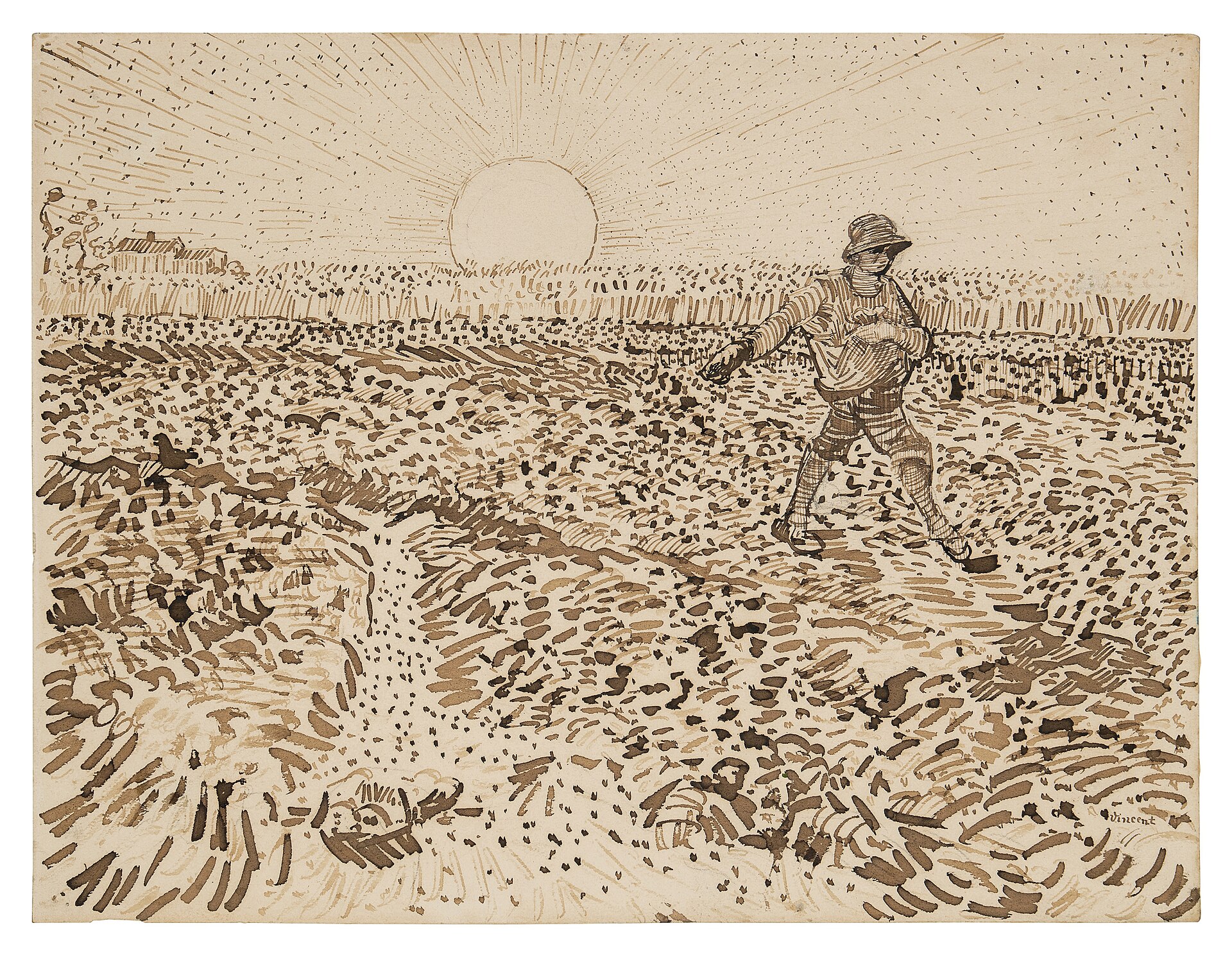
Sower with Setting Sun. Vincent van Gogh, mid July 1888. Sotheby's, New York, 18 November 2025, lot 4. Public domain.