
Psalm 52
9 verses · Psalm of lament
But I am like an olive tree flourishing in the house of God; I trust in the loving devotion of God forever and ever.
Introduction
David, the Boast and the Olive Tree, Book 2: The Elohistic Psalter, Poetry, Psalms Overview.
David wrote this as a fugitive, after an Edomite official of Saul's court reported where he had been and then killed the priests who had helped him. The psalm speaks to a powerful man who ruined others with his tongue and trusted his wealth. It was sung by a people who remembered the massacre at Nob. Listen for the man addressed to his face, for the change of speaker when the righteous watch his fall, and for the tree that stands where he could not.
Context
- Who
- Israelites who had heard what happened to the priests of Nob
- What
- A charge against a powerful informer, set beside the picture of an olive tree growing in God's house.
- Where
- The Judean hill country, after news arrived of a massacre at the priestly town of Nob
- When
- David's years as a fugitive from Saul. About 1015 BC, from the event the heading names
- Why
- To tell the hunted that the boaster is uprooted and that the man who trusts God's loving devotion still stands.
Historical context
The heading gives the psalm to David and ties it to a particular atrocity, the day Doeg the Edomite came to Saul and told him that David had gone to the house of Ahimelech. Nob was a settlement of priests a short walk north of Jerusalem, where the tabernacle stood after Shiloh fell. Doeg held a real royal office as chief of Saul's herdsmen. When Saul ordered the priests killed, his own Israelite guards refused to touch them, and the Edomite killed eighty-five men wearing the linen ephod and then the town with its women, children and livestock. Against that the psalm sets an olive tree growing in the house of God. Olives are nearly impossible to kill, since a cut stump sends up new shoots and a grove is worked for centuries.
Significance
Informers did well under Saul. The song told a frightened nation that the boasting tongue is a sharpened razor and that its owner is uprooted out of the land of the living, while the hunted man is still standing in God's courtyard. The congregation sang the details, which meant the priests of Nob were not quietly forgotten.
This chapter in Jewish lifeWhat this chapter is in Jewish life and reading.
How it is read
The heading of this psalm sets it at the day Doeg the Edomite told Saul that David had come to the house of Ahimelech, and Rashi reads the boast of the third line as the boast of a man strong in the Torah itself:
Why do you boast of evil, you mighty man? Why do you boast and brag of the evil that you do, you who are mighty in Torah? (Rashi on Psalms 52:3:1)
That is the sharpest thing in the chapter. The man the psalm denounces is not read as an outsider but as a scholar who used what he knew to destroy a priesthood. Rashi then answers the boast in God's name:
God’s kindness is constant to rescue the one whom you pursue. (Rashi on Psalms 52:3:2)
He reads the olive tree of the tenth line as the psalmist's own future, green with children and grandchildren in the house of God, at Rashi on Psalms 52:10:1, and the laughter of the eighth line as what onlookers will say of a man who trusted his wealth, at Rashi on Psalms 52:8:1. Ibn Ezra stands on this chapter at Ibn Ezra on Psalms 52:1:1, 52:2:1, 52:3:1, 52:5:1, 52:6:1, 52:8:1, 52:9:1, 52:10:1 and 52:11:1, Radak at Radak on Psalms 52:2:1 and 52:6:1, Metzudat David at Metzudat David on Psalms 52:1:1 and 52:5:1 and Malbim at Malbim on Psalms 52:2:1. Sefaria holds no English version of those references, so this card cites them without quotation.
What the rabbis say
The corpus records 29 places where the rabbinic literature takes up a line of this psalm, 25 of them in the Midrash, and the Midrash on the Psalms carries nine of them, at Midrash Tehillim 52:1, 52:2, 52:3, 52:4, 63:1, 52:5, 52:6, 92:7 and 101:1. Midrash Tanchuma takes the psalm up at Midrash Tanchuma, Chukat 4:1 and Metzora 2:1 and Otzar Midrashim at Otzar Midrashim, Pesikta, Pesikta Chadata 17 and Midrash on the Ten Commandments 1:48. The Talmud takes up lines of the psalm at Sanhedrin 106b:6, Sanhedrin 106b:10, Shevuot 36a:22 and Sanhedrin 106b:8, three of them in the tractate Sanhedrin, which is the tractate of the courts. Each is a locator, so the saying stands at its reference and is read there.
Sources: Rashi, Rashi on Psalms, in The Judaica Press complete Tanach with Rashi, translated by A. J. Rosenberg, under a CC-BY licence; Ibn Ezra, Ibn Ezra on Psalms, cited at Ibn Ezra on Psalms 52:1:1, 52:2:1, 52:3:1, 52:5:1, 52:6:1, 52:8:1, 52:9:1, 52:10:1 and 52:11:1; Radak, Radak on Psalms, cited at Radak on Psalms 52:2:1 and 52:6:1; Metzudat David, Metzudat David on Psalms, cited at Metzudat David on Psalms 52:1:1 and 52:5:1; Malbim, Malbim on Psalms, cited at Malbim on Psalms 52:2:1; Midrash Tehillim, the Midrash on the Psalms, cited at Midrash Tehillim 52:1, 52:2, 52:3, 52:4, 63:1, 52:5, 52:6, 92:7 and 101:1; The Talmud, cited at Sanhedrin 106b:6, Sanhedrin 106b:10, Shevuot 36a:22 and Sanhedrin 106b:8; MannaFest, the Sefaria corpus at scripts/data/sources/sefaria/psalms/52.json, fetched 2026-09-19, 2026.
Psalms 52:1-2
Why do you boast of evil: The boast of a mighty man stands against God's loving devotion, which endures all day long. The heading names him Doeg, the Edomite who killed the priests of Nob at 1 Samuel 22:18. His tongue is a sharpened razor doing a blade's work.
Psalms 52:1
“Why boasteth thyself in mischief, O mighty man? Doeg had small matter for boasting in having procured the slaughter of a band of defenceless priests. A mighty man indeed to kill men who never touched a sword! He ought to have been ashamed of his cowardice. He had no room for exultation! Honourable titles are but irony where the wearer is mean and cruel.”
Charles Spurgeon · The Treasury of David, Vol. 2 (1870)Particular Baptist
1 more voice on this verseWhat preachers and commentators have said about this verse, in their own words.
Psalms 52:1
“The 33rd Psalm was spoken by David when he "changed his countenance before Abimelech, and he sent him away, and he left." The current Psalm would be the one following that Psalm in historical sequence. For the Scripture says in Kingdoms, "And one of the servants of Saul was there that day." And this indicates the time at which David came into the house of Abimelech and ate the "loaves of offering," receiving them from the high priest.”
Eusebius of Caesarea · written before 339 · Commentary on the Psalms, On Psalm 51 (52)patristic
like a sharpened razor: A razor works quietly, and the man under it feels nothing until the damage is done. Charles Spurgeon applied that to Doeg's report, which sounded like service to Saul but was meant to destroy the priests. A half-truth bent to harm still lies, as Matthew Henry notes.
Psalms 52:2
“Thy tongue deviseth mischiefs. Thou speakest with an ulterior design. The information given was for Saul's assistance apparently, but in very deed in his heart the Edomite hated the priests of the God of Jacob. It is a mark of deep depravity, when the evil spoken is craftily intended to promote a yet greater evil. Like a sharp razor, working deceitfully. David represents the false tongue as being effectual for mischief, like a razor which, unawares to the person operated on, is making him bald; so softly and deftly do Oriental barbers perform their work.”
Charles Spurgeon · The Treasury of David, Vol. 2 (1870)Particular Baptist
2 more voices on this verse
Psalms 52:2
“Thy tongue deviseth mischiefs,.... Abundance of mischiefs, in a variety of ways, against many persons, even all good men. What properly belongs to the heart is here ascribed to the tongue; because, as Aben Ezra observes, it is the interpreter and discoverer of the thoughts of the heart: out of the abundance of that the tongue speaks and declares the mischief it has devised.”
Psalms 52:2
“It will not save us from the guilt of lying to be able to say, "There was some truth in what we said," if we pervert it, and make it to appear otherwise than it was. Subtlety in sin: " Thy tongue devises mischiefs; that is, it speaks the mischief which thy heart devises." The more there is of craft and contrivance in any wickedness the more there is of the devil in it.”
Matthew Henry · Commentary on the Whole Bible (1707-1721)puritan
Psalms 52:3-4
You love evil more than good: Twice the psalm says you love, of evil over good and falsehood over truth, then of every word that devours. The charge falls on the appetite behind the deed, on what the man loves. Verse 4 addresses the tongue as the man himself.
Psalms 52:3
“Thou lovest evil more than good. He loved not good at all. If both had been equally profitable and pleasant, he would have preferred evil. And lying rather than to speak righteousness. He was more at home at lying than at truth. He spake not the truth except by accident, but he delighted heartily in falsehood. Selah. Let us pause and look at the proud blustering liar. Doeg is gone, but other dogs bark at the Lord's people.”
Charles Spurgeon · The Treasury of David, Vol. 2 (1870)Particular Baptist
You love every word that devours: John Gill renders the Hebrew as words of swallowing up. They are lies and slanders that eat away a man's name and can end in his ruin. The psalm charges the man with loving such words.
Psalms 52:4
“Thou lovest all devouring words,.... Or "words of swallowing up" (y); such as lies, calumnies, and detractions are, which devour the characters and reputations of men, and are the cause sometimes of their utter ruin and destruction; of the devouring and blasphemous words of antichrist see Rev 13:5; O thou deceitful tongue; See Gill on Psa 52:2. (y) דברי בלע "verba absorptionis", Vatablus, Gejerus, Schmidt.”
bring you down to everlasting ruin: God is the subject of every clause in this verse. He brings the man down to everlasting ruin, tears him away from his tent, and uproots him from the land of the living. All three verbs are verbs of removal.
Psalms 52:5
And he will scrape you away from the tent, and will uproot you from the land of the living forever—so that the righteous, when they see it, will be afraid and will mock him, saying, "Look! a man who did not set God before himself as his strength, but trusted in the abundance of his wealth, and empowered himself in his own disaster!"
Eusebius of Caesarea · written before 339 · Commentary on the Psalms: Ps. 51 (52)patristic
2 more voices on this verse
Psalms 52:5
“God shall likewise destroy thee for ever. Fain would the persecutor destroy the church, and therefore God shall destroy him, pull down his house, pluck up his roots, and make an end of him. He shall take thee away. God shall extinguish his coal and sweep him away like the ashes of the hearth; he would have quenched the truth, and God shall quench him. And pluck thee out of thy dwelling place, like a plant torn from the place where it grew, or a captive dragged from his home.”
Charles Spurgeon · The Treasury of David, Vol. 2 (1870)Particular Baptist
Psalms 52:5
“Pluck thee - Violently and suddenly as the Hebrew word signifies, from thy house and lands, and all the wages of thy righteousness. Root - Though thou seemest to have taken deep root, yet God shall pluck thee up by the very roots, and destroy thee both root and branch.”
John Wesley · Explanatory Notes upon the Old Testament (1765)evangelical
Psalms 52:6-7
The righteous will see and fear: The righteous see and fear, then they mock, and verse 7 gives the words they use. They name the failure in one line: he did not make God his refuge, and he trusted the abundance of his wealth. His strength came out of what he destroyed.
Psalms 52:6
“The righteous —the object of the tyrant's hatred—shall outlive his enmity, and also shall see, before his own face, the end of the ungodly oppressor. God permits Mordecai to see Haman hanging on the gallows. David had brought to him the tokens of Saul's death on Gilboa. And fear. Holy awe shall sober the mind of the good man; he shall reverently adore the God of providence. And shall laugh at him. If not with righteous joy, yet with solemn contempt. Schemes so far reaching all baffled, plans so deep, so politic, all thwarted.”
Charles Spurgeon · The Treasury of David, Vol. 2 (1870)Particular Baptist
1 more voice on this verse
Psalms 52:6
“The righteous also shall see,.... The Targum adds, "the punishment of the wicked"; particularly what is before predicted of Doeg.”
trusted in the abundance of his wealth: These are the words the righteous say when they see the mighty man fall. John Gill notes that the Targum reads that he made not the Word of the Lord his strength. His refuge was wealth gained by destruction.
Psalms 52:7
“Lo, this is the man that made not God his strength,.... The Targum renders it, "that made not the Word of the Lord his strength". These are the words the righteous would say, when they should see the destruction of Doeg: see the man, the mighty man, and his end; what all his ill gotten honour and riches are come to; and what his wickedness, deceit, and cruelty, have brought upon him.”
1 more voice on this verse
Psalms 52:7
“And this was said as though to Doeg, who was a Syrian by descent, but lived in the midst of Israel—and, I suppose, perhaps even entered the tabernacle of God along with the multitude, pretending to be pious.”
Eusebius of Caesarea · written before 339 · Commentary on the Psalms, On Psalm 51 (52)patristic
Psalms 52:8-9
like an olive tree flourishing: The olive tree flourishes in the house of God, where verse 5 left the mighty man with no place. Verse 9 praises in the past tense, because You have done it, for the judgment verse 5 puts in the future. The psalm closes with waiting on that name.
Psalms 52:8
“But I, hunted and persecuted though I am, am like a green olive tree. I am not plucked up or destroyed, but am like a flourishing olive, which out of the rock draws oil, and amid the drought still lives and grows. In the house of God. He was one of the divine family, and could not be expelled from it; his place was near his God, and there was he safe and happy, despite all the machinations of his foes.”
Charles Spurgeon · The Treasury of David, Vol. 2 (1870)Particular Baptist
1 more voice on this verse
Psalms 52:8
“In singing this psalm we should conceive a detestation of the sin of lying, foresee the ruin of those that persist in it, and please ourselves with the assurance of the preservation of God's church and people, in spite of all the malicious designs of the children of Satan, that father of lies.”
Matthew Henry · Commentary on the Whole Bible (1707-1721)puritan
I will praise You forever, because You have done it: Waiting on God's name is the olive tree's posture, set against the mighty man's boast. Charles Spurgeon heard this praise outlasting the boasting of the rich, which is silenced in the tomb. John Wesley read the past tense as certainty.
Psalms 52:9
“I will praise thee for ever. Like thy mercy shall my thankfulness be. While others boast in their riches I will boast in my God; and when their glorying is silenced for ever in the tomb, my song shall continue to proclaim the lovingkindness of Jehovah. Because thou hast done it. Thou hast vindicated the righteous, and punished the wicked. God's memorable acts of providence, both to saints and sinners, deserve, and must have our gratitude. David views his prayer as already answered, the promise of God as already fulfilled, and therefore at once lifts up the sacred Psalm.”
Charles Spurgeon · The Treasury of David, Vol. 2 (1870)Particular Baptist
2 more voices on this verse
Psalms 52:9
Now, he pointed out that the end of the one who is powerful in wickedness is uprooting and destruction. For it was necessary for the root that bears bitter fruit to be †------ off† by the wise farmer of the universe. But David, like a fruitful olive tree in the house of God, put his hope in the mercy of God for ever, even forever and ever, procuring for himself immortality and eternal life on the basis of his good hope, from which he will never fall away. For according to the Apostle, "hope does not put us to shame."
Eusebius of Caesarea · written before 339 · Commentary on the Psalms, On Psalm 51 (52)patristic
Psalms 52:9
“Thou hast - Destroyed mine and thine implacable enemies, and established me in the throne, of which I am no less assured, than if it were already done. I will continue in thy way, placing my whole confidence in thy power and goodness, and faithfulness.”
John Wesley · Explanatory Notes upon the Old Testament (1765)evangelical
How this psalm is built
The form: A rebuke addressed to a single man, closing in the confidence of the man he hunted, as Spurgeon classes it.
The patterns in this chapter
| Device | What it does | Where to see it |
|---|---|---|
| The man addressed to his face | Verses 1 to 5 speak to one person in the second person, and the psalm never turns to God until verse 8. Spurgeon reads the opening question as irony, since Doeg had small matter for boasting in the slaughter of defenceless priests. Wesley says the same, that the title of mighty man is spoken ironically of a man who killed the weak and unarmed.Charles Spurgeon, The Treasury of David, Vol. 2, 1870, on Psalm 52:1. | Psalm 52:1, Psalm 52:4 |
| What the man loves, said twice | Verse 3 says you love evil more than good and falsehood more than truth, and verse 4 says you love every word that devours. The charge falls on the appetite behind the act rather than on the act, and verse 4 then addresses the tongue as though it were the man.Franz Delitzsch, Biblical Commentary on the Psalms, cited in this site's exposition note on Psalm 52:3 to 4. | Psalm 52:3, Psalm 52:4 |
| The four verbs of removal | In verse 5 God is the subject of every clause. He brings the man down to everlasting ruin, He snatches him up, He tears him away from his tent, and He uproots him from the land of the living. Every verb takes the man out of a place.John Gill, Exposition of the Old Testament, 1748 to 1763, on Psalm 52:5. | Psalm 52:5 |
| Uprooted against planted | The man of verse 5 is uprooted from the land of the living, and the singer of verse 8 is an olive tree flourishing in the house of God. Spurgeon reads the second against the first, a hunted man who is not plucked up but draws oil out of the rock and lives through the drought.Charles Spurgeon, The Treasury of David, Vol. 2, 1870, on Psalm 52:8. | Psalm 52:5, Psalm 52:8 |
The psalm is built on one reversal. The strong man is removed and the hunted man remains, and the words that did the harm are answered by words the righteous speak at verse 7.
6 more paragraphs on the patterns
The New Testament's use
The psalm is not quoted in the New Testament. Its subject carries forward through the teaching about the tongue, where a small member does a great harm. It carries forward too through the sayings about a man who lays up treasure and is not rich toward God, which is the charge of verse 7 in another form.
Where it stands
Psalm 52 opens the run of maskil psalms that carry historical headings from David's years as a fugitive, and Psalms 54, 56, 57, 59 and 60 continue it. Its nearest pair is Psalm 55, where the betrayal comes from a friend rather than from an informer.
The insight
The olive tree of verse 8 is chosen with care. An olive is among the hardest trees to kill, since a cut stump sends up new shoots and a grove is worked for centuries, and trees grew inside sanctuary courts. The claim is about a slow and stubborn kind of life set against a fast and violent one.
Keep studying
Studies1
Sources for this chapter
The summary
Jamieson, Fausset & Brown, Commentary Critical and Explanatory; John Calvin, Commentaries; John Wesley, Notes on the Old Testament and Matthew Henry, Complete Commentary.
The form and classifications
Charles Spurgeon, The Treasury of David, Vol. 2, 1870, on Psalm 52:1 and Matthew Henry, Commentary on the Whole Bible, 1710, on Psalm 52:8.
The exposition
Albert Barnes, Notes on the Book of Psalms; Charles Spurgeon, The Treasury of David; Franz Delitzsch, Biblical Commentary on the Psalms; John Calvin, Commentary on the Book of Psalms; John Gill, Exposition of the Old Testament; John Wesley, Explanatory Notes upon the Old Testament and Matthew Henry, Commentary on the Whole Bible.
The painting
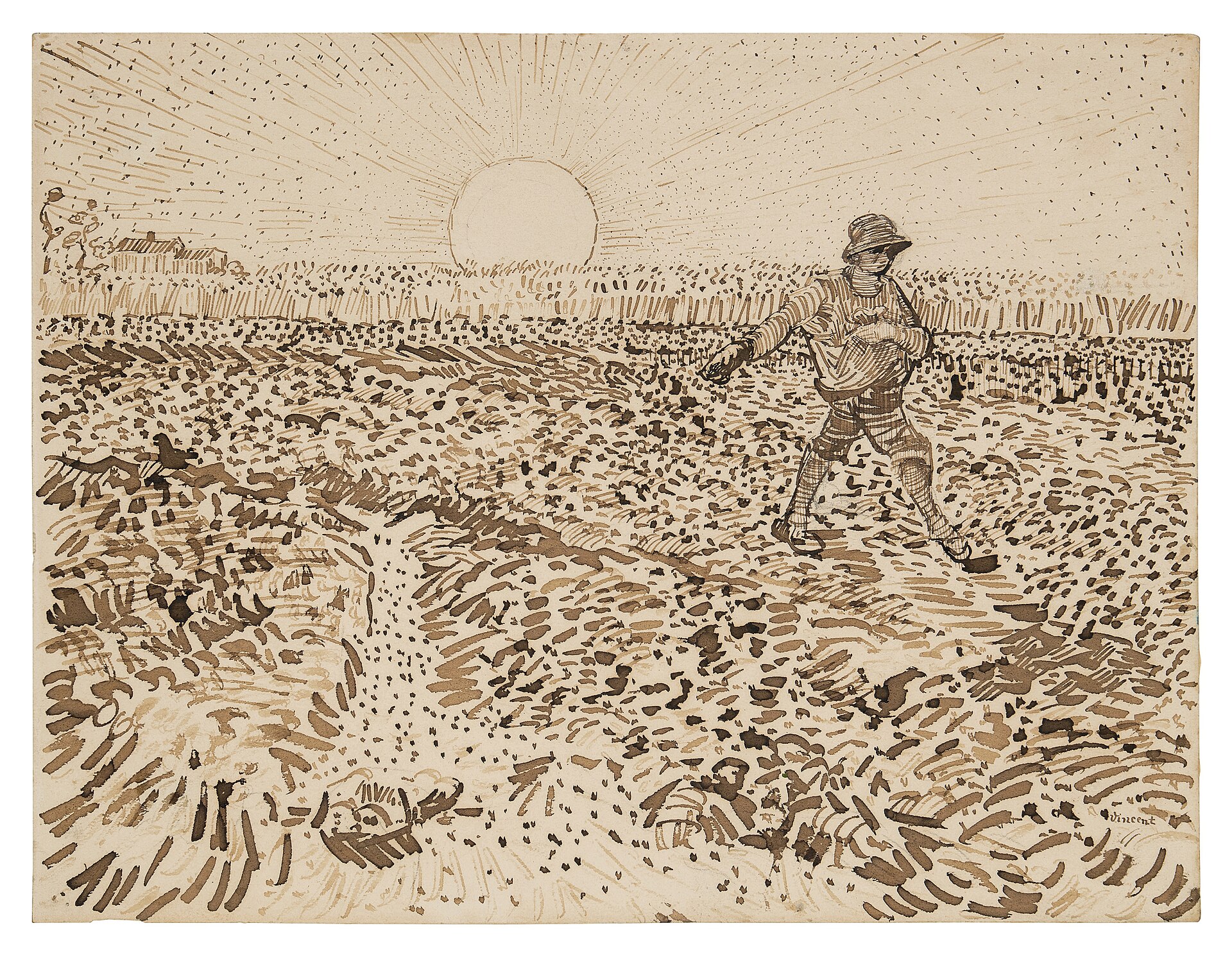
Sower with Setting Sun. Vincent van Gogh, mid July 1888. Sotheby's, New York, 18 November 2025, lot 4. Public domain.