
Psalm 15
5 verses · Entrance liturgy
He who walks with integrity and practices righteousness, who speaks the truth from his heart,
Introduction
David, the Holy Hill, Book 1: The book of David, Poetry, Psalms Overview.
David wrote this psalm around a question a worshipper asked at the entrance to the sanctuary. It is an entrance liturgy, a question about who may come near God followed by a portrait of the person who may. Almost every mark in the portrait concerns how a man treats his neighbour, his word and his money. Listen for the question at the start, then count the marks of the one who may enter. Read it beside Psalm 24, which asks the same question at the same gate, and ask what the answer requires of you.
Context
- Who
- Israelites arriving at the holy hill for worship
- What
- An entrance liturgy asking who may dwell with the LORD and answering with the marks of an upright life.
- Where
- The approach to the sanctuary, where a pilgrim is questioned before he goes up
- When
- The reign of David after the ark came to Jerusalem, about 1000 BC.
- Why
- To teach worshippers that the God they approach cares how they treat their neighbour, their word and their money.
Historical context
The psalm is a gate liturgy. A worshipper coming up to a sanctuary in that world was met with a question about who was fit to enter, and temples across the region posted their entrance requirements, which usually covered ritual cleanness, the right offerings and freedom from certain physical defects. The list in this psalm is made almost entirely of how a man treats other people. Charging interest to a fellow Israelite was forbidden because a loan inside the community was relief for a family in trouble. Keeping a costly oath describes a man who made a deal under oath, watched the market move against him and held to it anyway. In a village where a family's livelihood rested on its standing at the gate, a slander carried from house to house could finish a household.
Significance
The question at the door was the one a pilgrim most wanted answered, and the answer names conduct. The offerings went on being brought, and the psalm told the worshipper that the God who received them cared how he had treated a debtor on the way to the altar.
This chapter in Jewish lifeWhat this chapter is in Jewish life and reading.
How it is read
This psalm asks who may stay in God's tent, and Radak answers by moving the question past this life. He is quoted here from the Finch translation of 1919, which is public domain. He reads the tent as the heavens, spread out like a tent, and the holy hill as Mount Moriah. The two questions "have reference to the higher spiritual part" of a man. Whoever does these works in his lifetime has his spirit dwell "in the place of Glory after his death" (Radak on Psalms 15:1:1). Rashi, quoted from the Judaica Press Tanach with Rashi, keeps the psalm on the ground and says what it is for in one line. It is written "to inform us of the proper measure of piety" (Rashi on Psalms 15:3:1).
Radak then does something a reader will find useful anywhere. He sorts the psalm's list into the three kinds of law, one of deed, one of speech and one of thought, and shows which clause carries which (Radak on Psalms 15:2:2). The perfect man of the second verse is the one "who does not engage his deepest purpose in worldly schemes" (Radak on Psalms 15:2:1). Truth in the heart he reads as the whole man agreeing with himself, since such a man "does not say one thing with his mouth and another in his heart" (Radak on Psalms 15:2:3). Rashi says the same thing in six words, that such a man "is not a hypocrite" (Rashi on Psalms 15:2:1). Radak also explains why the psalm names only slander among the sins of speech. A true report that does harm is still tale-bearing, and "from tale-bearing, although its subject-matter may be true, great harm proceeds" (Radak on Psalms 15:3:1).
The humility of the fourth verse draws his best writing. The man who keeps this list does not pride himself on it. He thinks "that he cannot perform one-thousandth part of what it is his duty to do for the honour of his Creator" (Radak on Psalms 15:4:1). He counts his own good works as nothing and another man's as great (Radak on Psalms 15:4:2). Rashi reads the same verse the other way round, of the righteous man's contempt for a wicked one, and gives Hezekiah dragging his father's remains as the instance (Rashi on Psalms 15:4:1). On the oath that hurts the swearer, Rashi draws the inference upward: a man who keeps an oath against his own interest will certainly keep one that costs him nothing (Rashi on Psalms 15:4:3).
The fifth verse is where Radak turns and addresses Christian readers directly, and this card would be dishonest to leave it out. The psalm forbids lending at interest. Radak holds that David forbids only what the Law forbids, and that the Law forbids interest between Israelites while permitting it toward a foreigner. He states his purpose in the open, at Radak on Psalms 15:5:1. "Now I have enlarged on this matter so that you can answer the Christians who say that David did not distinguish between Jew and Gentile, and that all interest is forbidden". His reason is that David cannot forbid what Moses permitted at God's command. He also sets out the ground of the distinction, that an Israelite owes kindness to a fellow Israelite, and that an interest-free loan is such a kindness. He adds that a Gentile who shows kindness to an Israelite is owed kindness in return. The church has read the same verse as a rule against interest in general, and the two traditions have argued over it for centuries. The site reports Radak's argument in his own words, names the Christian reading he is answering, and leaves the disagreement standing rather than smoothing it. Rashi reads the bribe of the same verse against the poor man, and adds that the Sages extended it to a bribe taken to acquit (Rashi on Psalms 15:5:1). His last note is a word of mercy on the psalm's promise, that a man who falters "will falter and ascend" (Rashi on Psalms 15:5:3). Ibn Ezra, Malbim and Metzudat David comment on the opening verses, and the corpus carries their refs without English text. They stand here cited and unquoted at Ibn Ezra on Psalms 15:1:1 and 15:2:1, at Malbim on Psalms 15:1:1, and at Metzudat David on Psalms 15:1:1.
What the rabbis say
The corpus carries forty locators on this psalm and the text of none, so each is cited and linked here rather than quoted. Fifteen are Talmudic, and this is the heaviest Talmudic weight of any chapter in the first thirty. Ten of them stand in a single folio, Makkot 24a, running through the psalm verse by verse. They are 24a:3 on the first verse, 24a:4, 24a:5 and 24a:6 on the second, 24a:7, 24a:8 and 24a:9 on the third, 24a:10 on the fourth, and 24a:13 and 24a:14 on the fifth. That run is the rabbis' best known treatment of this psalm, and the corpus carries the locators without the text, so it is cited and linked here and quoted nowhere. Five more Talmudic locators stand at Bava Batra 88a:11 on the second verse, Ketubot 103b:23 on the fourth, and Bava Metzia 71a:6, Ketubot 105a:10 and Jerusalem Talmud Bava Metzia 5:8:2 on the fifth.
Midrash Tehillim carries five, at 11:7 and 11:8 on the first verse, and 15:3, 15:4 and 58:1 on the second. Six entries of Ein Yaakov stand across the chapter. In the Glick Edition they are Makkot 3:7 on the first verse, and Ketubot 12:3 with Sanhedrin 6:16 on the fourth. Beside them stand Makkot 3:10, Ketubbot 12:3, Sanhedrin 6:14 and Bava Metzia 5:8.
The rest are scattered. On the first and second verses the corpus carries Midrash Lekach Tov on Deuteronomy 1:9:1 and two entries of Midrash Tanchuma on Shoftim, at 9:1 and at 10:2 in the Buber recension. On the third it carries Bamidbar Rabbah 19:15, Midrash Lekach Tov on Genesis 45:3:1, Midrash Sekhel Tov on Genesis 47:27:16 and Midrash Tanchuma Buber, Chukat 33:1. On the fourth and fifth it carries Bereshit Rabbah 1:13 and 88:5. Four more stand later in the chapter, at Pesikta DeRav Kahana 4:3, Bereshit Rabbah 49:2, Shemot Rabbah 1:5 and an entry of Otzar Midrashim from the prayer of Rabbi Shimon bar Yochai. What each of them teaches is a saying of the rabbis, and is reported as theirs wherever this site quotes one. The quotations wait on a fetch that carries the text.
Sources: Rashi, Rashi on Psalms 15:2:1 to 15:5:3, the Judaica Press complete Tanach with Rashi, translated by A. J. Rosenberg; Radak, Radak on Psalms 15:1:1 to 15:5:2, R. David Kimhi on the first book of Psalms, translated by R. G. Finch, London, 1919; Ibn Ezra, Ibn Ezra on Psalms 15:1:1 and 15:2:1, cited by ref because the corpus carries no English text; Malbim, Malbim on Psalms 15:1:1, cited by ref because the corpus carries no English text; Metzudat David, Metzudat David on Psalms 15:1:1, cited by ref because the corpus carries no English text; The Sefaria corpus, scripts/data/sources/sefaria/psalms/15.json, the 15 Talmud and 25 Midrash locators of this chapter.
who may abide in Your tent?: The psalm asks who may abide in the tent and dwell on the holy mountain. Henry read the tent as the movable one of the wilderness and the mountain as Zion, where the temple was later built. Psalm 24:3 asks who may ascend the hill of the LORD.
Psalms 15:2-3
walks with integrity and practices righteousness: Spurgeon marked three things in verse 2, the man's walk, his work and his word. Verse 3 turns to the tongue, to slander, harm to a neighbor and scorn cast on a friend. Spurgeon wrote that some men's tongues bite more than their teeth.
Psalms 15:2
In everything, therefore, good faith is seemly, justice is pleasing, due measure in equity is delightful. But what shall I say about contracts, and especially about the sale of land, or agreements or covenants? Are there not rules just for the purpose of shutting out all false deceit and to make him whose deceit is found out liable to double punishment? Everywhere, then, does regard for what is virtuous take the lead; it shuts out deceit, it expels fraud. Wherefore the prophet David has rightly stated his judgment in general, saying, "He has done no evil to his neighbor."
Ambrose of Milan · written before 397 · On the Duties of the Clergy 3.10.66patristic
who has no slander on his tongue: Jerome and Wesley both took the neighbor as any man, and Jerome cited the parable of the Samaritan to show it. Henry read the scorn cast on a friend as a report the man refuses to carry, disproving it or letting it die with him. The slander ends with him.
Psalms 15:3
“He who has practiced no deceit with his tongue: he who has uttered in speech what he has pondered in his mind. Nor has done evil to his neighbor. Some think that a neighbor is a brother, or a fellow townsman, or a kinsman, or a blood relation. But our Lord teaches in the Gospel in that parable, where a certain man went down from Jerusalem to Jericho: a priest passed by, a Levite passed by, and had no pity: a Samaritan passed by, and had pity. And afterward the Lord asks, and says: Which of these was a neighbor?”
Jerome · written before 420 · Homily 5, on Psalm 14patristic
1 more voice on this verse
Psalms 15:3
“After the positive comes the negative. "He that backbiteth not with his tongue." There is a sinful way of backbiting with the heart when we think too hardly of a neighbour, but it is the tongue which does the mischief. Some men's tongues bite more than their teeth. The tongue is not steel, but it cuts, and it's wounds are very hard to heal; its worst wounds are not with its edge to our face, but with its back when our head is turned.”
Charles Spurgeon · The Treasury of David, Vol. 1 (1869)Particular Baptist
honors those who fear the LORD: Henry read the honoring of those who fear the LORD as real work, esteem and friendship and gladness when they prosper. The Hebrew verb behind revise means to alter or to barter away, so a costly oath stands.
Psalms 15:4
"In whose eyes a vile person is contemned; but he honoureth them that fear the Lord." We must be as honest in paying respect as in paying our bills. Honour to whom honour is due. To all good men we owe a debt of honour, and we have no right to hand over what is their due to vile persons who happen to be in high places.
Charles Spurgeon · The Treasury of David, Vol. 1 (1869)Particular Baptist
3 more voices on this verse
Psalms 15:4
“In his sight the malignant man is brought to nothing. See what he says. In his sight the malignant man is brought to nothing. Even if he is an emperor, even if he is a prefect, even if he is a bishop, even if he is a presbyter (for in the church these are the dignities), whoever is evil is counted for nothing in the sight of the holy man. And at once there follows, But he glorifies those who fear the Lord.”
Jerome · written before 420 · Homily 5, on Psalm 14patristic
Psalms 15:4
“Hurt - To his own damage. As if a man solemnly swear, that he will sell him such an estate at a price below the full worth; or that, he will give a poor man such a sum of money, which afterwards he finds inconvenient to him. Changeth not - His purpose, but continues firm and resolved to perform his promise.”
John Wesley · Explanatory Notes upon the Old Testament (1765)evangelical
Psalms 15:4
“He honours such, esteems them very highly in love, desires their friendship and conversation and an interest in their prayers, is glad of an opportunity to show them respect or do them a good office, pleads their cause and speaks of them with veneration, rejoices when they prosper, grieves when they are removed, and their memory, when they are gone, is precious with him.”
Matthew Henry · Commentary on the Whole Bible (1707-1721)puritan
lends his money without interest: The law had forbidden interest among God's people at Exodus 22:25, where the borrower is poor, and at Leviticus 25:36. The second half refuses a bribe against the innocent, money taken to condemn a man who has done no wrong. The man who does these things is never shaken.
Psalms 15:5
“What is more cruel than to lend money to one who has none and then to exact double the amount? If one cannot pay the simple amount, how will he pay double?… Nations have often failed because of usury, and this has been the cause of public calamity.”
Ambrose of Milan · written before 397 · Letter 19: To Vigiliuspatristic
2 more voices on this verse
Psalms 15:5
"He that putteth not out his money to usury." Usury was and is hateful both to God and man. That a lender should share with the borrower in gains made by his money is most fitting and proper; but that the man of property should eat up the poor wretch who unfortunately obtained a loan of him is abominable. Those who grind poor tradesmen, needy widows, and such like, by charging them interest at intolerable rates, will find that their gold, and their silver are cankered.
Charles Spurgeon · The Treasury of David, Vol. 1 (1869)Particular Baptist
Psalms 15:5
“To usury - In such a manner as is contrary to God's law: of which see otherwise, Exod. xxii, 25 Levit xxv, 36, 37, &c. Reward - Or, a bribe for him who hath a bad cause.”
John Wesley · Explanatory Notes upon the Old Testament (1765)evangelical
How this psalm is built
The form: Wisdom and Torah, a psalm that teaches rather than petitions, as Psalter classes it.
The patterns in this chapter
| Device | What it does | Where to see it |
|---|---|---|
| One question, answered by a list | Charles Spurgeon marks verse 1 as the question and verse 2 as the opening of the answer, which he takes as the Lord informing us by His Holy Spirit of the character of the man who may dwell in His holy hill. The answer runs as a string of clauses to the end of verse 5, and the clauses are the structure of the psalm. Each names one field of conduct: the walk, the tongue, the neighbor, the company a man honours, the oath he swore at cost, the money he lends and the bribe he refuses.Charles Spurgeon, The Treasury of David, Vol. 1, 1869, on Psalm 15:2. | Psalm 15:1, Psalm 15:2, Psalm 15:5 |
| The walk, the work and the word | Verse 2 answers in three matched clauses, and Charles Spurgeon tells the reader to observe the accepted man's walk, work and word. The walk is integrity, the work is righteousness practised, and the word is truth spoken from the heart. Spurgeon adds that faith and the graces of the Spirit are left unnamed here because the verse describes outward character, and where the fruits are found the root is there.Charles Spurgeon, The Treasury of David, Vol. 1, 1869, on Psalm 15:2. | Psalm 15:2 |
| The question put to the LORD Himself | The psalm opens by speaking to God rather than about Him, and the rest of it speaks about the man. Charles Spurgeon reads verse 1 as a man addressing the high and holy One, asking who of mortal mould shall dwell with Him, and he grounds the question in the sense of the holiness that belongs to God's house, His service and His attendants.Charles Spurgeon, The Treasury of David, Vol. 1, 1869, on Psalm 15:1. | Psalm 15:1 |
| The oath that costs and stands | Verse 4 says the man does not revise a costly oath. The published exposition of this chapter notes that the Hebrew verb behind revise means to alter or to barter away, so the line is about a promise a man would gain by changing. John Wesley reads the hurt as damage to the swearer himself, as when a man swears to sell an estate below its worth or to give a poor man a sum he later finds inconvenient, and keeps his purpose firm all the same.This site's published exposition of Psalm 15, the note on Psalm 15:4, drawn from Albert Barnes, Notes on the Book of Psalms, and Matthew Henry, Commentary on the Whole Bible. | Psalm 15:4 |
The law behind the list
The clauses of verses 4 and 5 are the law of Israel put as a portrait of a man. The published exposition of this chapter names the two places where the law had already forbidden interest among God's own people, Exodus 22:25, where the borrower is poor, and Leviticus 25:36. The second half of verse 5 refuses a bribe against the innocent, which the same note defines as money taken to condemn a man who has done no wrong. So the psalm asks about worship and answers about money, speech and the keeping of a promise.
2 more paragraphs on the patterns
The number this psalm wears
Jerome preached this psalm in a homily titled on Psalm 14, because the Greek and Latin traditions run one number behind the Hebrew through this part of the book. This site's published account of the acrostics records where the difference begins, since Psalms 9 and 10 carry one alphabet between them and those traditions count the two as one psalm. A reader who meets this chapter in a father or in an older Latin work should expect to find it under the number fourteen.
The debate over who can meet the list
The readings divide over whether the psalm sets a standard for a man or draws a portrait of Christ. Charles Spurgeon holds both at once, that the holiness is found in perfection only in the Man of Sorrows and is wrought in measure in all His people by the Holy Ghost, so the list stays a real description of real conduct. Arnobius the Younger reads the tabernacle of verse 1 as the place where the defiled are made undefiled, since Jesus alone entered the uncorrupted tabernacle and freed us from the defilement of the flesh. Jerome reads the psalm of Christ on the principle that our David is Christ. Augustine of Hippo settles the order rather than the reference, holding that a man is justified by faith before he has fulfilled the works of the Law, and that the works of justice follow the justifying rather than coming before it, which leaves the list standing as the fruit of salvation rather than its price.
Keep studying
Sources for this chapter
The summary
Jamieson, Fausset & Brown, Commentary Critical and Explanatory; John Calvin, Commentaries; John Wesley, Notes on the Old Testament and Matthew Henry, Complete Commentary.
The form and classifications
Augustine of Hippo, Exposition on Psalm 15, 430, on Psalm 15:2; Charles Spurgeon, The Treasury of David, Vol. 1, 1869, on Psalm 15:1 and 15:2 and This site's published structure of the Psalter, src/components/book/dossier-content/psalms-structure.ts, the psalm types table.
The exposition
Albert Barnes, Notes on the Book of Psalms; Charles Spurgeon, The Treasury of David; Franz Delitzsch, Biblical Commentary on the Psalms; Jerome, Homily 5, on Psalm 14; John Gill, Exposition of the Old Testament; John Wesley, Explanatory Notes upon the Old Testament and Matthew Henry, Commentary on the Whole Bible.
The painting
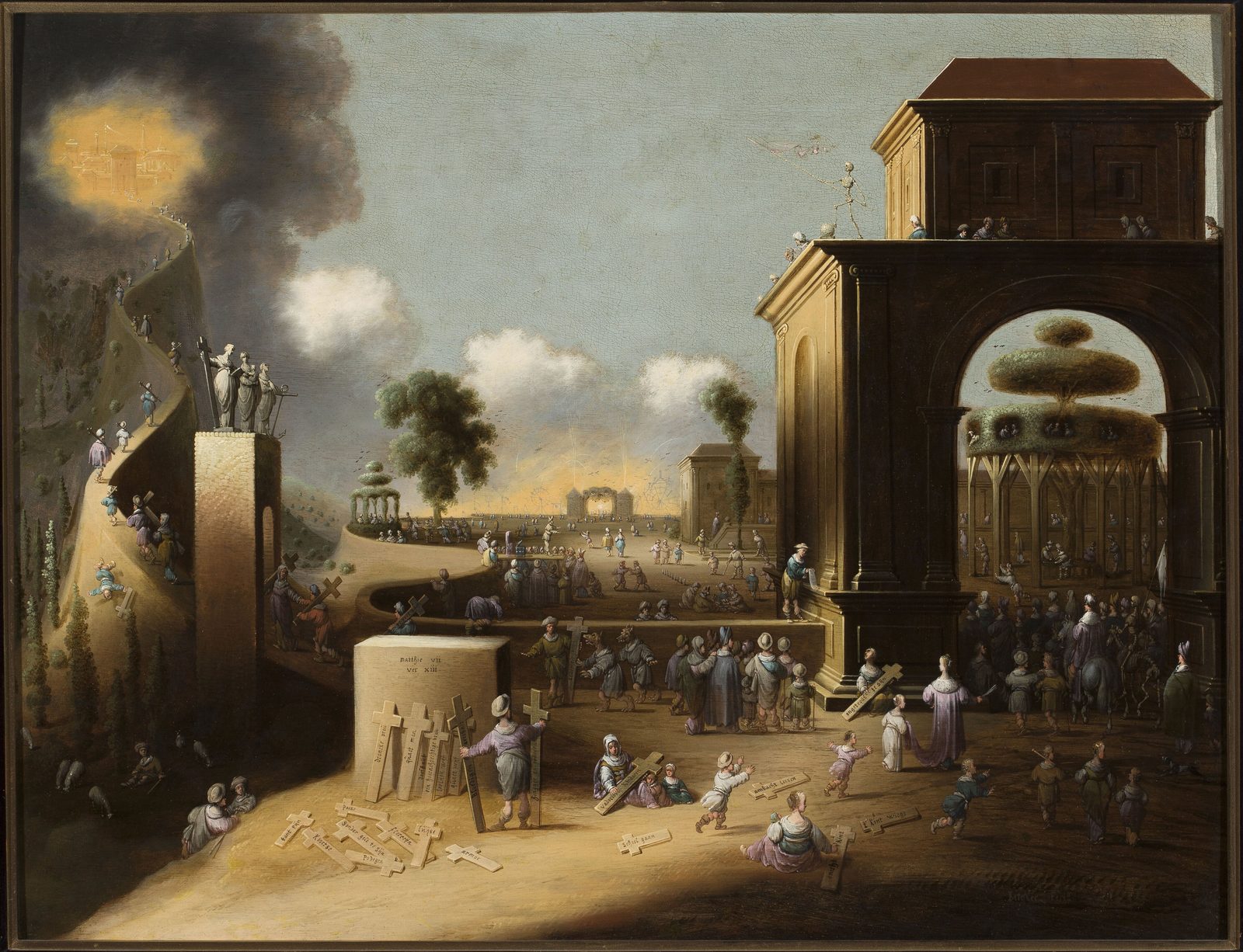
Narrow Road of Virtue and Wide Road of Sin. Jan Micker, not stated on the file page. National Museum in Warsaw. Public domain.