
Psalm 120
7 verses · David and others · 10th to 5th century BC · Wisdom and poetry
In my distress I cried to the LORD, and He answered me.
Introduction
Author unstated, the First Song of Ascents, Book 5: The return and the great Hallelujah, Poetry, Psalms Overview.
This psalm opens the fifteen Songs of Ascents, which pilgrims sang on the road up to Jerusalem for the feasts. Its writer is not named. It begins as far from Jerusalem as a man can be, among neighbours who meet his peace with hostility and his honesty with lies. Listen for how much of his trouble comes by the tongue, and for the two faraway peoples he names to say how far from home he lives. The road that ends at the temple begins here, with a man ready to leave.
Context
- Who
- Israelites setting out for a feast, and those who knew what it was to live among hostile neighbours
- What
- The first of the Songs of Ascents, the lament of a man living among liars and people who want war.
- Where
- Far from Jerusalem, among the peoples the psalm names as Meshech and Kedar.
- When
- The date is not recorded, and the author is unnamed.
- Why
- To name the hostility a pilgrim leaves behind at the start of the road up to Jerusalem.
Historical context
The psalm opens the Songs of Ascents, the fifteen psalms of Psalms 120 to 134 sung by pilgrims going up to Jerusalem for the feasts, and the collection that ends at the temple begins as far from it as the psalmist can describe. The danger in it is speech, and in a society where a man's reputation was his security, slander was a material threat. Meshech is placed far to the north in Asia Minor and Kedar is an Arabian people of the desert to the south east, so no one could live in both. The verb at verse 5 is garti, to live somewhere as a resident foreigner, a man with no land, no clan in the place and no vote in the gate. The coals of verse 4 are of the rotem, the desert broom, whose charcoal holds heat long after other wood has burned out.
Significance
To a Jew of the dispersion, or to anyone living among neighbours who wanted a fight, this psalm was the first step of the road home, and it began by naming what he wanted to leave. The answer stands in verse 1 before the request in verse 2, so the whole complaint is spoken by someone who knows he is heard.
This chapter in Jewish lifeWhat this chapter is in Jewish life and reading.
What is done
This psalm opens the Songs of Ascents, the fifteen pilgrim songs of Psalms 120 to 134 (src/components/book/dossier-content/psalms-structure.ts), and Rashi gives the practice behind the title in his first comment. He writes that it is the song "which the Levites will recite on the fifteen steps" between the court of Israel and the court of the women, and that there are fifteen psalms carrying the title, citing Mishnah Sukkah 5:4 and Mishnah Middot 2:5 (Rashi on Psalms 120:1:1, Rashi on Psalms, The Judaica Press complete Tanach with Rashi, translated by A. J. Rosenberg, CC-BY).
This site records the same two tractates on its page for the collection, Middot 2:5 for the fifteen steps rising from the court of the women to the court of Israel and Sukkah 5:4 for the Levites singing upon them, and it names John Calvin's rejection of the reading in his Commentary on the Book of Psalms, on Psalm 120 (src/app/featured/psalms-of-ascent/page.tsx).
How it is read
Rashi gives two further readings of the title beside the steps. He reports that the Rabbis said David composed these psalms to raise the deep, as Tractate Sukkah 53a explains, and that according to the Aggadah the title is read as a song for a hundred steps, citing the Jerusalem Talmud at Sanhedrin 10:2 (Rashi on Psalms 120:1:1, same edition).
The body of the psalm is read as a psalm about the tongue. Rashi glosses the false lips of verse 2 as the arm of those "who hunt people with their mouth with wicked accusations", and the sharpened arrows of verse 4 as the power to kill in a distant place (Rashi on Psalms 120:2:1 and 120:4:1, same edition).
Metzudat David presses the same figure into a rule. He reads the arrows as the speaker of evil speech, who is like arrows in a warrior's hand "because he kills with them from a distance", and so kills the one standing far off (Metzudat David on Psalms 120:4:1, Metzudat David on Psalms, Sefaria Community Translation, CC0).
Verse 5 Rashi reads in the voice of the whole people, as the congregation of Israel saying that it has already suffered in many exiles and has sojourned in Meshech among the sons of Japheth, in the kingdoms of Persia, Greece and Meshech (Rashi on Psalms 120:5:1, same edition). Ibn Ezra, Metzudat David, Radak and Malbim carry fourteen comments for which Sefaria holds no English version, and they are cited by reference (Ibn Ezra on Psalms 120:1:1 and the thirteen references beside it).
What the rabbis say
Rashi carries one saying here about the coals of the broom tree in verse 4. All other coals, the teaching runs, are extinguished on the outside and then on the inside, where these extinguish themselves on the outside and go on burning within, and he sets beside it a second reading in which the arrows come from above and Gehinnom from below (Rashi on Psalms 120:4:2, same edition). The site reports it as what the rabbis taught.
The corpus records thirty four places where the Midrash and the Talmud cite this psalm, twenty six under Midrash and eight under Talmud, and it carries the locator for each one with no text. Verses 3 and 4 draw the Babylonian Talmud into the tractate on the laws of the tongue three times, at Arakhin 15b:5, 15b:14 and 15b:15, and again at Kiddushin 30b:1.
The Babylonian Talmud cites the first verse at Taanit 15a:7, and the Jerusalem Talmud cites it at Sanhedrin 10:2:20 and Taanit 2:2:1 and verse 4 at Peah 1:1:48. Midrash Tehillim treats the psalm at 120:1 and 120:2 and reads verse 4 from two other psalms at 12:2 and 52:2. The site reports where the rabbis cite the verse and reports no saying, because the locator carries none.
Sources: Rashi, Rashi on Psalms 120, in The Judaica Press complete Tanach with Rashi, translated by A. J. Rosenberg, CC-BY; The Mishnah, Sukkah 5:4 and Middot 2:5, as Rashi cites them and as recorded at src/app/featured/psalms-of-ascent/page.tsx, about AD 200; Metzudat David, Metzudat David on Psalms 120, Sefaria Community Translation, CC0; Ibn Ezra, Radak and Malbim, their comments on Psalms 120, cited by reference; Sefaria holds no English version; The Midrash and the Talmud, the thirty four locators on Psalms 120 in scripts/data/sources/sefaria/psalms/120.json.
Psalms 120:1-2
In my distress I cried to the LORD: The psalm opens on a cry already answered: he called in distress and the LORD answered him. What he asks to be delivered from is speech, lying lips and a deceitful tongue. The danger here is what other men say.
Psalms 120:1
“In my distress I cried unto the Lord,.... Being at a distance from his own country, or, however, from the house of God; persecuted by men, under the lash of their tongues; reproached, abused, and belied by them: in this his case and circumstances, he betook himself by prayer to the Lord, and importuned help and deliverance of him, knowing that none could help him as he; see Psa 18:6; and he heard me; answered him, and delivered him. The petition he put up follows, which shows his case, and his particular distress.”
3 more voices on this verseWhat preachers and commentators have said about this verse, in their own words.
Psalms 120:1
Therefore it was none other than God whom David too implored for his deliverance: "When I was in trouble, I called on the Lord, and he heard me; deliver my soul, O Lord, from lying lips and from a deceitful tongue." To him also giving thanks he spoke the words of the song in the seventeenth psalm [LXX], in the day in which the Lord delivered him from the hand of all his enemies and from the hand of Saul, saying, "I will love you, O Lord, my strength; the Lord is my strong rock and my defense and deliverer."
Athanasius of Alexandria · written before 373 · Discourses Against the Arians 3.25.13patristic
Psalms 120:1
“The name of the author of the Psalm is not expressed, but the style of it throughout presents David to our view. Although, therefore, I cannot positively affirm, yet I am rather inclined to think that it was composed by him. Nor will it be improper, in my judgment, to explain it as if his name had been mentioned in the inscription.”
John Calvin · Commentaries (1554)reformed
Psalms 120:1
“David was herein a type of Christ, who was distressed by lying lips and deceitful tongues. In this distress he had recourse to God by faithful and fervent prayer: I cried unto the Lord.”
Matthew Henry · Commentary on the Whole Bible (1707-1721)puritan
from lying lips and a deceitful tongue: The first of the Songs of Ascents begins with a cry to the LORD to deliver the soul from lying lips. Calvin said if David, a man of such virtue, suffered lying tongues, the children of God should expect the same. Henry saw Christ in it, distressed by lying lips.
Psalms 120:2
“O Lord, deliver my soul from unjust lips and from a deceitful tongue. He says this about all heresies: he says it about the Jews, he says it about the Arians, he says it about the Manichees, he says it about the rest of the heresies. When the Arian says: The Father is greater, the Son lesser; what do we say? O Lord, deliver my soul from unjust lips and from a deceitful tongue.”
Jerome · written before 420 · Homily 41, on Psalm 119patristic
1 more voice on this verse
Psalms 120:2
“Now if David, who was endued with such eminent virtue, and free from every mark of disgrace, and far removed from every wicked action, was yet assailed with contumely, is it to be wondered at if the children of God in the present day labor under false accusations, and that when they have endeavored to conduct themselves uprightly they are yet in reported of?”
John Calvin · Commentaries (1554)reformed
Psalms 120:3-4
What will He do to you: The psalm turns and speaks to the tongue itself, asking what will be done to it. The answer is a warrior's sharpened arrows and burning coals of the broom tree, the shrub the King James calls juniper. Speech is answered with arrows.
Psalms 120:3
“What shall be given to you, or what shall be added to you, to a deceitful tongue? The Holy Spirit answers the prophet, who says, O Lord, deliver my soul from unjust lips and from a deceitful tongue: What shall be given to you, or what shall be added to you, to a deceitful tongue? He answers him and says: You who say, O Lord, deliver my soul from unjust lips and from a deceitful tongue, what do you want given to you?”
Jerome · written before 420 · Homily 41, on Psalm 119patristic
1 more voice on this verse
Psalms 120:3
“What shall be given unto thee?.... Or, "what shall it give unto thee?" (s) That is, what shall the deceitful tongue give unto thee, O my soul? or to thee, to anyone that hears and reads this psalm?”
Sharp arrows will come from the warrior: John Gill noted that some read the arrows and coals as a picture of the lying tongue itself, fast and burning. He pointed to James 3:6, where the tongue is a fire. The broom is the desert shrub Elijah sat under at 1 Kings 19:4.
Psalms 120:4
“The sharp arrows of the mighty one, with the coals that lay waste. The arrows of the mighty one. This man now answers the Lord as to what he asks. Because the Lord had said, What shall be given to you, or what shall be added to you? now this man says what he asks. O Lord, this I ask: the sharp arrows of the mighty one, with the coals that lay waste. See what he says. The poison of my tongue and my slander nothing can cast out, except your arrows, which make a desolation of my tongue.”
Jerome · written before 420 · Homily 41, on Psalm 119patristic
Psalms 120:5-7
Woe to me that I dwell in Meshech: The first verb is garti, the word for living somewhere as a stranger, and the second is dwelling among the tents of Kedar. The complaint is length: too long among people who hate peace. He speaks for peace and they answer with war.
Psalms 120:5
“Woe is me, that I sojourn in Mesech,.... Meshech was a son of Japheth, Gen 10:2; whose posterity are thought by some to be the Muscovites (z) and Scythians, a barbarous sort of people: Mesech is frequently mentioned with Tubal and his brother, and with Gog and Magog, Eze 38:2; the Targum here calls them Asiatics.”
3 more voices on this verse
Psalms 120:5
“MESECH was the son of Japheth, from whom, according to history, were descended the men who inhabited that most barbarous of all regions, according to the opinion of the ancients, the northern parts of Muscovy or Moscow and Russia. The inhabitants of the tents of Kedar were the descendants of one of the sons of Abraham who had taken to nomadic habits and were continually wandering about over the deserts. They were thought to have and doubtless were, guilty of plundering travelers and were by no means the most respectable of mankind.”
Charles Spurgeon · written before 1892 · The Metropolitan Tabernacle Pulpit, Sermon No. 2780: “The Sojourn in Mesech” (lightly modernized text, CCEL edition)Particular Baptist
Psalms 120:5
“Mesech - Mesech and Kedar are two sorts of people often mentioned in scripture, and reckoned amongst the barbarous nations. But their names are here to be understood metaphorically.”
John Wesley · Explanatory Notes upon the Old Testament (1765)evangelical
Psalms 120:5
“A residence in these remote lands pictures his miserable condition. While those who surrounded him were maliciously hostile, he was disposed to peace. This Psalm may well begin such a series as this, as a contrast to the promised joys of God's worship.”
Jamieson, Fausset & Brown · Commentary Critical and Explanatory on the Whole Bible (1871)reformed
those who hate peace: are the Meshech and Kedar the psalmist dwelt among, and Gill placed Meshech among the sons of Japheth at Genesis 10:2. Kedar was a son of Ishmael, at Genesis 25:13. The Songs of Ascents begin here among haters of peace and reach Psalm 122:6.
Psalms 120:6
“With those who hated peace I was peaceable; when I spoke to them, they attacked me without cause. Unhappy we, we cannot restrain our tongue, we cannot help slandering the brethren. If someone offends us, we as it were present a peaceful face, but for the rest the heart has poison. We are called monks, and although we are not such as we ought to be, yet we are so called. At the third hour we pray, at the sixth hour we pray, at the ninth, we hold the lamp-lighting, at midnight we rise, then at cockcrow we pray.”
Jerome · written before 420 · Homily 41, on Psalm 119patristic
I am in favor of peace: The Hebrew says simply that he is peace, and Spurgeon read it as a man who wants peace so much that he is peace itself. After dwelling too long among those who hate peace, he speaks peace and they want war. Psalm 121:1 then lifts its eyes to the hills.
Psalms 120:7
“I am for peace. Properly, "I am peace"; desirous of peace, peaceful, forbearing, —in fact, peace itself. But when I speak, they are for war. My kindest words appear to provoke them, and they are at daggers drawn at once. Nothing pleases them; if I am silent they count me morose, and if I open my mouth they cavil and controvert. Let those who dwell with such pugilistic company console themselves with the remembrance that both David and David's Lord endured the same trial. It is the lot of the saints to find foes even in their own households.”
Charles Spurgeon · The Treasury of David, Vol. 6 (1882)Particular Baptist
How this psalm is built
The form: The first of the Songs of Ascents, sung on the pilgrim road up to Jerusalem, as Delitzsch classes it.
The patterns in this chapter
| Device | What it does | Where to see it |
|---|---|---|
| The answer before the request | Verse 1 says he called and the LORD answered him, and verse 2 is the request. The psalm gives the answer first and the prayer second, so the whole complaint that follows is spoken by a man who already knows he is heard.Charles Spurgeon, The Treasury of David, Vol. 5, 1878, on Psalm 120:1. | Psalm 120:1, Psalm 120:2 |
| The tongue addressed directly | Verses 3 and 4 turn and speak to the deceitful tongue itself, asking what will be done to it and what more. The answer is a warrior's sharpened arrows and burning coals of the broom tree, so speech is answered with weapons.John Gill, Exposition of the Old Testament, 1748 to 1763, on Psalm 120:3. | Psalm 120:3, Psalm 120:4 |
| Meshech and Kedar | Meshech lay far to the north and Kedar in the Arabian desert to the south east, and no man lived in both. The two names together are a way of saying that the speaker is as far from home as it is possible to be, in whatever direction.Matthew Henry, Commentary on the Whole Bible, 1710, on Psalm 120:5. | Psalm 120:5 |
| I am for peace, they are for war | The last verse sets the two halves against each other in the fewest possible words. He speaks and they answer, and the answer is the opposite of what he said. The psalm ends on that unresolved line.Franz Delitzsch, Biblical Commentary on the Psalms, 1871, on Psalm 120:7. | Psalm 120:6, Psalm 120:7 |
| Living as a stranger, dwelling too long | The first verb at verse 5 is garti, the word for living somewhere as a resident foreigner, and verse 6 says his soul has dwelt too long with those who hate peace. The complaint is about duration as much as about place.Franz Delitzsch, Biblical Commentary on the Psalms, 1871, on Psalm 120:5. | Psalm 120:5, Psalm 120:6 |
What the psalm does with slander
7 more paragraphs on the patterns
The psalm treats words as a weapon and answers them with weapons. Arrows and coals are the reply to a tongue, which is the same equivalence James 3:5 and 6 make when the tongue is called a fire. The psalm makes no argument for the comparison and simply places the two side by side.
The order of the psalm
The answer stands in verse 1, before the request in verse 2 and long before the complaint in verses 5 to 7. A reader who notices that order reads the rest differently, since the man describing his trouble has already reported that the LORD answered him.
The debated setting
Whether the psalm is spoken by a literal exile or by a man at home among hostile neighbours has been argued both ways. Matthew Henry reads it as the complaint of a man at home among the hostile, so that Meshech and Kedar stand for the company rather than the country. The other reading takes the distance as real and the psalm as the prayer of a Jew of the dispersion. The naming of two places that cannot both be inhabited tells in favour of the figure, and the psalm gives no date that would settle it.
Where the collection is going
The fifteen Songs of Ascents move from this psalm to Psalm 134, which is sung by those who stand by night in the house of the LORD. The distance travelled between the two is the collection's whole shape, and Psalm 120 is worth reading with that destination in view.
Keep studying
Sources for this chapter
The summary
Jamieson, Fausset & Brown, Commentary Critical and Explanatory; John Calvin, Commentaries; John Wesley, Notes on the Old Testament and Matthew Henry, Complete Commentary.
The form and classifications
Charles Spurgeon, The Treasury of David, Vol. 5, 1878, on Psalm 120:2; Franz Delitzsch, Biblical Commentary on the Psalms, 1871, on Psalm 120:1 and Matthew Henry, Commentary on the Whole Bible, 1710, on Psalm 120:5.
The exposition
Albert Barnes, Notes on the Book of Psalms; Charles Spurgeon, The Treasury of David; Franz Delitzsch, Biblical Commentary on the Psalms; John Calvin, Commentary on the Psalms; John Gill, Exposition of the Old Testament and Matthew Henry, Commentary on the Whole Bible.
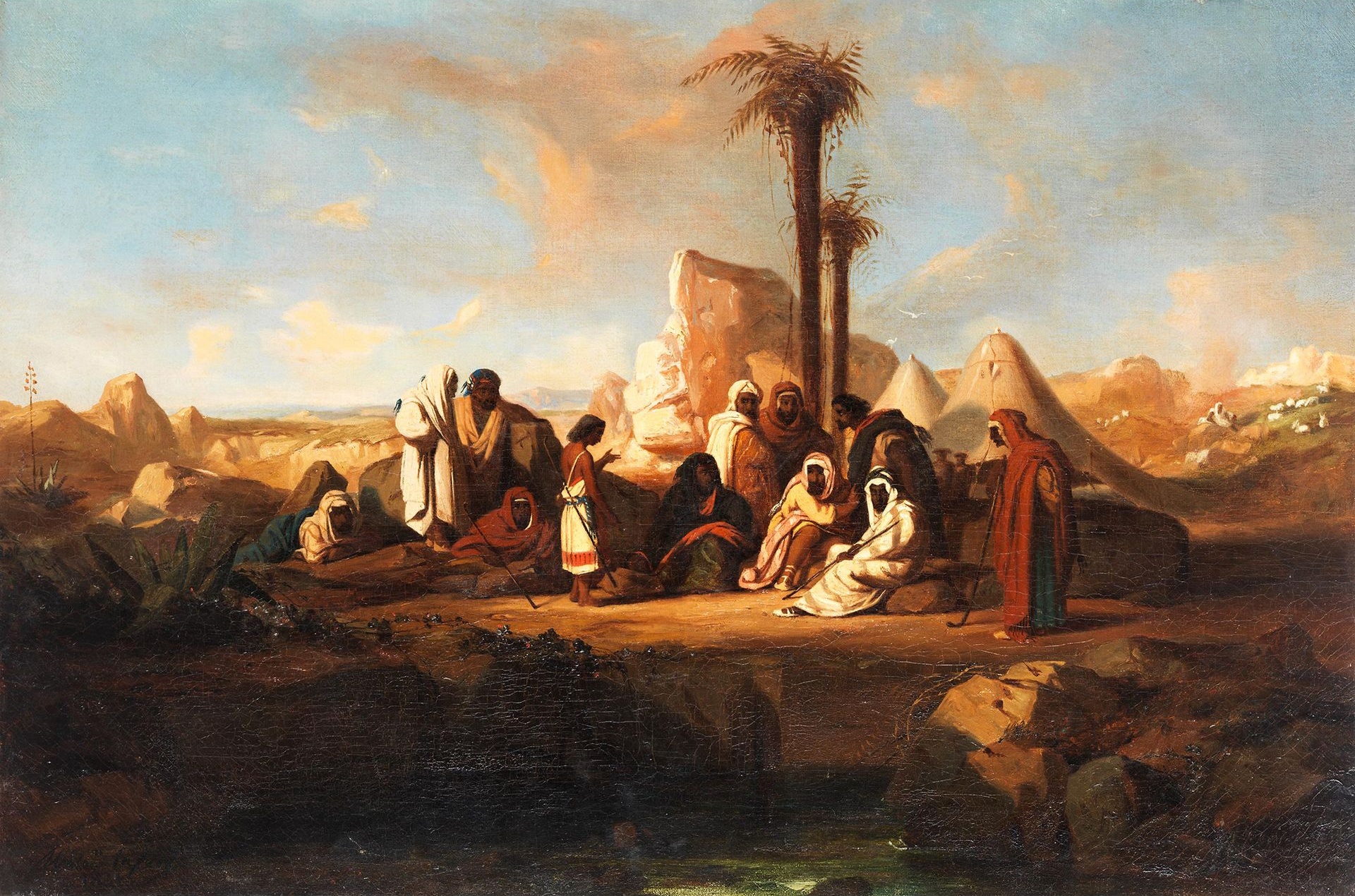
The painting
Campement de bédouins dans le désert. Marie Méloé Lafon, 1841. Gazette Drouot, image cropped by the uploader. Public domain.