
Psalm 117
2 verses · David and others · 10th to 5th century BC · Wisdom and poetry
Praise the LORD, all you nations! Extol Him, all you peoples!
Introduction
Author unstated, the Nations Called to Praise, Book 5: The return and the great Hallelujah, Poetry, Psalms Overview.
This psalm is the shortest chapter in the Bible, two verses long. Its writer is not named, and it was sung among the Passover songs of Israel. It is addressed to people who were not in the room: the other nations of the world. It gives them a single reason to join Israel's praise, drawn from the words Israel used for God's loyalty to itself. Listen for who is being spoken to, and for the reason given. The New Testament takes this call up as a word about the Gentiles coming in to praise.
Context
- Who
- Israelites at a feast, and through them the Gentile peoples the psalm addresses by name
- What
- The shortest psalm, a call to all nations to praise the LORD for His loving devotion and faithfulness.
- Where
- Jerusalem, sung at the feasts among the Passover songs.
- When
- Sung in the second temple period, with the author and the date of writing unnamed.
- Why
- To summon the Gentile peoples to praise the God of Israel on the ground of His covenant loyalty.
Historical context
Two verses is the whole psalm, and it is the shortest chapter in the Bible. The command is addressed to the goyim, the nations, and to all the peoples, which is unusual in the Old Testament, where the psalms normally call Israel to praise God for what He did for Israel. The reason given is a pair of covenant words. Loving devotion renders chesed, the loyalty God keeps to those He has bound Himself to, and it stands beside the faithfulness of the LORD that endures forever. The psalm sits inside Psalms 113 to 118, the group sung at Passover, so a song addressed to the Gentile world was in Israel's mouth at its most national feast every year.
Significance
For Israel it was a short, strange thing to sing at a feast about their own deliverance: a summons to the outside world to join in, grounded on a covenant the outside world was not party to. It said that God's loyalty to Israel was itself a reason for other nations to praise Him, which made Israel's election a thing done in front of an audience.
This chapter in Jewish lifeWhat this chapter is in Jewish life and reading.
What is done
The shortest chapter in the Bible is said inside a set rather than on its own. It stands fifth in the Hallel, Psalms 113 to 118, said as one unit at the appointed feasts (src/app/featured/the-hallel/page.tsx). In the Temple court those standing there said the Hallel while the Passover lambs were killed, group by group (Mishnah Pesachim 5:7).
At the seder the set is split across the meal, and this psalm falls after the seam on either ruling of the Houses, in the part finished over the fourth cup with the blessing of song (Mishnah Pesachim 10:6-7). At Tabernacles the lulav is waved during the Hallel, and the set is also said on the days of Dedication and at the New Moon (Mishnah Sukkah 3:9 and Mishnah Taanit 4:5). Eighteen days in the Land carry the whole Hallel and twenty one outside it (Babylonian Talmud Arakhin 10a).
How it is read
The corpus holds two comments of Rashi on this chapter, both on the second verse, and together they supply the reason the two verses give for the praise. On the kindness that overwhelmed us he reads an implied conclusion, that surely we must praise Him for it, and on the truth of the Lord he writes that God "kept His promise that He promised the Patriarchs" (Rashi on Psalms 117:2:1 and 117:2:2, Rashi on Psalms, The Judaica Press complete Tanach with Rashi, translated by A. J. Rosenberg, CC-BY).
The reading is worth a Christian reader's attention. The psalm calls the nations to praise the God of Israel, and Rashi grounds that call in the promise made to the Patriarchs rather than in anything the nations themselves have received. Paul read the same two verses as warrant for the Gentiles praising alongside Israel and quoted the psalm at Romans 15:11, which is the same text carrying a further claim.
Ibn Ezra, Malbim, Metzudat David and Radak carry six comments on these two verses for which Sefaria holds no English version, and they are cited by reference (Ibn Ezra on Psalms 117:1:1, Malbim on Psalms 117:1:1, Metzudat David on Psalms 117:1:1, Radak on Psalms 117:1:1 and the two references beside them).
What the rabbis say
The corpus records twenty two places where the Midrash and the Talmud cite this psalm, seventeen under Midrash and five under Talmud, which is a heavy weight for two verses. It carries the locator for each one with no text.
The Babylonian Talmud cites the first verse at Pesachim 118a:19 and 118b:11 and the second at Pesachim 118b:1, all on the pages that set out the Hallel at the seder. The Jerusalem Talmud cites the psalm at Chagigah 2:1:9 and Taanit 2:1:9.
Midrash Tehillim treats it four times, at 117:1, 117:2, 117:3 and 117:4, and reads it again from Psalm 119 at 119:24. Vayikra Rabbah reads the second verse three times, at 2:1, 24:2 and 37:4, and Bereshit Rabbah reads the first at 96:5. The site reports where the rabbis cite the verse and reports no saying, because the locator carries none.
Sources: The Mishnah, Pesachim 5:7 and 10:6-7, Sukkah 3:9 and Taanit 4:5, as recorded at src/app/featured/the-hallel/page.tsx, about AD 200; Babylonian Talmud, Arakhin 10a, as recorded at src/app/featured/the-hallel/page.tsx; Rashi, Rashi on Psalms 117, in The Judaica Press complete Tanach with Rashi, translated by A. J. Rosenberg, CC-BY; Ibn Ezra, Malbim, Metzudat David and Radak, their comments on Psalms 117, cited by reference; Sefaria holds no English version; The Midrash and the Talmud, the twenty two locators on Psalms 117 in scripts/data/sources/sefaria/psalms/117.json.
Psalms 117:1-2
Praise the LORD, all you nations!: The call goes out to all the nations and all the peoples, and the ground of it is given in one line. His loving devotion is chesed, covenant loyalty, and it stands here beside the faithfulness of the LORD. Paul quotes verse 1 at Romans 15:11 of the Gentiles.
Psalms 117:1
“The original words are the same that are used for the heathen that rage and the people that imagine against Christ ( Ps. ii. 1 ); those that had been enemies to his kingdom should become his willing subjects. The gospel of the kingdom was to be preached to all the world, for a witness to all nations, Matt. xxiv.”
Matthew Henry · Commentary on the Whole Bible (1707-1721)puritan
Cross references
Psalms 117:1
- Quoted inRomans 15:11And again: “Praise the Lord, all you Gentiles, and extol Him, all you peoples.”
'Praise the Lord, all ye Gentiles'
great is His loving devotion: The nations are told to praise the loving devotion shown to Israel, and Spurgeon widened it to the whole family of man. He read great as mighty, a love that prevails as the flood waters prevailed over the earth. Loving devotion and faithfulness are the pair of Exodus 34:6.
Psalms 117:2
“For his merciful kindness is great toward us. By which is meant not only his great love toward the Jewish people, but towards the whole family of man. The Lord is kind to us as his creatures, and merciful to us as sinners, hence his merciful kindness to us as sinful creatures. This mercy has been very great, or powerful. The mighty grace of God has prevailed even as the waters of the flood prevailed over the earth: breaking over all bounds, it has flowed towards all portions of the multiplied race of man.”
Charles Spurgeon · The Treasury of David, Vol. 5 (1878)Particular Baptist
1 more voice on this verse
Psalms 117:2
“There is a great deal of gospel in this psalm. The apostle has furnished us with a key to it ( Rom. xv. 11 ), where he quotes it as a proof that the gospel was to be preached to, and would be entertained by, the Gentile nations, which yet was so great a stumbling-block to the Jews.”
Matthew Henry · Commentary on the Whole Bible (1707-1721)puritan
How this psalm is built
The form: A gospel psalm, to which the apostle himself supplies the key, as Henry classes it.
The patterns in this chapter
| Device | What it does | Where to see it |
|---|---|---|
| The call, then the ground of it | The psalm is two verses and it does one thing in each. Verse 1 is the command, given twice over to all the nations and all the peoples. Verse 2 is the reason, given twice over as His loving devotion toward us and the faithfulness of the LORD that endures forever.Charles Spurgeon, The Treasury of David, Vol. 5, 1878, on Psalm 117:2. | Psalm 117:1, Psalm 117:2 |
| Every nation named twice | The two halves of verse 1 say one thing in two ways, all the nations and all the peoples. Matthew Henry notes that the words are the same ones used of the heathen who rage and the people who imagine against Christ at Psalm 2:1, so the psalm calls the very nations that opposed Him to praise Him.Matthew Henry, Commentary on the Whole Bible, 1710, on Psalm 117:1. | Psalm 117:1 |
| The closing Hallelujah | The psalm opens with the command to praise the LORD and closes on the word Hallelujah, which says the same thing in one word. A reader who obeys the first line has already done what the last line calls for.Charles Spurgeon, The Treasury of David, Vol. 5, 1878, on Psalm 117:2. | Psalm 117:1, Psalm 117:2 |
Paul quotes the first verse of this psalm at Romans 15:11, in the passage where he stacks Old Testament texts to prove that the Gentiles were always meant to glorify God for His mercy. Matthew Henry calls that quotation the key to the psalm and says there is a great deal of gospel in it, since the point was a stumbling block to the Jews of Paul's day and the psalm had been saying it all along.
2 more paragraphs on the patterns
The ground the psalm gives is a covenant word. Loving devotion renders chesed, the covenant loyalty of God, and it stands here beside the faithfulness of the LORD that endures forever. The two together are the standing pair the Old Testament uses for God's character toward His own people, and this psalm hands that pair to the nations as their reason for praise.
Spurgeon reads the mercy in the same direction, as love that reaches past the Jewish people to the whole family of man, grace that has prevailed over all bounds as the flood prevailed over the earth.
Keep studying
Sources for this chapter
The summary
Jamieson, Fausset & Brown, Commentary Critical and Explanatory; John Calvin, Commentaries; John Wesley, Notes on the Old Testament and Matthew Henry, Complete Commentary.
The form and classifications
Charles Spurgeon, The Treasury of David, Vol. 5, 1878, on Psalm 117:2 and Matthew Henry.
The exposition
Charles Spurgeon, The Treasury of David and Matthew Henry, Commentary on the Whole Bible.
The painting
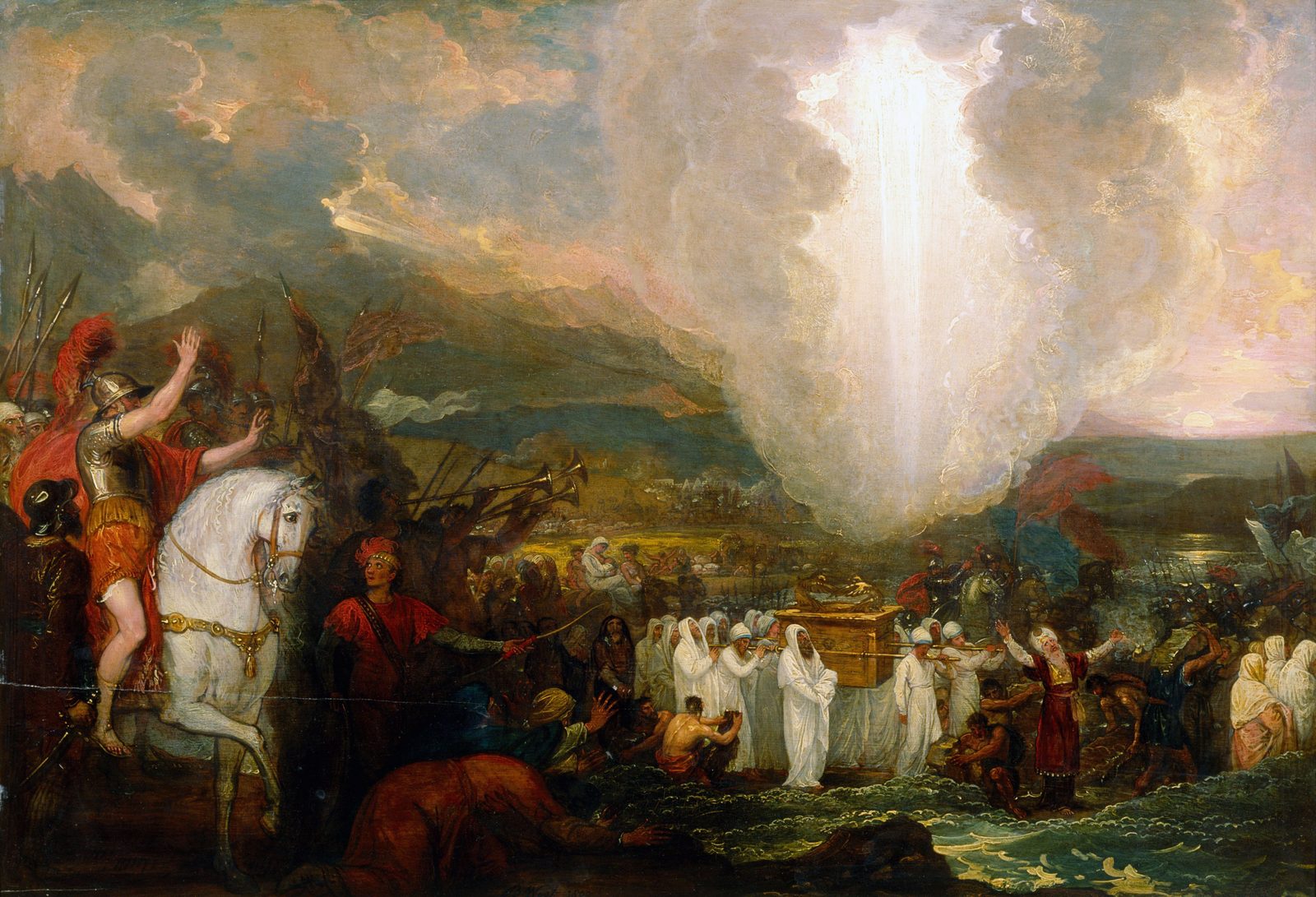
Joshua passing the River Jordan with the Ark of the Covenant. Benjamin West, 1800. Wikimedia Commons. Public domain.