
A courtroom story about a false charge · Greek addition to Daniel, c. 2nd-1st century BC
Susanna
Two respected judges lie about an innocent woman, and a young man stops the execution by asking one question twice.
- 1Chapter
- 64Verses
- c. 200-100 BCEWritten
Original language: Greek (Susanna and Bel originally); Hebrew/Aramaic substrate for Prayer of Azariah
King James Version Apocrypha (1769 standardized text) · public domain
Read Susanna
King James Version + Apocrypha (standardized 1769 text), eBible.org USFX edition of the Crosswire/eBible KJV — Public Domain — One of the three Additions to Daniel.
Featured studies on this book
— the deep dives, each its own page
Plain answers first
What this book is
Susanna is a single-chapter story attached to the Greek Daniel, printed in some Bibles as Daniel chapter 13. It is a court tale, the same kind of story as Daniel 1-6: a faithful Jew in a foreign land is cornered and God vindicates them.
Susanna is a wealthy, God-fearing wife in Babylon. Two elders, appointed judges that year, watch her in her husband's garden and burn for her. They corner her alone and give her a choice: give in to them, or they will testify that they caught her with a young man. She refuses, and says it is better to fall into their hands than to sin against God.
They accuse her publicly. The assembly believes them, because they are elders, and condemns her to death. She is being led away when a young Daniel stops the crowd and demands a real trial.
He separates the two witnesses and asks each the same question: under what tree did you see this? One says a mastic tree, the other says a holm oak. The stories do not match, the elders are condemned under the law's rule for false witnesses, and Susanna goes home.
In Greek, each tree name puns on the sentence Daniel pronounces, which is one reason many scholars think the story was composed in Greek, though others argue for a Hebrew or Aramaic original. It is usually dated to the second or first century BC.
Why a student of the 66 should still open it
Why read it: and how
For a story this old, its instincts about justice are striking. It insists that the office of judge does not make a man honest, that a crowd can be certain and wrong, and that testimony must be tested before it costs a life. Separating witnesses to see whether their accounts agree is basic cross-examination, and this is one of the earliest places anyone wrote it down. The story has echoed far beyond the Bible: it gave the English language the phrase a Daniel come to judgment, and it has been painted for five hundred years, most searchingly by Artemisia Gentileschi, who painted Susanna's fear from the inside.
It is one chapter, so read it whole, in one go. Read it against Deuteronomy 19:15-21, the law about false witnesses, which is exactly the law Daniel applies. Then ask the uncomfortable question the story is really asking: whose word does your community automatically believe, and who pays when that trust is misplaced?
The canon question, honestly
Why it stands outside the 66
Like the other Daniel additions, Susanna is absent from the Hebrew and Aramaic Daniel and appears only in the Greek. Jerome flagged it as not being in the Hebrew. As early as the third century Julius Africanus wrote to Origen arguing the story could not be original because of those Greek wordplays, and Origen wrote back defending it, so the question was being debated among Christians long before the Reformation. The Reformers placed it among the apocrypha; Rome and the Orthodox churches keep it with Daniel.
Doors into the text
Key moments
Verses 1-14. Two appointed judges hide in a private garden, each ashamed to tell the other what he wants.
Verses 19-23. Cornered, she says it is better to fall into their hands than to sin in the sight of the Lord.
Verses 28-41. Their standing carries the room, and she is condemned without evidence.
Verses 45-49. A young man refuses to go along with the verdict and calls the trial a sham.
Verses 51-59. The witnesses are separated, asked the same question, and give different answers.
Verses 60-64. The false witnesses receive the penalty they intended for her, and Daniel's reputation begins.
Plainly told
The story it tells
The garden
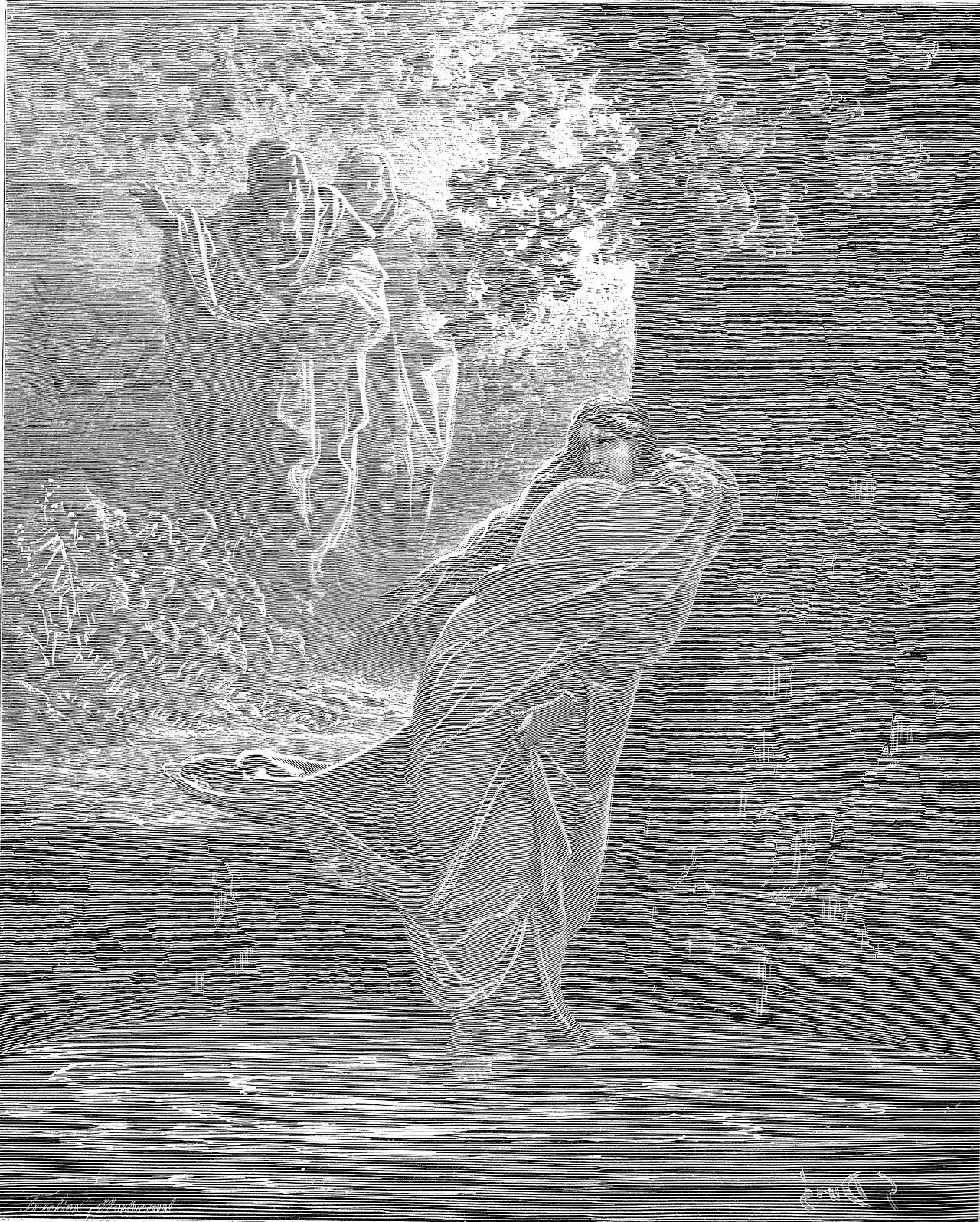
Two elders, newly appointed as judges for the year, begin secretly watching Susanna, a wealthy and God-fearing wife, as she walks in her husband’s garden. Each burns for her, and each is ashamed to tell the other, until the day they catch each other watching and admit it.
The ultimatum
The two corner her alone. Give in, they say, or we will testify that we caught you with a young man. It is a threat with no honest way out: refuse, and be accused; give in, and sin against God and her husband.
Susanna’s choice
She refuses outright. “It is better for me to fall into your hands, and not do it, than to sin in the sight of the Lord,” she says, and cries out for help. The elders make good on the threat and accuse her publicly the next day.
Condemned on their word
The assembly trusts the elders because they are elders, and Susanna is condemned to death without a shred of evidence beyond two men’s word. She is led out for execution.
A young man stops the crowd
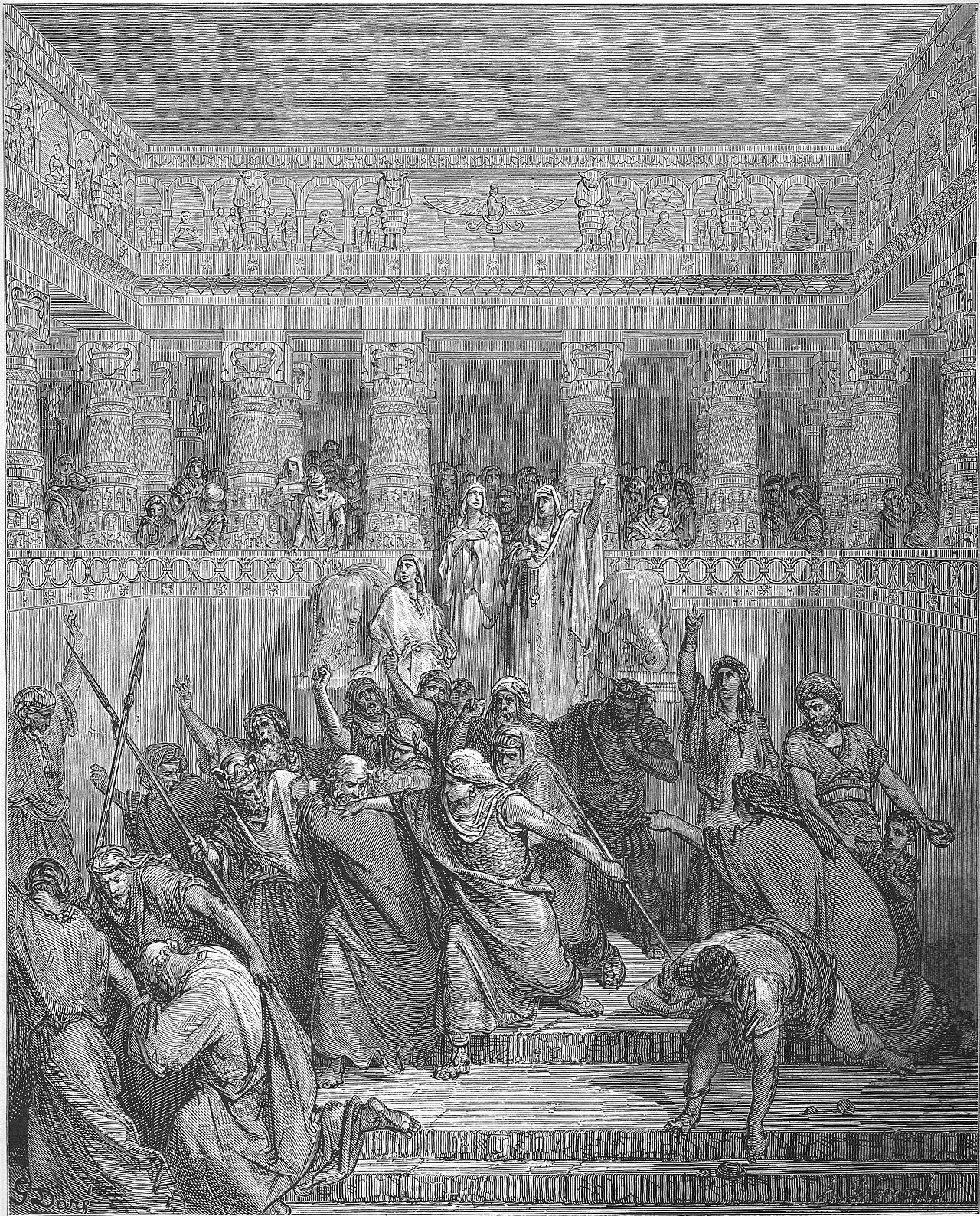
A young Daniel refuses to go along with the verdict and demands a real trial. He separates the two witnesses so neither can hear the other, then asks each the same question: under what tree did you see this happen?
Under what tree?
One says a mastic tree; the other says a holm oak. The mismatch exposes the lie. Under the law of Deuteronomy 19:15–21, the false witnesses receive the death sentence they intended for her, and Susanna goes home vindicated.
Dates hedged where scholarship hedges
Where it sits in history
- c. 2nd–1st century BC
Susanna circulates as one of three independent “Additions to Daniel,” alongside Bel and the Dragon and the Song of the Three Children, before being folded into the Greek text of Daniel.
- early 3rd century AD
Julius Africanus writes to Origen arguing the story cannot be original to Daniel, because its central wordplay only works in Greek. Origen writes back defending it: the earliest recorded argument over its authenticity.
- c. AD 400
Jerome, translating Daniel into Latin, notes plainly that the story is absent from the Hebrew Bible even as he carries it into his own translation.
- 1546
The Council of Trent affirms Susanna as canonical Scripture, printed as Daniel chapter 13.
- 1571
Article VI of the Church of England’s Thirty-Nine Articles places Susanna among the books read for the example of life, not for establishing doctrine.
- 1672
The Synod of Jerusalem reaffirms Eastern Orthodoxy’s reception of Susanna as part of the Book of Daniel.
The disagreement is old: here it is plainly
Where the traditions stand
Susanna was never part of the Hebrew Bible. No Hebrew or Aramaic form of the story was known to Origen, Eusebius, or Jerome, and it survives only in Greek: in two independent ancient versions, the Old Greek and the later Theodotion text the church settled on. That absence from the Hebrew record is the whole of the disagreement; nobody on any side has argued the story was suppressed, only that it was never there.
The debate over it is far older than the Reformation. In the early third century, Julius Africanus told Origen the story could not be original to Daniel because its pivotal wordplay (the tree names punning on the sentence Daniel pronounces) only works in Greek. Origen defended its place anyway. Christians were arguing honestly about this text a thousand years before Luther.
The Reformers followed the Hebrew list and set Susanna among the books the church may read for instruction in godly living, never to settle a doctrine on. Rome and the Eastern churches went the other way, treating it as inseparable from Daniel itself and printing it as that book’s thirteenth chapter.
So the split runs where it usually runs on these books: not over whether the story is edifying (almost no one has ever said it isn’t) but over which list of books a church received as the Hebrew canon that Jesus and the apostles held.
| Tradition | Where this book stands |
|---|---|
| jewish | not canonical; Hebrew original (if any) lost |
| anglican | apocryphal — read for example of life and instruction of manners |
| catholic | canonical (deuterocanonical; Daniel 3, 13, 14 in Vulgate) |
| protestant | non-canonical; retained in Luther's 1534 Apocrypha |
| eastern orthodox | canonical (anagignoskomena) |
| oriental orthodox | canonical |
2 threads into the 66
Its connections into Scripture
The Song of the Three Young Men — a responsive creation hymn sung from within the furnace ("Bless the Lord, all works of the Lord") — structurally and thematically parallels Psalm 148's universal call to creation to praise the Creator. The Song's refrain-based structure and its expansion of the furnace narrative into a liturgical theology of creation made it one of the earliest Christian canticles (the Benedicite).
Susanna's vindication turns on Daniel's separate cross-examination of the two witnesses, who contradict each other on which tree the alleged offense occurred under. The principle — careful testing of two or three witnesses — is Torah (Deut 19:15) sharpened into forensic wisdom narrative, and it surfaces in Jesus' church-discipline instruction: "every charge may be established by the evidence of two or three witnesses" (Matt 18:16).
Reception history, never our confession
What the church has made of it
The story’s procedural core has outlasted every argument about its canonical status: separate the witnesses, ask them the same question independently, and see whether their accounts agree. That is basic cross-examination, applying the rule of Deuteronomy 19:15–21 that a false witness bears the penalty he sought for the accused, and this is one of the earliest places in literature anyone wrote the method down in story form.
It has been painted for five centuries. Tintoretto and Rembrandt both took up the garden scene, but the reading most discussed today is Artemisia Gentileschi’s Susanna and the Elders (1610), which paints the moment from Susanna’s own fear rather than as a spectacle for the viewer: a choice art historians regularly connect to Gentileschi’s own life.
The story also gave English a lasting phrase. “A Daniel come to judgment,” Shakespeare’s line in The Merchant of Venice, draws on exactly this image: an unlikely young man whose sudden wisdom overturns a wrongful verdict.
The voices
What the teachers have said
“the Story of Susanna and the Hymn of the Three Children, and the fables of Bel and the Dragon, which are not contained in the Hebrew Bible”
“the Church doth read for example of life and instruction of manners; but yet doth it not apply them to establish any doctrine”
Every claim above rests on these
Where this comes from
- Bruce M. Metzger, An Introduction to the Apocrypha (Oxford, 1957)
- David A. deSilva, Introducing the Apocrypha: Message, Context, and Significance (Baker Academic)
- R. H. Charles, ed., The Apocrypha and Pseudepigrapha of the Old Testament, vol. 1: Apocrypha (Oxford, 1913)