
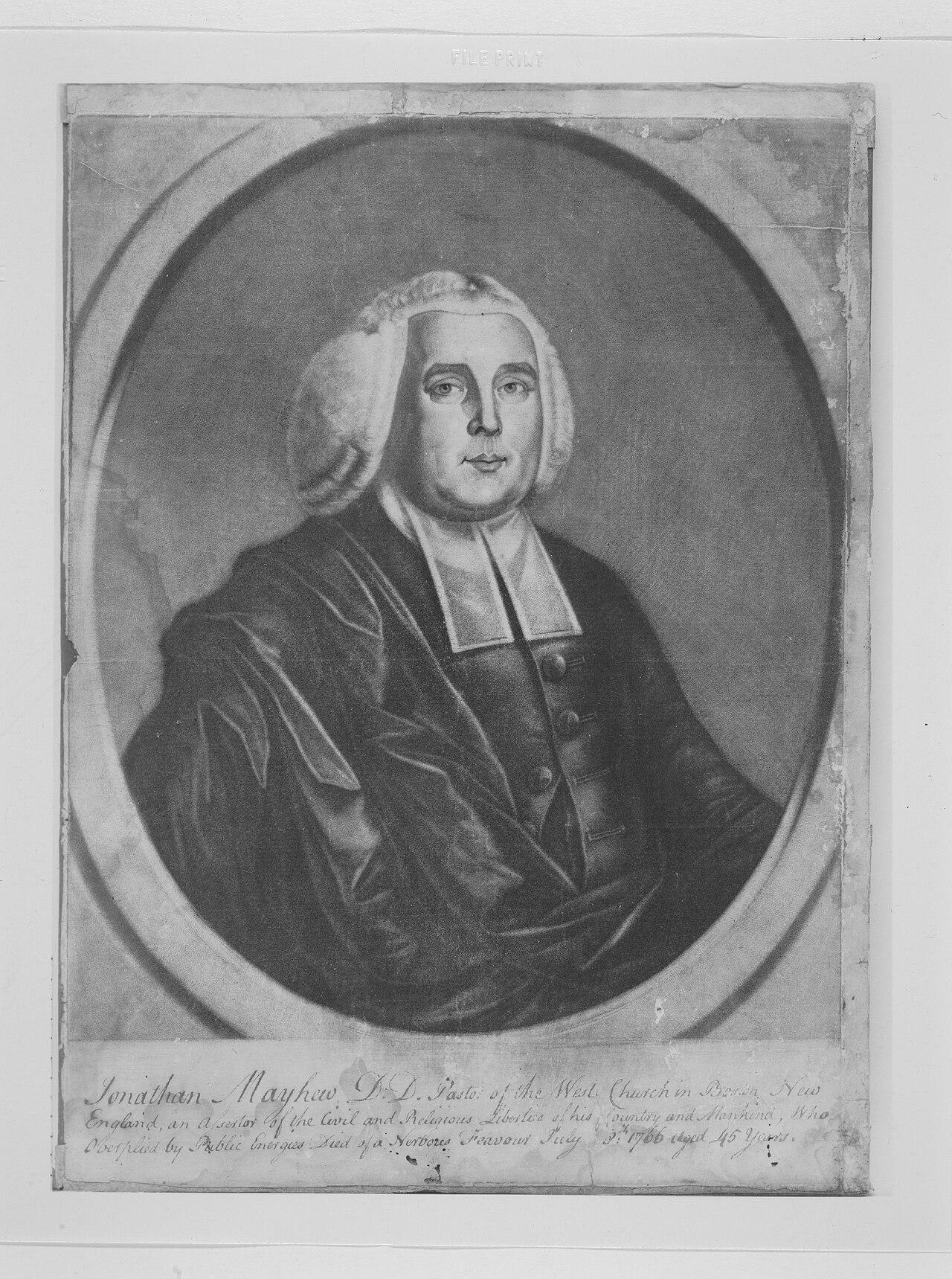
Richard Jennys Jr. and Nathaniel Hurd, Jonathan Mayhew, 1766. CC0.
The American colonies, 1750 to 1781 · Story · Featured Study
The Black-Robed Preachers of the Awakening
A Boston sermon of 1750 on Romans 13 and a Loyalist's history of 1781 frame the part the colonial pulpit took in the Revolution.
A Boston minister taught that Paul's command to obey rulers carried its own limit.
Everyone must submit himself to the governing authorities, for there is no authority except that which is from God. The authorities that exist have been appointed by God.
Everyone must submit himself to the governing authorities, for there is no authority except that which is from God. The authorities that exist have been appointed by God.
- Where
- Boston, Woodstock, Virginia, Springfield, New Jersey
- Who
- Jonathan Mayhew, Peter Oliver, Peter Muhlenberg, James Caldwell, John Adams
- When
- 1750 to 1781
Summary
Early in 1750 Jonathan Mayhew preached in Boston on Romans 13. He argued that a people may resist a ruler who turns tyrant. Twenty-five years later Congress paid chaplains for its army. Peter Oliver, a Loyalist, blamed the dissenting clergy for the rebellion and called them the black Regiment.
- John Adams wrote in 1818 that Mayhew's sermon "was read by everybody".
- Mayhew's sermon was printed at the request of those who heard it.
- The story of Peter Muhlenberg throwing off his gown in the pulpit first appears in full in a Life of 1849.
The Text Mayhew Preached
Mayhew's sermon is an exposition of Romans 13, and a later telling sets Ecclesiastes 3 in Muhlenberg's mouth.
Mayhew's Discourse opens with Romans 13:1 to 7 and argues from Paul's own reason for obedience. Rulers are owed obedience because they rule for the good of the people, so a ruler who destroys the people has no claim to it, he writes.
The powers ordained of God
For he is God’s servant for your good. But if you do wrong, be afraid, for he does not carry the sword in vain. He is God’s servant, an agent of retribution to the wrongdoer.
Mayhew held that Paul calls the ruler God's minister because he rules for the people's good.
Romans 13:4BSB
A time for everything
To everything there is a season, and a time for every purpose under heaven:
The Life of Muhlenberg puts this chapter in his mouth at Woodstock.
Ecclesiastes 3:1
The Pulpit and the War by Date
Each date comes from a printed record of the time or from a later book that names its source.
The thirty-one years from Mayhew's sermon to Oliver's history.
- 1750Mayhew preaches his Discourse on Romans 13 on the Sunday after the thirtieth of January.The title page of the Discourse, 1750
- 7 December 1772A writer signing himself Israelite uses the term black regiment in the Boston Gazette.Adair and Schutz, note 24
- 29 July 1775Congress sets a chaplain's pay at twenty dollars a month.Journals of the Continental Congress, volume 2, page 220
- December 1775Washington writes that the chaplains' pay is too small for men of ability.Headley, pages 62 and 63
- 11 January 1776Oliver uses the term black regiment in the Boston Weekly News-Letter.Adair and Schutz, note 24
- January 1776Peter Muhlenberg preaches a farewell sermon at Woodstock and marches with his regiment.The Life of 1849, page 54
- 1780James Caldwell hands out hymn books for wadding at Springfield, New Jersey.Headley, page 227
- 1781The date on the Loyalist history that names the black Regiment.Adair and Schutz, introduction
A timeline of eight dates from Mayhew's sermon to Oliver's manuscript, each with the record that prints it.
1780, 1781
From Mayhew's Pulpit to the Army
The record runs from a Boston sermon to chaplains in the field.
Mayhew preached his Discourse at the West Meeting-House in Boston on the Lord's Day after the thirtieth of January, which its title page dates 1749/50.
He asked how far the subjection of Romans 13 extends. He answered that "Rulers have no authority from God to do mischief" and that "It is blasphemy to call tyrants and oppressors God's ministers."
At Springfield, New Jersey, Headley tells how the pastor James Caldwell saw a company's fire slacken for want of wadding. He ran into the Presbyterian meeting house, came back with his arms full of hymn books and threw them to the men with the words "Now put Watts into them, boys."
Headley names no source for the hymn books, nor for the letter of Washington that the timeline cites, and the page gives both as his.
How the Muhlenberg Story Grew
Three printed tellings of the Woodstock sermon each add to the one before.
James Thacher's Military Journal of 1823 says that Muhlenberg "entered his pulpit with his sword and cockade, preached his farewell sermon", and the next day marched at the head of his regiment.
Samuel Kercheval's History of the Valley of Virginia of 1833 says in one line that he "laid off his gown and took up the sword."
The Life of 1849 gives the full scene. In it Muhlenberg wears full uniform under his gown. He tells the congregation that there was "a time to preach and a time to pray". Then he says "there was a time to fight, and that time had now come", and puts off the gown before them.
The Life says that "numerous traditionary accounts" of the event were still preserved, and that nearly three hundred men enlisted about the middle of January 1776. Its note on the scene cites Thacher and Kercheval and says that most other accounts contain "some incorrect particulars".
Peter Oliver's Black Regiment
The name comes from a history written on the losing side of the war.
Peter Oliver dated his manuscript history of the rebellion in 1781. Its editors of 1961 printed it as Origin & Progress of the American Rebellion.
Oliver writes that James Otis held "it was necessary to secure the black Regiment", and that Otis meant by it the dissenting clergy.
Under the heading The Black Regiment he set out to "reconnoitre Mr. Otis's black Regiment, the dissenting Clergy, who took so active a Part in the Rebellion." Of the blockade of Boston he wrote that "the black Regiment played its Artillery to some purpose".
How the Key Verse Was Taught
Commentators and a preacher of the Awakening era on the powers ordained of God.
Matthew Henry (1662 to 1714)
Commentary on the Whole Bible
Matthew Henry taught that the power itself is from God while its abuse and its usurpation are not.
“By him kings reign, Prov. viii. The usurpation of power and the abuse of power are not of God, for he is not the author of sin; but the power itself is. As our natural powers, though often abused and made instruments of sin, are from God's creating power, so civil powers are from God's governing power.”
on Romans 13:1 to 4Puritan
John Gill (1697 to 1771)
Exposition of the New Testament (1746-1748)
John Gill read the chapter as Paul's teaching on the duties of Christians as members of a civil society.
“Let every soul be subject unto the higher powers,.... The apostle having finished his exhortations to this church, in relation to the several duties incumbent upon both officers and private Christians, as members of a church, and with reference to each other, and their moral conduct in the world; proceeds to advise, direct, and exhort them to such duties as were relative to them as members of a civil society; the former chapter contains his Christian Ethics, and this his Christian Politics.”
on Romans 13:1Reformed
Francis Asbury (1745 to 1816)
The Journal of the Rev. Francis Asbury, volume 1, April 1778, page 272
Francis Asbury, a Methodist preacher, would not take the state oath of Maryland in 1778 and withdrew to Delaware to keep preaching.
“From March 10, 1778, on conscientious principles I was a non-juror, and could not preach in the State of Maryland; and therefore withdrew to the Delaware State, where the clergy were not required to take the State-oath”
Methodist
In Their Own Words
Two passages of Mayhew's sermon from Thornton's reprint of 1860, and the letter of Adams from his Works of 1856.
Jonathan Mayhew
A Discourse Concerning Unlimited Submission and Non-Resistance to the Higher Powers (1750), p. 79
Bound to resist, the turn in Mayhew's Discourse on Romans 13
“If it be our duty, for example, to obey our king merely for this reason, that he rules for the public welfare (which is the only argument the apostle makes use of), it follows, by a parity of reason, that when he turns tyrant, and makes his subjects his prey to devour and destroy, instead of his charge to defend and cherish, we are bound to throw off our allegiance to him, and to resist; and that according to the tenor of the apostle's argument in this passage.”
Congregational
About this saying1 paragraph
In 1750 Mayhew turned his argument here from obedience to resistance.
Jonathan Mayhew
A Discourse Concerning Unlimited Submission and Non-Resistance to the Higher Powers (1750), p. 62
The extent of subjection, the question the sermon put to Paul's command
“Some have thought it warrantable and glorious to disobey the civil powers in certain circumstances, and in cases of very great and general oppression, when humble remonstrances fail of having any effect; and, when the public welfare cannot be otherwise provided for and secured, to rise unanimously even against the sovereign himself, in order to redress their grievances; to vindicate their natural and legal rights; to break the yoke of tyranny, and free themselves and posterity from inglorious servitude and ruin.”
Congregational
About this saying1 paragraph
In 1750 Mayhew set out the question his Discourse would answer from Romans 13.
John Adams
Letter to Hezekiah Niles, 13 February 1818, pp. 287 to 288
Read by everybody, John Adams on Mayhew's sermon, in his letter of 1818
“particularly a sermon in 1750, on the 30th of January, on the subject of passive obedience and non-resistance, in which the saintship and martyrdom of King Charles the First are considered, seasoned with wit and satire superior to any in Swift or Franklin. It was read by everybody; celebrated by friends, and abused by enemies.”
Congregational
About this saying1 paragraph
Adams looked back in 1818 on a sermon preached sixty-eight years before.
Did the Pulpit Make the Revolution?
Writers of the time and historians since have weighed how much the preachers did.
Thornton, who reprinted Mayhew in 1860, called the Discourse "the morning gun of the Revolution". Oliver, on the Loyalist side, gave the preachers a large share of the blame.
Books to Read Next
The Pulpit of the American Revolution
John Wingate Thornton · 1860
Thornton reprints Mayhew's Discourse whole among the sermons of the Revolution era.
Read Thornton free onlineOrigin & Progress of the American Rebellion
Peter Oliver, edited by Douglass Adair and John A. Schutz · 1961
Oliver wrote this history as a Loyalist, and he names the black Regiment in it.
Read Oliver free onlineThe Life of Major-General Peter Muhlenberg
Henry A. Muhlenberg · 1849
The Life tells the Woodstock sermon in full and names the earlier accounts it used.
Read the Life free onlineThe Chaplains and Clergy of the Revolution
J. T. Headley · 1864
Headley gathers the chaplains' stories, Caldwell at Springfield among them.
Read Headley free onlineWhat the Colonial Preachers Left
The colonial preachers read Romans 13 to their people in a time of war, and the sermons they printed let every later reader weigh what they taught.
Sources
Scripture is the Berean Standard Bible.
- The Holy Bible, Berean Standard Bible (read 2026)
- Jonathan Mayhew, A Discourse Concerning Unlimited Submission and Non-Resistance to the Higher Powers (Boston, 1750), title page.
- John Wingate Thornton, The Pulpit of the American Revolution (Boston: Gould and Lincoln, 1860), the Discourse with Thornton's notes.
- The Works of John Adams, volume 10, edited by Charles Francis Adams (Boston: Little, Brown, 1856), letter to Hezekiah Niles, 13 February 1818, pages 282 to 288.
- Peter Oliver's Origin & Progress of the American Rebellion, edited by Douglass Adair and John A. Schutz (San Marino: Huntington Library, 1961), pages 29, 41 and 131, with the editors' introduction and note 24.
- Henry A. Muhlenberg, The Life of Major-General Peter Muhlenberg (Philadelphia: Carey and Hart, 1849), pages 50 to 54 and note 9, pages 337 to 338.
- James Thacher, A Military Journal during the American Revolutionary War (Boston: Richardson and Lord, 1823), pages 184 to 185.
- Samuel Kercheval, A History of the Valley of Virginia (Winchester: Samuel H. Davis, 1833), page 188.
- Journals of the Continental Congress, volume 2 (Washington: Government Printing Office, 1905), 29 July 1775, page 220.
- J. T. Headley, The Chaplains and Clergy of the Revolution (New York: Charles Scribner, 1864), pages 62 to 63 and 227.
- Jon Butler, Awash in a Sea of Faith (Cambridge: Harvard University Press, 1990)