
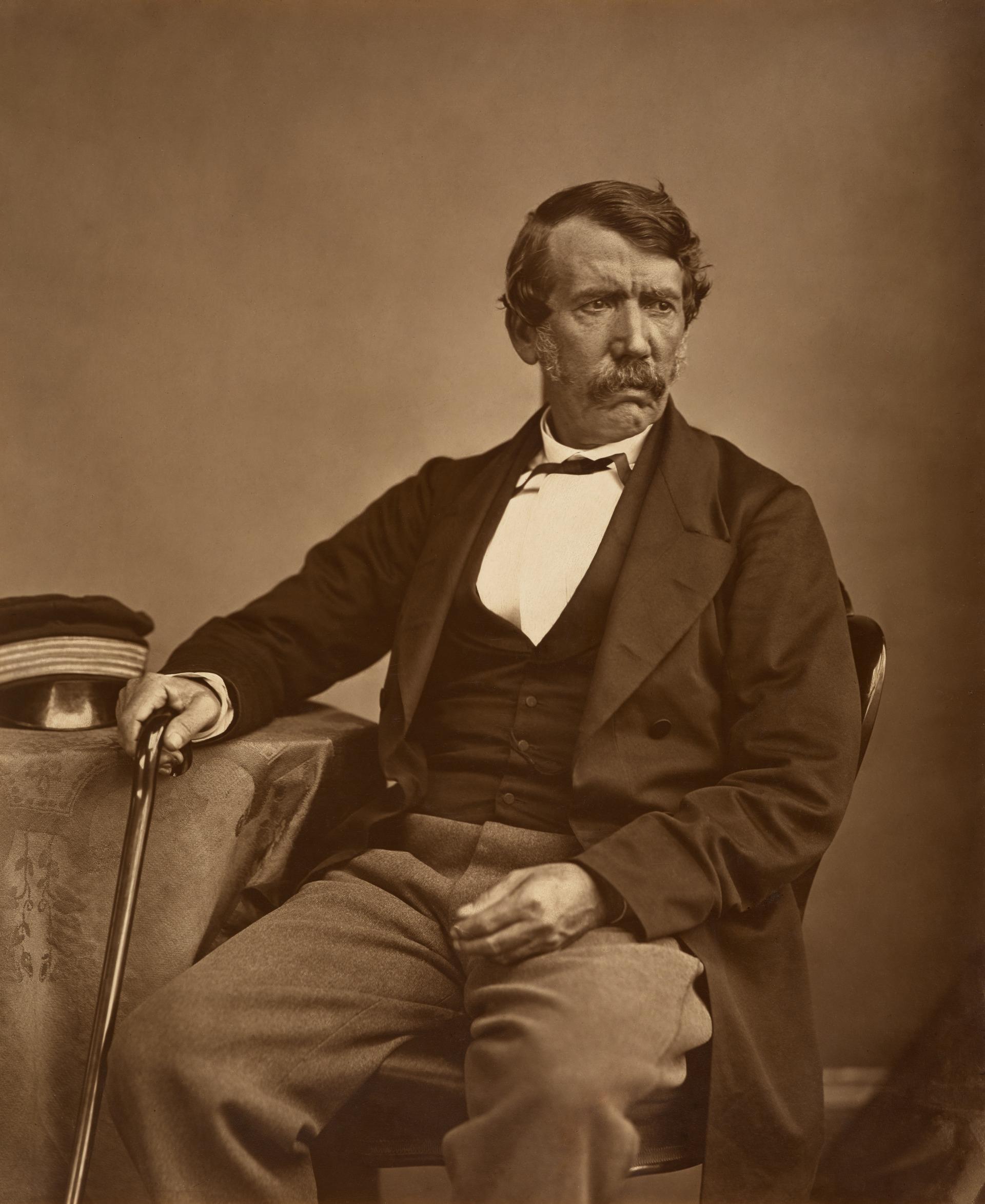
Thomas Annan, David Livingstone, 1864. Public domain.
Southern and central Africa, 1841 to 1873 · Person · Featured Study
David Livingstone
He crossed Africa from Loanda to Quilimane and died in central Africa in 1873.
Facing a hostile crossing in 1856, he read the last verse of Matthew and called it the word of a gentleman.
and teaching them to obey all that I have commanded you. And surely I am with you always, even to the end of the age.”
- Born
- 19 March 1813 at Blantyre in Lanarkshire
- Died
- 1 May 1873 at Chitambo's village, by his men's account (probable)
- Family
- father: Neil Livingstone; mother: Agnes Hunter; wife: Mary Moffat
- Places
- Blantyre, Kuruman, Kolobeng, Loanda, Quilimane, Shupanga, Ujiji, Chitambo's
Summary
David Livingstone, a Blantyre mill boy, served the London Missionary Society in Africa from 1841. His wife died on the Zambezi in 1862. Henry Stanley found him at Ujiji in 1871, and his men found him dead in May 1873.
- His own books and journals, and Blaikie's life of 1880, give most of what is known.
- He joined commerce and Christianity in one aim, and he said so at Cambridge.
- His heart was buried in Africa and his body in Westminster Abbey.
The Word of a Gentleman
With hostile men ahead at a river crossing, he set the last words of Jesus in Matthew against his fear.
Blaikie names Psalm 37:5 and Matthew 28:20 as two of his favourite texts in a letter to Mrs. Moffat.
At the meeting of the Loangwa and the Zambezi he feared that the people would attack his party the next day. That evening he read the command and promise of Matthew 28. He wrote that he would not cross by night as he had meant to, and he took his observations for latitude and longitude.
Commit your way to the LORD; trust in Him, and He will do it.He sent this text to quiet his mother-in-law's fears for his plans.
The Life in Order
Blaikie gives the dates from the journals, and Waller gives the last weeks from the men who were there.
He spent thirty-two years in Africa from his first landing.
- 19 March 1813He was born at BlantyreBlaikie, chapter 1
- About 1823He went into the factory as a piecer at tenLivingstone, Missionary Travels
- 20 November 1840He was ordained a missionary in LondonBlaikie, chapter 3
- 1841He reached South Africa and went to KurumanBlaikie, chapter 3
- 1 October 1848He recorded a chief's baptism in his journalHis journal, in Blaikie
- 31 May 1854He came out at the Atlantic with twenty-seven menBlaikie, chapter 8
- 20 May 1856He came out at the Indian OceanBlaikie, chapter 9
- 4 December 1857He lectured in the Senate House at CambridgeMonk, Cambridge Lectures
- 27 April 1862His wife Mary died at ShupangaBlaikie, chapter 14
- 10 November 1871Stanley met him at UjijiStanley, How I Found Livingstone
- 1 May 1873He died at Chitambo's villageWaller, Last Journals
- 18 April 1874He was buried in Westminster AbbeyBlaikie, chapter 22
Each step of the life stands with its witness.
20 May 1856, 4 December 1857, 27 April 1862, 10 November 1871, 1 May 1873, 18 April 1874
From the Mill to Chitambo's
He tells his boyhood himself, and his journals and his men tell the end.
David Livingstone went into the Blantyre mill as a piecer at the age of ten. With part of his first week's wages he bought a Latin grammar, and he read at work from a book set on the spinning-jenny. He was ordained a missionary in London in November 1840, and he reached South Africa in 1841 for the London Missionary Society.
He worked north of Kuruman, and he married Mary Moffat in the 1840s. In October 1848 he baptized Sechele, chief of the Bakwains.
From 1853 to 1856 he walked from Linyanti in the Makololo country to Loanda on the west coast, and then back east to Quilimane. On the way east he came to the great falls of the Zambezi and named them for the Queen.
He made few converts himself. In his journal of June 1853 he wrote that future missionaries would be rewarded by conversions for every sermon, and that his generation were their pioneers and helpers.
He led a government expedition up the Zambezi from 1858. Mary joined him on the river, and a week's illness took her at Shupanga in 1862. In 1866 he left Zanzibar for the interior for the last time.
Henry Stanley reached him at Ujiji in November 1871. He would not go home with Stanley while his work was unfinished.
His men found him dead early on 1 May, kneeling at the bedside. They buried his heart in a tin box at the place where he died, and they carried his body to the coast. He was buried in Westminster Abbey in April 1874.
The Slave Trade and the Gospel
He set the end of the slave trade beside the gospel in his lectures and in his last journals.
In Missionary Travels he argued that commerce could put a stop to the slave trade. He wrote that neither civilization nor Christianity can be promoted alone.
At Cambridge on 4 December 1857 he asked the university to carry on the work he had begun. He said that he was going back to Africa to make an open path for commerce and Christianity.
On 1 May 1872, a year before he died, he wrote of the slave trade as the open sore of the world. Those words were later cut on his tablet in the Abbey.
In Their Own Words
Four sayings from his journals and his Cambridge lecture, on the pioneers, the promise, the open path and the trade.
David Livingstone (1813 to 1873)
Journal, June 1853, chapter 7
Pioneers and helpers
“Our work and its fruits are cumulative. We work toward another state of things. Future missionaries will be rewarded by conversions for every sermon. We are their pioneers and helpers.”
Congregationalist
About this saying1 paragraph
Blaikie prints this among his Sunday entries for the summer of 1853.
David Livingstone
Journal, 14 January 1856, chapter 9
The promise at the river
“It is the word of a gentleman of the most sacred and strictest honor, and there is an end on't. I will not cross furtively by night as I intended. It would appear as flight, and should such a man as I flee? Nay, verily, I shall take observations for latitude and longitude to-night, though they may be the last. I feel quite calm now, thank God.”
Congregationalist
About this saying1 paragraph
This is the entry for 14 January 1856, as Blaikie prints it.
David Livingstone
Lecture I, Senate House, Cambridge, 4 December 1857, page 24
An open path
“I go back to Africa to try to make an open path for commerce and Christianity; do you carry out the work which I have begun.”
Congregationalist
About this saying1 paragraph
He ended his first lecture at Cambridge with this charge to his hearers on 4 December 1857.
David Livingstone
The Last Journals, volume 2 (1874), entry of 1 May 1872
The open sore
“All I can add in my loneliness is, may Heaven's rich blessing come down on everyone, American, English, or Turk, who will help to heal the open sore of the world.”
Congregationalist
About this saying1 paragraph
He wrote this in his journal on 1 May 1872, a year before he died.
The People Around Him
The witnesses name his family, the chief he baptized, the men who carried him and the reporter who found him.
His men brought his body and his journals to the coast.
| Person | Tie to Livingstone | The witness |
|---|---|---|
| Neil Livingstone | His father, a poor man of Blantyre. | Blaikie, chapter 1 |
| Robert Moffat | The missionary of Kuruman, whose eldest daughter he married. | Blaikie, chapter 4 |
| Mary Livingstone | His wife, who went with their children on his third expedition. | Blaikie, chapter 6 |
| Sechele | He sent away his other wives when he took baptism. | His journal, in Blaikie |
| Henry Morton Stanley | The New York Herald's man who reached him in 1871. | Stanley, How I Found Livingstone |
| Susi | One of his men, whose account Waller followed for the last night. | Waller, Last Journals |
| Jacob Wainwright | He read the burial service over the heart and bore the coffin in the Abbey. | Waller; Blaikie |
| Horace Waller | He edited the Last Journals from the men's account. | Waller, Last Journals |
Jacob Wainwright, Horace Waller
The Places of His Life
His life runs from a Scottish mill village across southern Africa to the lakes of the interior.
Each of his travels took him farther north.
| Place | What the witnesses say | The witness |
|---|---|---|
| Blantyre | He was born there and worked in its mill. | Blaikie, chapter 1 |
| Kuruman | He went there first, to the Moffats' station. | Blaikie, chapter 3 |
| Loanda | He reached it with twenty-seven followers in 1854. | Blaikie, chapter 8 |
| Quilimane | A Portuguese port where the crossing ended. | Blaikie, chapter 9 |
| Shupanga | His wife rests by a great baobab, sixty feet round. | Blaikie, chapter 14 |
| Ujiji | Stanley found him there on Lake Tanganyika. | Stanley, How I Found Livingstone |
| Chitambo's | A village by the Molilamo, his last camp. | Waller, Last Journals |
| Westminster Abbey | He was buried near the centre of the nave. | Blaikie, chapter 22 |
Chitambo's, Westminster Abbey
The Missionary and the Map
He held that opening the country was itself a work for the gospel.
He wrote to the Directors of his society that he was at their disposal to go anywhere, provided it be forward.
Blaikie reckons that he traveled twenty-nine thousand miles in Africa. Blaikie also says that the falls, for all their fame, led to no very remarkable results.
He measured his own work by what would follow it. He thought the earth would be filled with the knowledge of the glory of the Lord, and he wrote that this was enough.
The Voices
One teacher on Matthew 28:20.
Jerome (died 420)
Catena Aurea by Aquinas
He will never depart from those that believe
“Observe the order of these injunctions. He bids the Apostles first to teach all nations, then to wash them with the sacrament of faith, and after faith and baptism then to teach them what things they ought to observe; Teaching them to observe all things whatsoever I have commanded you.”
on Matthew 28:20Patristic
The rest1 more paragraph
He then who promises that He will be with His disciples to the end of the world, shows both that they shall live for ever, and that He will never depart from those that believe.
What the Witnesses Leave Open
Readers differ on his joining of commerce and the gospel, and two famous moments rest on one witness each.
Commerce and ChristianityDavid Livingstone; Andrew Porter
Livingstone made commerce and Christianity one aim at Cambridge and in Missionary Travels. Bradford's review of Andrew Porter's book of 2004 on missions and empire says that Porter finds moments of entanglement in a relation that was nuanced on the whole.
The words at UjijiHenry Morton Stanley
Stanley's book of 1872 prints his greeting, "Dr. Livingstone, I presume?", and dates the meeting to a Friday in November 1871. It is his report alone.
The day of his deathHorace Waller; W. G. Blaikie
Waller puts the death early on 1 May 1873 from Susi's account, who saw him alive near eleven at night and found him dead about four. Blaikie gives the hour of four in the morning and no calendar date.
Books to Read Next
Missionary Travels and Researches in South Africa
David Livingstone · 1857
This is his own account of his boyhood and of the crossing of the continent.
Read Missionary Travels free at Project GutenbergThe Personal Life of David Livingstone
W. G. Blaikie · 1880
Blaikie prints his journals and letters from the family's papers.
Read Blaikie free at Project GutenbergThe Last Journals of David Livingstone
Horace Waller, editor · 1874
Waller prints his journals from 1866 to his death, with his men's account of the end.
Read the Last Journals free at Project GutenbergWhat Livingstone Left
He left maps of a continent, a case against the slave trade, and the journals his men carried to the coast.
Sources
Scripture is the Berean Standard Bible.
- The Holy Bible, Berean Standard Bible (read 2026)
- David Livingstone, Missionary Travels and Researches in South Africa (London: John Murray, 1857)
- W. G. Blaikie, The Personal Life of David Livingstone (London: John Murray, 1880)
- Horace Waller, ed., The Last Journals of David Livingstone, volume 2 (London: John Murray, 1874)
- William Monk, ed., Dr Livingstone's Cambridge Lectures (Cambridge: Deighton, Bell, 1858)
- Jerome, in the Catena Aurea of Thomas Aquinas, on Matthew 28:20.
Keep Studying
Studies1
People and groups5