
Event
Exodus from Egypt
The departure of Israel from Egyptian bondage under the leadership of Moses, foundational to Israel's self-understanding in the Hebrew Bible.
Also called The Exodus
Start here
The night God kept His promise
God told Abraham that his family would live as strangers in a land not their own, and that He would bring them out with great possessions. The Exodus is that promise kept.
Israel was not rescued for being strong. Israel was rescued because God heard the groaning, remembered His covenant, and came down.
The blood on the doorpost is the shape of the whole Bible: judgment passes over the house that stands under the blood. Paul says it plainly: Christ our Passover has been sacrificed.
The record itself
Where it is written
The LORD said, “I have indeed seen the affliction of My people in Egypt. I have heard them crying out because of their oppressors, and I am aware of their sufferings. I have come down to rescue them from the hand of the Egyptians and to bring them up out of that land to a good and spacious land, a land flowing with milk and honey—the home of the Canaanites, Hittites, Amorites, Perizzites, Hivites, and Jebusites.The reason for everything that follows: God saw, heard, and came down.
On that night I will pass through the land of Egypt and strike down every firstborn male, both man and beast, and I will execute judgment against all the gods of Egypt. I am the LORD. The blood on the houses where you are staying will distinguish them; when I see the blood, I will pass over you. No plague will fall on you to destroy you when I strike the land of Egypt.The blood on the door, and the promise attached to it.
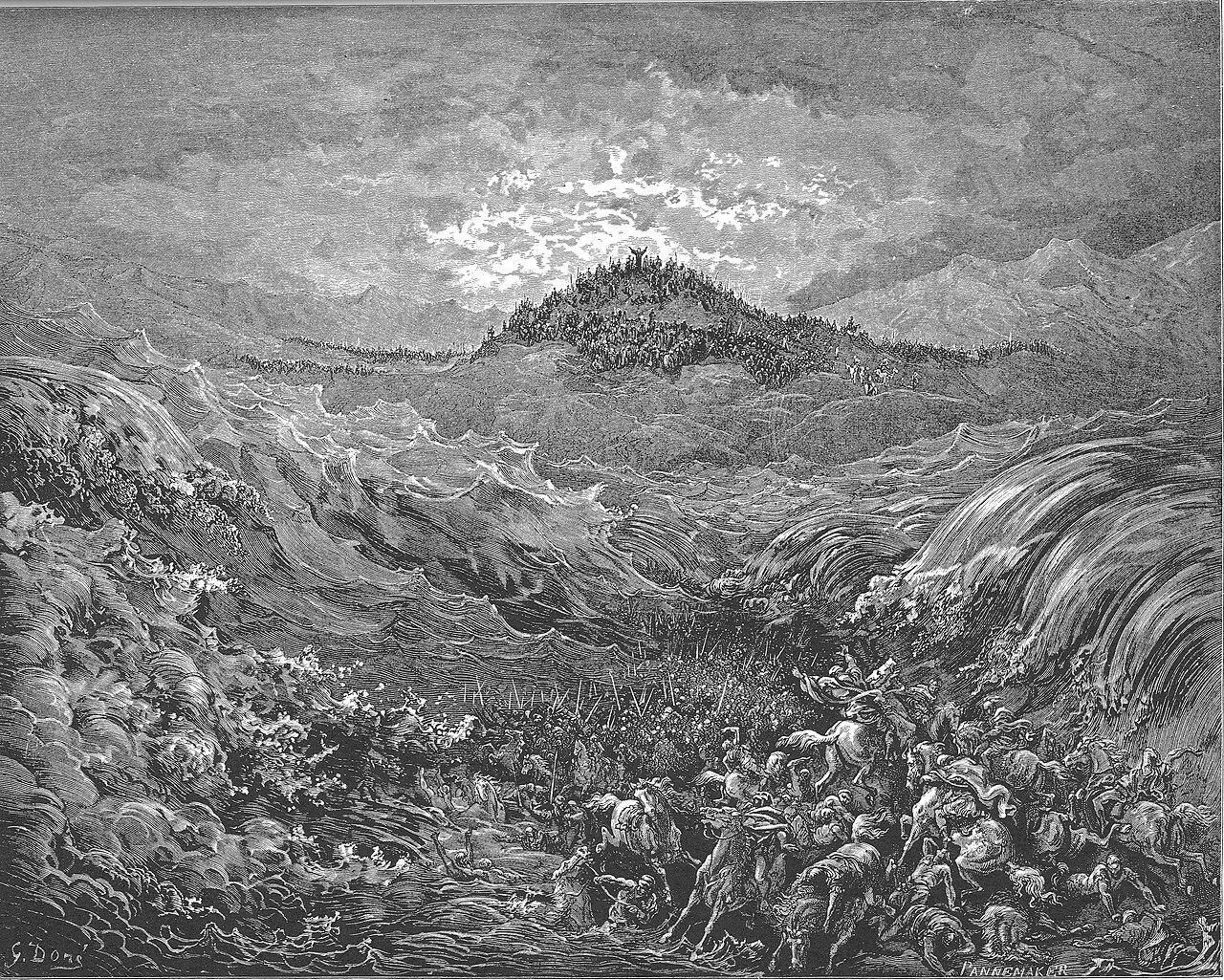
Then Moses stretched out his hand over the sea, and all that night the LORD drove back the sea with a strong east wind that turned it into dry land. So the waters were divided, and the Israelites went through the sea on dry ground, with walls of water on their right and on their left.The sea opened; a nation walked through on dry ground.
Get rid of the old leaven, that you may be a new unleavened batch, as you really are. For Christ, our Passover lamb, has been sacrificed.The apostle names the lamb the first Passover was pointing at.
The account in brief
What happened
The Exodus is the event described in the second book of the Pentateuch (Exodus) in which God, through Moses, delivered the Israelite people from slavery in Egypt. Major narrative moments include the ten plagues (Exodus 7–12), the institution of Passover (Exodus 12), the crossing of the Red Sea (Exodus 14–15), and the forty-year wilderness journey culminating at the edge of the Promised Land.
The Exodus is treated in Scripture as Israel's foundational act of divine deliverance (e.g., Deuteronomy 5:15; Psalm 105:37–38). The historical date of the Exodus is debated: traditional biblical chronology, following 1 Kings 6:1, places it in the mid-15th century BCE (c. 1446 BCE). A "late-date" scholarly view following archaeological arguments about Ramesside Egypt places it in the 13th century BCE under Rameses II.
Some academic scholars have proposed that the Exodus narrative is a collective memory incorporating multiple smaller migrations rather than a single historical event; this view is contested by conservative scholars. The reference works cited survey these positions.
◈The date: about 1446 BC, or the 1200s?contested
MannaFest reads 1 Kings 6:1 as it stands: 480 years from the Exodus to the fourth year of Solomon, which places the departure near 1446 BC, in the Eighteenth Dynasty.
The common alternative dates the Exodus to the reign of Rameses II in the 1200s BC, chiefly because Exodus 1:11 names a store-city Rameses and because destruction layers in Canaan cluster later.
The later date requires reading the 480 years as twelve symbolic generations. The earlier date takes the number as a number, and that is the reading this site follows.