
Psalm 28
9 verses · Lament
The LORD is the strength of His people, a stronghold of salvation for His anointed.
Introduction
David, the Answered Cry, Book 1: The book of David, Poetry, Psalms Overview.
David is named in the heading of this short prayer, and it begins in fear of silence. The man praying would rather face his enemies than a God who gives him no answer, and he says so. He lifts his hands toward the inner room of the sanctuary, which was the posture of prayer in his day. Listen for the one line where everything changes, when the request becomes a report that the prayer has been heard, and for the last verses, where a prayer for one man widens into a prayer for the whole people and their king.
Context
- Who
- Israelites who prayed facing the place where God had put his name
- What
- A lament that becomes thanksgiving once the singer knows his prayer has been heard.
- Where
- A worshipper at the sanctuary with his hands raised toward the most holy place
- When
- The reign of David, about 1010 to 970 BC by the superscription.
- Why
- To carry a person from the fear of God's silence to praise before the rescue is in sight.
Historical context
Lifting the hands toward the holy sanctuary, in verse 2, names a direction and a posture: the innermost room was where the ark stood, and Israelites prayed facing it with raised open hands. The Pit of verse 1 uses the word for a cistern or a shaft. Judean towns cut bottle-shaped cisterns into the limestone to hold the winter rain, and an empty one served as a prison, so a pit was a place a man could not climb out of by himself. Speaking peace to a neighbour while malice sits in the heart, in verse 3, describes the greeting of the marketplace. Men who used shalom while planning harm were poisoning the one currency village life ran on.
Significance
For first hearers this was a prayer about the terror of God's silence, which the psalm treats as worse than the enemies who prompted it. The turn comes in one line at verse 6, where the LORD has heard the cry for mercy, and everything after it is thanksgiving offered before the outcome is in sight.
This chapter in Jewish lifeWhat this chapter is in Jewish life and reading.
How it is read
This chapter and the thirteenth are the two thinnest of the first thirty in the corpus, and the row says so rather than filling the gap. Sefaria holds English text for three comments of Rashi on this psalm and for nothing else. Ibn Ezra comments on every verse, Radak on seven and Metzudat David on five, and every one of those entries carries the ref without the text. They stand here cited and unquoted at Ibn Ezra on Psalms 28:1:1 to 28:9:1, and at Radak on Psalms 28:1:1 to 28:8:1. Metzudat David stands at Metzudat David on Psalms 28:1:1, 28:2:1, 28:4:1, 28:5:1 and 28:6:1.
Rashi is quoted here from the Judaica Press Tanach with Rashi. His note on the third verse turns on one verb. The psalm asks not to be dragged away with the wicked, and Rashi glosses the word as drawing, with an Old French word beside it for the sense (Rashi on Psalms 28:3:1). The request is to be kept out of a company rather than out of a punishment, which is the same concern the twenty-sixth psalm opens with.
The seventh verse is where Rashi says the most. The psalm promises thanks in song, and Rashi asks what the thanks actually is. His answer takes the following words as the content of the song. God is strength "to those who rely on Him, viz. the entire house of Israel", at the hour when he is the stronghold of the salvations of his anointed (Rashi on Psalms 28:7:1). So the thanksgiving of one man is read as a statement about the whole people, and the anointed of the psalm is the king through whom their rescue comes. A Christian reader will hear the word for the anointed in that verse and think of Christ, and the classical reading here keeps it on the king of Israel with the nation standing behind him. Rashi's last note reads the tending of the ninth verse from the word for pasture, so that the psalm ends by asking God to shepherd his people (Rashi on Psalms 28:9:1). What the psalm says about going down to the pit, and what Sheol and the pit mean across the Psalter, is owed a page under docs/lanes/FEATURE-PAGES-OWED.md.
What the rabbis say
The corpus carries twenty-seven locators on this psalm and the text of none, so each is cited and linked here rather than quoted. Four are Talmudic. Three stand in the Jerusalem Talmud, at Berakhot 4:3:15 and 4:4:8 on the sixth verse and Taanit 2:2:14 on the same verse. One more stands at Avot DeRabbi Natan, Recension B 32:23 on the fifth verse.
Midrash Tehillim carries eleven, the largest share. Four stand on the first verse, at 28:1, 28:2, 28:3 and 28:4. Beside them stand 30:1 on the second verse, 121:1 and 17:15 on the fourth, 28:5 on the fifth, 28:6 on the seventh, and 29:1 with 75:1 on the ninth.
The seventh verse, where the heart trusts and is helped, draws the songs of the Exodus. On it the corpus carries Mekhilta DeRabbi Shimon Ben Yochai 15:2 and 15:13, with Mekhilta DeRabbi Yishmael, Shirah 3:2. Beside them stand Midrash Lekach Tov on Exodus 15:2:2, Midrash Tannaim on Deuteronomy 33:29:5, Shir HaShirim Rabbah 1:4:7 and Yalkut Shimoni on Torah 244:3. Two more entries of Mekhilta DeRabbi Yishmael stand later in the chapter, at Shirah 3:1 and 9:10.
The fifth verse carries four: Mekhilta DeRabbi Yishmael, Shirah 6:10, Midrash Sekhel Tov on Exodus 15:7:1, and two entries of Yalkut Shimoni on Torah at 247:1 and 363:1. The rest are single, at Aggadat Bereshit 69:1 on the second verse, Midrash Lekach Tov on Lamentations 3:64:1 on the fourth, and Yalkut Shimoni on Torah 251:6 on the eighth. What each of them teaches is a saying of the rabbis, and is reported as theirs wherever this site quotes one. The quotations wait on a fetch that carries the text.
Sources: Rashi, Rashi on Psalms 28:3:1, 28:7:1 and 28:9:1, the Judaica Press complete Tanach with Rashi, translated by A. J. Rosenberg; Ibn Ezra, Ibn Ezra on Psalms 28:1:1 to 28:9:1, cited by ref because the corpus carries no English text; Radak, Radak on Psalms 28:1:1 to 28:8:1, cited by ref because the corpus carries no English text; Metzudat David, Metzudat David on Psalms 28:1:1, 28:2:1, 28:4:1, 28:5:1 and 28:6:1, cited by ref because the corpus carries no English text; MannaFest, the Sheol and the Pit row of docs/lanes/FEATURE-PAGES-OWED.md; The Sefaria corpus, scripts/data/sources/sefaria/psalms/28.json, the 4 Talmud and 27 Midrash locators of this chapter.
To You, O LORD, I call: David calls on the LORD as his Rock and asks him not to stay silent. If God is silent, David is like those descending to the Pit, already counted among the dead. He lifts his hands toward the holy sanctuary.
Psalms 28:1
“Frequently, in Scripture, the righteous are said to have called out to God. Each one tries to beseech God with a cry, and I may say with an unusual cry. He goes to his bedroom closet, locks the door and calls out to God: "Do not be silent before me." It was written of Moses, Aaron and Joshua the son of Nun. Indeed, they were the worthy ones to whom God spoke. He spoke through the prophets whenever the people stood before God.”
Origen of Alexandria · written before 253 · Selections from the Psalms 28:1patristic
3 more voices on this verseWhat preachers and commentators have said about this verse, in their own words.
Psalms 28:1
“Unto thee will I cry, O Lord, my rock. A cry is the natural expression of sorrow, and is a suitable utterance when all other modes of appeal fail us; but the cry must be alone directed to the Lord, for to cry to man is to waste our entreaties upon the air.”
Charles Spurgeon · The Treasury of David, Vol. 2 (1870)Particular Baptist
Psalms 28:1
“Unto thee, O Jehovah! will I cry. The Psalmist begins by declaring that he would betake himself to the help of God alone, which shows both his faith and his sincerity.”
John Calvin · Commentaries (1554)reformed
Psalms 28:1
“That was a type of Christ, and it is to him that we must lift up our eyes and hands, for through him all good comes from God to us. It was also a figure of heaven ( Heb. ix. 24 ); and from God as our Father in heaven we are taught to expect an answer to our prayers.”
Matthew Henry · Commentary on the Whole Bible (1707-1721)puritan
Psalms 28:2
“Often, we communicate by the lifting of hands, as when Moses' arms were lifted up and Israel was victorious. When his hands were down, the Amalekites won.… Our hands are our deeds of piety. If we store treasures in heaven, we have hands lifted to God and overcome the enemy. When, therefore, I raise my hands to God, I lift my spirit to him through my uplifted hands. Amalek is conquered by me. So, it is needful to lift your hands to God. The temple of God is his glory.”
Origen of Alexandria · written before 253 · Selections from the Psalms 28:2patristic
1 more voice on this verse
Psalms 28:2
“Hear the voice of my prayers when I cry to thee. This repetition is a sign of a heart in anguish. David's ardor and vehemence in prayer are also intimated by the noun signifying voice, and the verb signifying to cry.”
John Calvin · Commentaries (1554)reformed
drag me away with the wicked: The wicked here speak peace and hide malice. David asks God to repay them for their deeds and give back what they have earned. Verse 5 gives the ground, that they disregard what God has done, and He tears them down for good.
Psalms 28:3
“Draw me not away with the wicked. They shall be dragged off to hell like felons of old drawn on a hurdle to Tyburn, like logs drawn to the fire, like fagots to the oven. David fears lest he should be bound up in their bundle, drawn to their doom; and the fear is an appropriate one for every godly man. The best of the wicked are dangerous company in time, and would make terrible companions for eternity; we must avoid them in their pleasures, if we would not be confounded with them in their miseries.”
Charles Spurgeon · The Treasury of David, Vol. 2 (1870)Particular Baptist
Psalms 28:4
"Lord, they think all well that they do, and justify themselves in their wicked practices. Lord, give them after the work of their hands, and so undeceive those about them, who think there is no harm in what they do because it goes unpunished," Ps. xciv. This prayer is a prophecy that God will, sooner or later, render to all impenitent sinners according to their deserts.
Matthew Henry · Commentary on the Whole Bible (1707-1721)puritan
2 more voices on this verse
Psalms 28:4
“When we view the wicked simply as such, and not as our fellow men, our indignation against sin leads us entirely to coincide with the acts of divine justice which punish evil, and to wish that justice might use her power to restrain by her terrors the cruel and unjust; but still the desires of the present verse, as our version renders it, are not readily made consistent with the spirit of the Christian dispensation, which seeks rather the reformation than the punishment of sinners.”
Charles Spurgeon · The Treasury of David, Vol. 2 (1870)Particular Baptist
Psalms 28:4
“Because they do not understand through blessings, they will understand through suffering.”
Jerome · written before 420 · Brief Commentary on Psalm 28patristic
Psalms 28:5
“Because they regard not the works of the Lord, nor the operation of his hands. God works in creation—nature teems with proofs of his wisdom and goodness, yet purblind atheists refuse to see him: he works in providence, ruling and overruling, and his hand is very manifest in human history, yet the infidel will not discern him: he works in grace—remarkable conversions are still met with on all hands, yet the ungodly refuse to see the operations of the Lord. Where angels wonder, carnal men despise. God condescends to teach, and man refuses to learn.”
Charles Spurgeon · The Treasury of David, Vol. 2 (1870)Particular Baptist
1 more voice on this verse
Psalms 28:5
“Disregard of God's judgments brings a righteous punishment. destroy . . . build . . . up--The positive strengthened by the negative form.”
Jamieson, Fausset & Brown · Commentary Critical and Explanatory on the Whole Bible (1871)reformed
Blessed be the LORD: The psalm turns to praise: the LORD has heard the cry for mercy. Shield is a soldier's word, and the strength beside it is what holds him up. His heart trusts, he is helped, and the song follows.
Psalms 28:6
“Blessed be the Lord. Saints are full of benedictions; they are a blessed people, and a blessing people; but they give their best blessings, the fat of their sacrifices, to their glorious Lord. Our Psalm was prayer up to this point, and now it turns to praise.”
Charles Spurgeon · The Treasury of David, Vol. 2 (1870)Particular Baptist
1 more voice on this verse
Psalms 28:6
“Those that pray in faith may rejoice in hope. "He hath heard me (graciously accepted me) and I am as sure of a real answer as if I had it already." 2. What we win by prayer we must wear by praise.”
Matthew Henry · Commentary on the Whole Bible (1707-1721)puritan
Psalms 28:7
“Here is David's declaration and confession of faith, coupled with a testimony from his experience. The Lord is my strength. The Lord employs his power on our behalf, and moreover, infuses strength into us in our weakness. The psalmist, by an act of appropriating faith, takes the omnipotence of Jehovah to be his own. Dependence upon the invisible God gives great independence of spirit, inspiring us with confidence more than human. And my shield. Thus David found both sword and shield in his God.”
Charles Spurgeon · The Treasury of David, Vol. 2 (1870)Particular Baptist
the strength of His people: The psalm widens from David to the nation. His anointed is the king himself, mashiach in Hebrew, the word that later carries the title Messiah. The closing prayer asks four things, save, bless, shepherd and carry them forever.
Psalms 28:8
“The Lord is their strength. The heavenly experience of one believer is a pattern of the life of all. To all the militant church, without exception, Jehovah is the same as he was to his servant David, "the least of them shall be as David." They need the same aid and they shall have it, for they are loved with the same love, written in the same book of life, and one with the same anointed Head. And he is the saving strength of his anointed.”
Charles Spurgeon · The Treasury of David, Vol. 2 (1870)Particular Baptist
2 more voices on this verse
Psalms 28:8
“Whoever is baptized in Christ is his anointed.”
Jerome · written before 420 · Brief Commentary on Psalm 28patristic
Psalms 28:8
“God, in strengthening him that was their king and fought their battles, strengthened the whole kingdom. He calls himself God's anointed because it was the unction he had received that exposed him to the envy of his enemies, and therefore entitled him to the divine protection. Of Christ, his anointed, his Messiah, in the anti-type.”
Matthew Henry · Commentary on the Whole Bible (1707-1721)puritan
Psalms 28:9
“This is a prayer for the church militant, written in short words, but full of weighty meaning. We must pray for the whole church, and not for ourselves alone. Save thy people. Deliver them from their enemies, preserve them from their sins, succour them under their troubles, rescue them from their temptations, and ward off from them every ill. There is a plea hidden in the expression, "thy people:" for it may be safely concluded that God's interest in the church, as his own portion, will lead him to guard it from destruction. Bless thine inheritance.”
Charles Spurgeon · The Treasury of David, Vol. 2 (1870)Particular Baptist
1 more voice on this verse
Psalms 28:9
"Lift them up into thy glorious kingdom, lift them up as high as heaven." There, and there only, will the saints be lifted up for ever, never more to sink or be depressed. Observe, Those, and those only, whom God feeds and rules, who are willing to be taught, and guided, and governed, by him, shall be saved, and blessed, and lifted up for ever.
Matthew Henry · Commentary on the Whole Bible (1707-1721)puritan
How this psalm is built
The form: A prayer for hearing that becomes thanksgiving before the deliverance appears, as Henry classes it.
The patterns in this chapter
| Device | What it does | Where to see it |
|---|---|---|
| The prayer spoken to God, then about God, then to God again | Verses 1 to 4 speak straight to the LORD and ask Him to hear and to repay. Verse 6 turns and speaks about Him to anyone listening, and verses 7 and 8 keep that direction. Verse 9 turns back and asks Him again for the people. Spurgeon marks the join at verse 6 in one sentence: the psalm was prayer up to that point and now it turns to praise.Charles Spurgeon, The Treasury of David, Vol. 2, 1870, on Psalm 28:6. | Psalm 28:1, Psalm 28:6, Psalm 28:9 |
| The cry for mercy asked and then granted | Verse 2 asks God to hear the cry for mercy, and verse 6 blesses Him in the same words for having heard that cry for mercy. The request and the answer use one phrase, so the middle of the psalm stands inside it. John Calvin reads the doubling at the start as the sign of a heart in anguish, and Matthew Henry reads the answer at verse 6 as faith counting the mercy as good as received.Matthew Henry, Commentary on the Whole Bible, 1710, on Psalm 28:6. | Psalm 28:2, Psalm 28:6 |
| The repayment asked four times over | Verse 4 asks the same thing in four clauses: according to their deeds, for their works of evil, for what their hands have done, and what they deserve. Jamieson, Fausset and Brown hold that the piling up of terms is what gives the verse its force, and that the imprecation is justified by the reason verse 5 gives. Albert Barnes reads the whole verse as a prayer that justice be done and finds no malice in it.Jamieson, Fausset and Brown, Commentary Critical and Explanatory on the Whole Bible, 1871, on Psalm 28:4. | Psalm 28:4, Psalm 28:5 |
| Three sets of hands | The word hands carries the psalm's argument three times over. The suppliant lifts his hands toward the sanctuary at verse 2, the wicked are repaid for what their hands have done at verse 4, and verse 5 says they showed no regard for what the hands of the LORD have done. Origen reads the lifted hands of verse 2 as deeds of piety rather than a posture, and Spurgeon reads the works of God's hands at verse 5 as creation, providence and grace, all of them refused by men who will not look.Charles Spurgeon, The Treasury of David, Vol. 2, 1870, on Psalm 28:5. | Psalm 28:2, Psalm 28:4, Psalm 28:5 |
The structure
The psalm turns on a repeated phrase and a repeated word. The cry for mercy asked at verse 2 is the cry God has heard at verse 6, so the middle of the psalm stands inside one request granted. The word hands carries the argument three times: lifted toward the sanctuary at verse 2, repaid for their work at verse 4, and God's own at verse 5. The fourfold repayment of verse 4 and the change of direction at verses 6 and 9 are set out in the devices above.
4 more paragraphs on the patterns
Psalms of the same words
Albert Barnes sends the reader from the strength and shield of verse 7 to Psalm 18:1 and Psalm 3:3, and from there to Psalm 33:20, Psalm 59:11, Psalm 84:9 and Psalm 89:18, and to Genesis 15:1, where God is first called a shield. He takes the trusting heart of the same verse back to Psalm 13:5 and the song at its close to Psalm 22:25. Matthew Henry reads the prayer of verse 4 alongside Psalm 94, where God is asked to pay the proud what they deserve.
The Pit and the grave
Albert Barnes treats the Pit of verse 1 as the word he explains again at Psalm 30:3, the region of the dead entered through the grave, and compares Isaiah 14:9 and Psalm 6:5. The fear of verse 1 is that God's silence would put the man among those going down there while he still lives. A feature page on Sheol and the Pit in the Psalms is owed and listed in the lane's register of pages owed.
The links the commentators draw to the New Testament
Matthew Henry takes the holy sanctuary of verse 2 as a figure of heaven and names Hebrews 9:24 for it, and reads the two requests of verse 10 as the mercy and the help a believer may bring to the throne of grace in Hebrews 4. Augustine reads the men who speak peace while malice is in their hearts at verse 3 through John 3:2, where teachers call Jesus a teacher come from God, and reads the people of verse 8 through Romans 10:3, as those who know their strength is not their own.
The pattern inside the psalm
The psalm holds opposites one against another. The wicked speak peace and mean harm at verse 3, and the psalmist asks for mercy and means it. They disregard the works of God's hands at verse 5 and are torn down, and the man who lifts his hands toward the sanctuary at verse 2 is heard at verse 6. Adam Clarke reads the tearing down of verse 5 as a prophecy kept in history, and points to Babylon, destroyed by Cyrus and never rebuilt.
Keep studying
Sources for this chapter
The summary
Jamieson, Fausset & Brown, Commentary Critical and Explanatory; John Calvin, Commentaries; John Wesley, Notes on the Old Testament and Matthew Henry, Complete Commentary.
The form and classifications
Charles Spurgeon, The Metropolitan Tabernacle Pulpit, Sermon No. 768, “A Prayer for the Church Militant”, 1867, on Psalm 28:9 and Matthew Henry, Commentary on the Whole Bible, 1710, on Psalm 28:9.
The exposition
Albert Barnes, Notes on the Book of Psalms; Charles Spurgeon, The Treasury of David; Franz Delitzsch, Biblical Commentary on the Psalms; John Gill, Exposition of the Old Testament and Matthew Henry, Commentary on the Whole Bible.
The painting
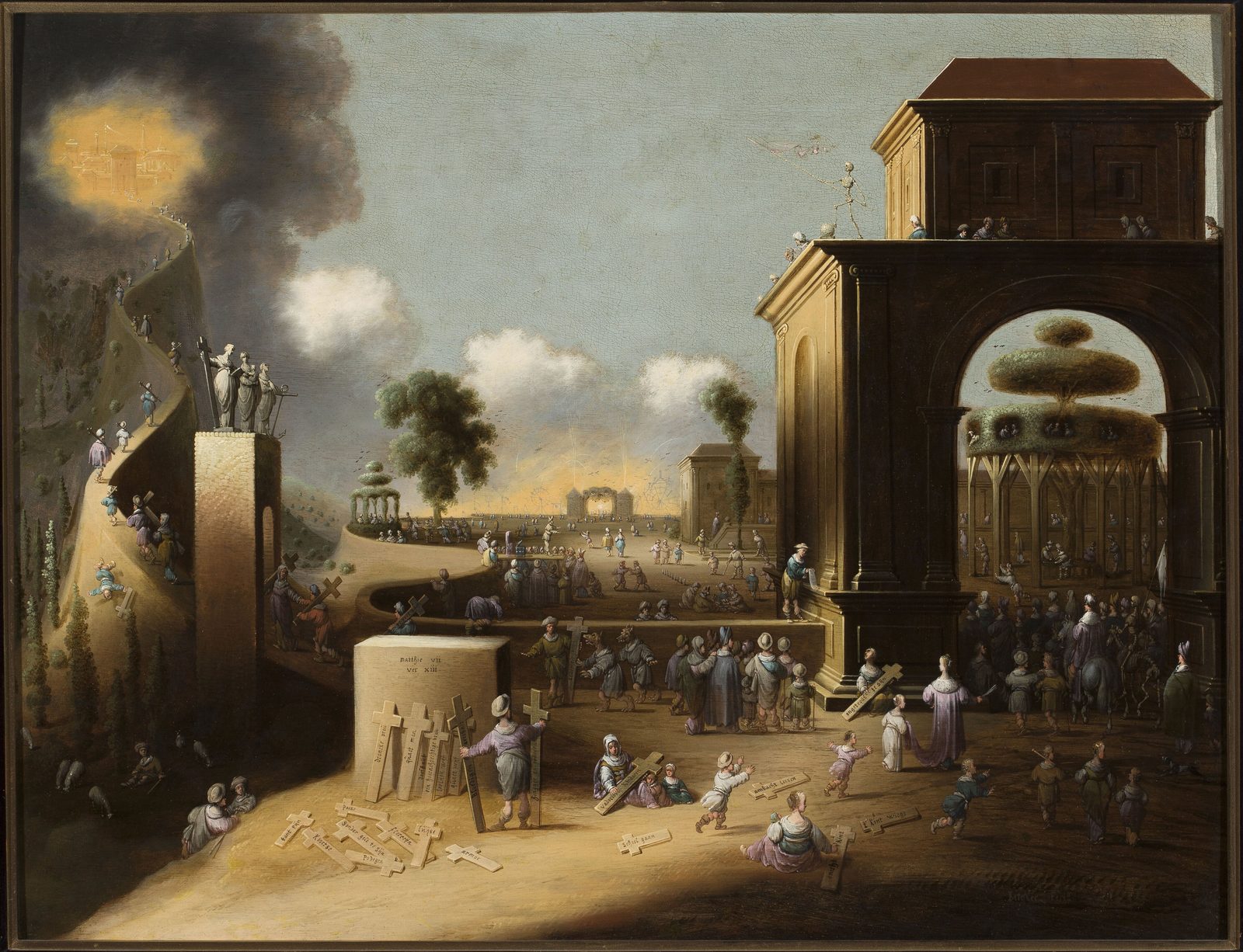
Narrow Road of Virtue and Wide Road of Sin. Jan Micker, not stated on the file page. National Museum in Warsaw. Public domain.