
Psalm 1
6 verses · Wisdom psalm
Blessed is the man who does not walk in the counsel of the wicked, or set foot on the path of sinners, or sit in the seat of mockers.
Introduction
Author unstated, the Two Ways, Book 1: The Davidic Core, Poetry, Psalms Overview.
This psalm stands at the door of the Psalter and asks the reader which of two lives he intends to live. Its writer is not named. He sets a man who keeps company with God's instruction against a man who keeps company with those who despise it, and he lets the two run to their ends without argument. Listen for the pictures drawn from farming country, a rooted tree and threshed husks, and for the single sentence at the close that names who watches each road. Read it as the question the hundred and forty-nine psalms after it answer.
Context
- Who
- Israelites learning on the first page which of two roads a life takes
- What
- A wisdom poem setting two ways of living side by side and naming where each one ends.
- Where
- The farmland and the irrigation channels of Judah, and the seat of judgment in the gateway of a walled town
- When
- The date is unstated, since the psalm carries no superscription, and it was set at the head of the collection when the Psalter was arranged.
- Why
- To put the choice between the two ways in front of a reader before he sings anything else in the book.
Historical context
The psalm names no author, no place and no occasion, and the men who arranged the book set it first, so what it says about the two roads governs everything sung after it. The tree of verse 3 is a planted tree beside channels of water, ditches dug by hand to carry water from a spring out to an orchard. Judah's rain falls in one season, so a tree with its roots in a channel keeps its leaf while the hillside browns. The chaff of verse 4 was beaten out on a flat threshing floor set where the wind could reach it, and it was worth nothing, even as fodder. Israel's judging was done in the open gateway of a town, so the wicked who will not stand in the judgment lose the hearing at the gate.
Significance
An Israelite opening this collection was told before a single prayer began that the songs ahead belong to a road, and that there are two of them. One life is rooted where the water runs and the other is husk waiting for the wind. It also changed what happiness meant. The blessed man is the one whose delight is the instruction of the LORD, which landed hard on people whose year was decided by a harvest.
This chapter in Jewish lifeWhat this chapter is in Jewish life and reading.
How it is read
Rashi opens the whole book at this psalm. He records that it was composed with ten expressions of song, and sets ten men against them. The ten he names are Adam, Malchizedek, Abraham, Moses, David, Solomon, Asaph and the three sons of Korah. He leaves a dispute standing over Jeduthun, whom some read as a man and some as a word for the decrees passed over Israel (Rashi on Psalms 1:1:1, the Judaica Press Tanach with Rashi). On the first verse he reads the three verbs as a descent held back at the top. The praise is "that he did not follow, because since he did not follow, he did not stand, and since he did not stand, he did not sit" (Rashi on Psalms 1:1:2). Ibn Ezra holds that the word for sinners carries the heavier state. That is why the verse gives them a path, "because it is the way he is accustomed to walk" (Ibn Ezra on Psalms 1:1:2, the Sefaria Community Translation).
The second verse turns the psalm into a rule of study for all three commentators. Rashi draws the inference backwards, that "the company of scorners brings one to neglect the study of Torah" (Rashi on Psalms 1:2:1). He then marks what possession of the Torah costs. "In the beginning, it is called the law of the Lord, and after he has toiled to master it, it is called his own Torah" (Rashi on Psalms 1:2:2). Radak will let neither half of the verse stand alone. A man who has left the evil way and done no good "has not performed his work completely" (Radak on Psalms 1:2:1, the Finch translation of 1919, public domain). Radak closes the point by holding that "doing apart from learning is not sufficient". Rashi reads even the unwithering leaf as study, and takes it that "the conversation of Torah scholars is essential and requires study" (Rashi on Psalms 1:3:3).
At the chaff of the fourth verse the two part company by a hair. Ibn Ezra sets the righteous soul beside the grain "which remains standing, while the wicked are like straw before the wind" (Ibn Ezra on Psalms 1:4:1). Radak takes the chaff for the light stubble that "does harm in its movement, for it strikes passers-by in the face and eyes" (Radak on Psalms 1:4:1). Metzudat David comments on the same verse. The corpus carries his ref without an English text, so he stands here cited and unquoted at Metzudat David on Psalms 1:4:1.
The last two verses are where a Christian reader will want to listen closely. The commentators are already speaking about what happens after death. Ibn Ezra takes the judgment of the fifth verse as the Day of Judgment. It comes "for everyone together on a single day, or for each individual at the time of their death" (Ibn Ezra on Psalms 1:5:2). Radak reads the Lord knowing the way of the righteous as an act rather than an awareness. To know here is "to look upon and consider with a view to doing them good", and God gathers the souls of the righteous to himself. Of the wicked Radak says that "at their death they have no raising again" (Radak on Psalms 1:6:1 and 1:6:2). Rashi ends the psalm on the same day, with the foot of the wicked failing to stand at the judgment (Rashi on Psalms 1:6:1). A judgment after death is held in common here by Jewish and Christian teaching. The ground Christian teaching puts under that judgment is the resurrection of Christ and the verdict already given in him, and the classical reading of this psalm carries no word of it. This site reads the psalm's two ways in that light, and reports the commentators in their own.
What the rabbis say
The rabbis treated this psalm at length. The corpus carries forty of their locators for it and the text of none, so each is cited and linked here rather than quoted. The heaviest run stands in one tractate of the Babylonian Talmud, anchored across the first three verses. It runs from Avodah Zarah 18b:5 to Avodah Zarah 19b:8, at fifteen separate places in those four folios. The remaining Talmudic locators sit on the fifth and sixth verses. They are Sanhedrin 107b:19, Jerusalem Talmud Sanhedrin 10:3:1 and Jerusalem Talmud Pesachim 10:1:7. Three more stand in Avot DeRabbi Natan, at 21:1 and 36:1, and at 34:3 of Recension B.
The midrashic locators follow the same verses. On the chaff of the fourth verse the corpus carries Midrash Tehillim 1:18 and 92:6, and Tanna DeBei Eliyahu Rabbah 18:10. Two more sit in Midrash Lekach Tov on Genesis, at 17:13:7 and 22:13:5. On the standing of the fifth verse it carries Midrash Tehillim 1:19, with Ein Yaakov, Sanhedrin 11:110 and 11:111 in the Glick Edition. On the sixth verse it carries Bereshit Rabbah 2:5 and 8:4, and Aggadat Bereshit 37:4. Beside them stand Midrash Aggadah on Genesis 18:20:3 and Midrash Lekach Tov on Genesis 41:40:4. Three further locators stand under this psalm: Pirkei DeRabbi Eliezer 54:1, Yalkut Shimoni on Torah 850:4 and Ein Yaakov, Sanhedrin 6:2 in the Glick Edition. What each of them teaches is a saying of the rabbis, and is reported as theirs wherever this site quotes one. The quotations wait on a fetch that carries the text.
Sources: Rashi, Rashi on Psalms 1:1:1 to 1:6:1, the Judaica Press complete Tanach with Rashi, translated by A. J. Rosenberg; Ibn Ezra, Ibn Ezra on Psalms 1:1:2 to 1:6:1, the Sefaria Community Translation; Radak, Radak on Psalms 1:2:1 to 1:6:2, R. David Kimhi on the first book of Psalms, translated by R. G. Finch, London, 1919; Metzudat David, Metzudat David on Psalms 1:4:1, cited by ref because the corpus carries no English text; The Sefaria corpus, scripts/data/sources/sefaria/psalms/1.json, the 21 Talmud and 19 Midrash locators of this chapter.
Psalms 1:1-2
the counsel of the wicked: Verse 1 moves from the counsel of the wicked to the path of sinners to the seat of mockers. Matthew Henry read the three as a hardening, from the man who lays his religion aside to the scorner. Verse 2 gives him one delight, the Law of the LORD.
Psalms 1:1
Blessed— see how this Book of Psalms opens with a benediction, even as did the famous Sermon of our Lord upon the Mount! The word translated "blessed" is a very expressive one. The original word is plural, and it is a controverted matter whether it is an adjective or a substantive. Hence we may learn the multiplicity of the blessings which shall rest upon the man whom God hath justified, and the perfection and greatness of the blessedness he shall enjoy. We might read it, "Oh, the blessednesses!"
Charles Spurgeon · The Treasury of David, Vol. 1 (1869)Particular Baptist
2 more voices on this verseWhat preachers and commentators have said about this verse, in their own words.
Psalms 1:1
“Scornful - Of those who make a mock of sin, and scoff at goodness and goodmen. Divers observe a gradation in this verse; the following clause still exceeding the former, for standing is more than walking, and sitting more than standing; and sinners in scripture use, are worse than the ungodly, and the scornful are the worst of sinners.”
John Wesley · Explanatory Notes upon the Old Testament (1765)evangelical
Psalms 1:1
“When the services of religion are laid aside, they come to be sinners, that is, they break out into open rebellion against God and engage in the service of sin and Satan. Omissions make way for commissions, and by these the heart is so hardened that at length they come to be scorners, that is, they openly defy all that is sacred, scoff at religion, and make a jest of sin.”
Matthew Henry · Commentary on the Whole Bible (1707-1721)puritan
ConnectionsPsalms 150:6
his delight is in the Law of the LORD: Verse 1 named the three companies this man refuses, and verse 2 names what he loves instead. Adam Clarke took the Hebrew word for delight as the whole desire of the heart turned toward God. The Law now fills his days and nights.
Psalms 1:2
“But his delight is in the law of the Lord - חפצו chephtso, his will, desire, affection, every motive in his heart, and every moving principle in his soul, are on the side of God and his truth. He takes up the law of the Lord as the rule of his life; he brings all his actions and affections to this holy standard. He looketh into the perfect law of liberty; and is not a forgetful hearer, but a doer of the word; and is therefore blessed in his deed.”
Adam Clarke · Commentary on the Bible (1810-1826)evangelical
planted by streams of water: The tree yields fruit in season and a green leaf, and the man prospers in all he does. John Gill read the verse's opening word as then, setting the tree after the meditation of verse 2. Jeremiah 17:8 draws the same tree for one who trusts in God.
Psalms 1:3
“And he shall be like a tree planted—not a wild tree, but "a tree planted, " chosen, considered as property, cultivated and secured from the last terrible uprooting, for "every plant which my heavenly Father hath not planted, shall be rooted up:" Matthew 15:13. "By the rivers of water;" so that even if one river should fail, he hath another. The rivers of pardon and the rivers of grace, the rivers of the promise and the rivers of communion with Christ, are never-failing sources of supply.”
Charles Spurgeon · The Treasury of David, Vol. 1 (1869)Particular Baptist
Psalms 1:4-6
chaff driven off by the wind: Chaff is the husk left on the threshing floor, and the wind carries it off. Matthew Henry read the judgment of verse 5 as the court where the saints sit with Christ over the world, and he cited Jude 14. The LORD guards one path, and the other perishes.
Psalms 1:4
“The ungodly are not so - The Vulgate and Septuagint, and the versions made from them, such as the Ethiopic and Arabic, double the last negation, and add a clause to the end of the verse, “Not so the ungodly, not so; they shall be like the dust which the wind scatters away from the face of the earth.” There is nothing solid in the men; there is nothing good in their ways.”
Adam Clarke · Commentary on the Bible (1810-1826)evangelical
will not stand in the judgment: Therefore ties the verdict to the chaff of verse 4. Albert Barnes took to stand as the posture of a man tried in court and acquitted by the judge. Charles Spurgeon added that every assembly on earth is mixed, so the separation this verse names is still to come.
Psalms 1:5
“Therefore - Because they are thus worthless. The ungodly - See the notes at Psa 1:1. The wicked in general; the wicked of any kind or degree. Shall not stand - Compare the notes at Psa 1:1. The idea is, that they will not be found among those who are acquitted by the Judge, and approved by him. The idea seems to be derived from the act of standing up to be tried, or to receive a sentence. In the judgment - The Aramaic Paraphrase renders this, “in the great day” - understanding it of the day of judgment.”
1 more voice on this verse
Psalms 1:5
“They shall stand there to be judged, but not to be acquitted. Fear shall lay hold upon them there; they shall not stand their ground; they shall flee away; they shall not stand in their own defense; for they shall blush and be covered with eternal contempt. Well may the saints long for heaven, for no evil men shall dwell there, "nor sinners in the congregation of the righteous." All our congregations upon earth are mixed. Every Church hath one devil in it. The tares grow in the same furrows as the wheat.”
Charles Spurgeon · The Treasury of David, Vol. 1 (1869)Particular Baptist
the LORD guards the path of the righteous: The Hebrew verb is yada, to know, which the King James renders knoweth and the Berean renders guards. Charles Spurgeon read it as a watching that goes on without a break, through mist and storm. The psalm ends where it began, on two ways.
Psalms 1:6
Or, as the Hebrew hath it yet more fully, "The Lord is knowing the way of the righteous." He is constantly looking on their way, and though it may be often in mist and darkness, yet the Lord knoweth it. If it be in the clouds and tempest of affliction, he understandeth it. He numbereth the hairs of our head; he will not suffer any evil to befall us. "He knoweth the way that I take: when He hath tried me, I shall come forth as gold." (Job 23:10.) "But the way of the ungodly shall perish."
Charles Spurgeon · The Treasury of David, Vol. 1 (1869)Particular Baptist
1 more voice on this verse
Psalms 1:6
“The Lord knoweth - יודע yodea approveth the way, “aloweth the way”, Coverdale, of the righteous, צדיקים tsaddikim, from צדק tsadak, to give even weight; the men who give to all their due; opposed to רשעים reshaim, Psa 1:1, they who withhold right from all; see above. Such holy men are under the continual eye of God’s providence; he knows the way that they take; approves of their motives, purposes, and works, because they are all wrought through himself. He provides for them in all exigencies, and defends them both in body and soul.”
Adam Clarke · Commentary on the Bible (1810-1826)evangelical
How this psalm is built
The form: A psalm with no title of its own, standing as a kind of title for the whole work, as Aquinas classes it.
The patterns in this chapter
| Device | What it does | Where to see it |
|---|---|---|
| The three steps away | Verse 1 names three moves and three companies, walking in the counsel of the wicked, setting foot on the path of sinners, sitting in the seat of mockers. John Wesley records the gradation others had marked before him, that standing is more than walking and sitting more than standing. Matthew Henry reads the same three as a hardening, from the man who lays his religion aside to the sinner to the scorner.John Wesley, Explanatory Notes upon the Old Testament, 1765, on Psalm 1:1. | Psalm 1:1 |
| The tree, then the chaff | The psalm turns at verse 4 on the words Not so the wicked, and every line after it answers a line before it. The tree stands where the water runs and the chaff has nothing under it at all. Adam Clarke records that the Septuagint and the Vulgate say the denial twice over, not so the ungodly, not so.Adam Clarke, Commentary on the Bible, 1832, on Psalm 1:4. | Psalm 1:3, Psalm 1:4 |
| Three things the planted tree does | Verse 3 lists the results one after another, fruit in its season, a leaf that does not wither, and a man who prospers in all he does. John Gill reads the Hebrew word that opens the verse as then, which sets the tree after the meditation of verse 2 rather than beside it.John Gill, Exposition of the Old Testament, 1748 to 1763, on Psalm 1:3. | Psalm 1:3 |
| The way named at both ends | The psalm opens on the counsel of the wicked and the path of sinners and closes on the path of the righteous and the way of the wicked, so it ends on the same two roads it began with. Charles Spurgeon reads verse 6 as a present watching, since the Hebrew says that the LORD is knowing the way of the righteous.Charles Spurgeon, The Treasury of David, Vol. 1, 1869, on Psalm 1:6. | Psalm 1:1, Psalm 1:6 |
Where the picture comes from
9 more paragraphs on the patterns
The tree of verse 3 is drawn again in Jeremiah 17:8, where the man who trusts in the LORD is a tree planted by the waters whose leaf stays green. The two passages share the water, the leaf and the fruit, and Jeremiah adds the drought, so a student who reads them together gets the same picture twice from two directions.
Where it sits in the Psalter
Psalm 1 and Psalm 2 stand together at the head of the book. Both carry no superscription, the blessing of Psalm 1:1 returns as the last line of Psalm 2:12 on all who take refuge in Him, and the two open the Psalter with the same word. The first psalm sets the two ways for a man and the second sets them for the nations and their kings.
The judgment it states
The judgment of verse 5 is the psalm's other link. Matthew Henry reads the assembly of the righteous as the court in which the saints sit with Christ over the world, and cites Jude 14 for the Lord coming with His holy myriads. The psalm states the verdict and leaves the scene to other pages.
The debated concept: the two ways and the blessed man
The psalm sets two roads and two ends beside each other, and the readers of it differ over whom the first road belongs to. Eusebius of Caesarea holds that the first psalm must refer to Christ, who is the first of those rightly called blessed and the husband of His bride the church, and he rests that reading on the article the Hebrew puts on the word for man (Commentary on the Psalms 1.1, 339). Hilary of Poitiers holds that these words are inapplicable to the divinity of the Only-begotten, so the happy man is the one who conforms himself by zeal for justice to the body the Lord assumed, which keeps Christ and the believer in one reading (Homily on Psalm 1, 367). Matthew Henry reads the two ways of any man and traces a descent through verse 1, where omissions make way for commissions until the heart is hardened into scorn (Commentary on the Whole Bible, 1710). Origen of Alexandria divides the wicked of verse 1 into three types, the man who walks, the man who stands and the man who sits, and reads them as three stages of one hardening (Selections from the Psalms 1.1, 253). Basil of Caesarea guards the reach of the blessing, since the virtue of man and woman is the same and creation is equally honoured in both, so the reward is the same for both (Homilies on the Psalms 10.3, 379).
Where the New Testament touches it
The links here are drawn by figure and by echo rather than by a quotation of the psalm. Charles Spurgeon reads the planted tree of verse 3 against Matthew 15:13, where every plant the heavenly Father has not planted is rooted up, and holds that the tree of the psalm is chosen, cultivated and secured (The Treasury of David, Vol. 1, 1869). Clement of Alexandria applies the seat of verse 1 to the theatres and tribunals of his own city, which is how the early church used the line in practice (The Stromata, Book 2, 215).
The three Torah psalms
Three psalms make the law of the LORD their subject rather than their background, and the form critics group them together as one kind. Psalms that teach rather than petition: the two ways, the law as delight, the prosperity of the wicked, and the shortness of a life. Psalms 127 and 128 teach in the same way and stand under the ascents.
- Psalm 16 verses, this chapterThe two ways, and the tree planted by streams of water.
- Psalm 1914 versesThe heavens tell of God, and the law of the LORD is perfect.
- Psalm 119176 versesOne hundred and seventy-six verses on the word of God.
The grouping is the form criticism of Hermann Gunkel, Einleitung in die Psalmen, 1933, as C. Hassell Bullock sets it out in Encountering the Book of Psalms, 2001. Frank-Lothar Hossfeld writes that Psalm 119 is deemed to be the Torah psalm per se.
Keep studying
Sources for this chapter
The summary
Jamieson, Fausset & Brown, Commentary Critical and Explanatory; John Calvin, Commentaries; John Wesley, Notes on the Old Testament and Matthew Henry, Complete Commentary.
The form and classifications
Basil of Caesarea, Homilies on the Psalms 10.3, on Psalm 1, 379; Charles Spurgeon, The Treasury of David, Vol. 1, 1869, on Psalm 1:1 and Thomas Aquinas, Exposition on the Psalms of David, 1274, on Psalm 1:1.
The exposition
Adam Clarke, Commentary on the Bible; Albert Barnes; Charles Spurgeon, The Treasury of David; John Gill, Exposition of the Old Testament and Matthew Henry, Commentary on the Whole Bible.
The painting
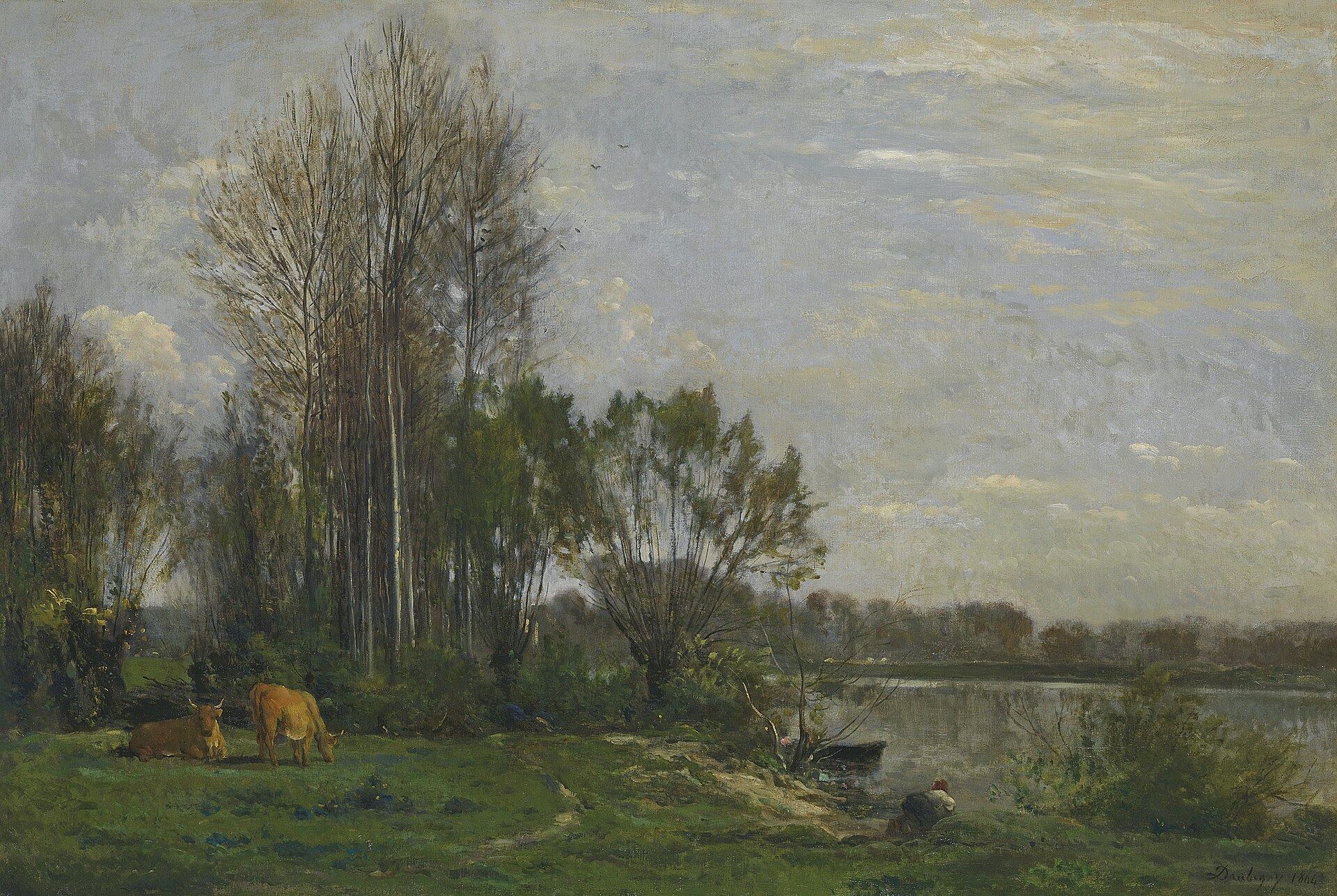
The Banks of the Oise. Charles-François Daubigny, 1864. Wikimedia Commons. Public domain.