
Psalm 134
3 verses · Song of Ascents
Come, bless the LORD, all you servants of the LORD who serve by night in the house of the LORD!
Introduction
Author unstated, the Blessing by Night, Book 5: The return and the great Hallelujah, Poetry, Psalms Overview.
This is the last of the fifteen pilgrim songs, and its heading names no writer. It was sung at night in the temple courts as the feast ended and the families prepared to walk home. It is addressed to the priests and Levites who kept watch in the sanctuary after dark. Listen for the two voices in it, the departing pilgrims calling on the night staff to praise God, and the blessing that comes back over the pilgrims as they go. It closes the whole road of the Songs of Ascents in three verses.
Context
- Who
- Israelites going home from the feast, and the Levites who stayed behind
- Where
- The temple courts after dark, with the night staff on duty and the pilgrims leaving
- When
- The Songs of Ascents, the last song, sung at night. The superscription names no writer. It is the closing psalm of the pilgrim collection and fits any period in which the temple was staffed through the night
Historical context
No name stands in the heading. Three verses close the collection that began with a man stranded in a foreign country, and the road ends in the house of the LORD at night. The people addressed are the night shift. The sanctuary was guarded around the clock, and Jewish records describe priests keeping watch at three posts and Levites at twenty one more, with a captain making rounds and waking anyone found asleep. Lifting the hands toward the sanctuary was the ordinary posture of prayer and blessing. The blessing runs both ways in the psalm, which is what makes it a farewell: the departing pilgrims call on the servants who stay on duty, and the answer comes back over them as they go.
Significance
The fifteen Songs of Ascents are a road in themselves, far away, on the way, at the gates, in the city, and finally in the courts, and this is the last step. For families packing up to walk home for another year, the point was that worship continued after they left. Somebody stood in that house all night, and the blessing they carried out of it came from the God who made everything.
This chapter in Jewish lifeWhat this chapter is in Jewish life and reading.
What is done
Psalm 134 is the fifteenth and last of the Songs of Ascents, the collection whose setting this site records at /featured/psalms-of-ascent from Mishnah Middot 2:5 and Mishnah Sukkah 5:4. Its three verses are addressed to the servants of the LORD who stand in His house through the night, and Radak reports that the commentators before him took the last verse as the words the priests said back to Israel in their blessing. His own reading makes the whole psalm an exchange: "if you bless Him, He will bless you" (Radak on Psalms 134:3:1, translated by Rabbi Mike Feuer, Jerusalem Anthology, CC-BY). The corpus ties the first verse to the Talmud at Pesachim 117a:22 and Pesachim 118a:2, which is where the Hallel is treated.
How it is read
Malbim takes this short psalm to carry a foundation of faith, that what is done below fills the source above. Through the good deeds and prayers of Israel "the supernal pool is filled", and when their deeds are evil the streams dry up, and he cites the saying of the Sages that Israel adds strength to the power above (Malbim on Psalms 134:1:1, Feuer translation, CC-BY). On the third verse he explains what blessing the LORD means on that reading: Israel fills Him with blessing so that He can pour it out on them, and the blessing comes from Zion rather than from the order of the heavens. A Christian reader meets a real difference here, because this reading makes the blessing of God by men a cause of what God then gives, and this site holds that God gives freely and is blessed in return. Radak reads the closing line about the Maker of heaven and earth as an argument from what God made: the One who made the heavens that bring blessing and the earth that yields its produce is blessed as He commands. Ibn Ezra and Metzudat David comment on all three verses and stand as citations, at Ibn Ezra on Psalms 134:1:1 and Metzudat David on Psalms 134:1:1.
What the rabbis say
The corpus records twenty-nine locators on this chapter, twenty Midrash and nine Talmud. The servants standing by night are taken up at Midrash Tehillim 134:1, Bamidbar Rabbah 11:4, Menachot 110a:8, Sotah 39b:11, Pesachim 117a:22, Pesachim 118a:2 and Jerusalem Talmud Berakhot 1:1:19. The lifting of hands toward the sanctuary is taken up at Midrash Aggadah, Leviticus 1:5:1, Berakhot 51a:21 and Sotah 39a:3. The blessing from Zion is taken up at Vayikra Rabbah 24:4, Pesikta Rabbati 5:1, Midrash Tehillim 14:7, Midrash Tanchuma, Lech Lecha 15:3 and Sotah 39b:12. Each of these is a locator without text in the corpus.
Sources: Malbim, Malbim on Psalms 134:1:1 and 134:3:1, translated by Rabbi Mike Feuer, Jerusalem Anthology, CC-BY; Radak, Radak on Psalms 134:3:1 and 134:3:2, Feuer translation, Jerusalem Anthology, CC-BY; Ibn Ezra, Ibn Ezra on Psalms 134:1:1, cited only, no English version in the corpus; Metzudat David, Metzudat David on Psalms 134:1:1, cited only; Babylonian Talmud, Pesachim 117a:22 and 118a:2, Menachot 110a:8, Sotah 39a:3, 39b:11 and 39b:12, Berakhot 51a:21; Jerusalem Talmud, Berakhot 1:1:19 and 1:1:30; Midrash, Midrash Tehillim 134:1 and 14:7, Bamidbar Rabbah 11:4, Midrash Aggadah, Leviticus 1:5:1, Vayikra Rabbah 24:4, Pesikta Rabbati 5:1, Midrash Tanchuma, Lech Lecha 15:3; Mishnah, Middot 2:5 and Sukkah 5:4, as /featured/psalms-of-ascent records them; MannaFest, the Songs of Ascents, at /featured/psalms-of-ascent, 2026.
Psalms 134:1-2
Come, bless the LORD: The call goes to the servants of the LORD who are on duty in His house at night. The Hebrew word behind serve is stand. Spurgeon put their main business as blessing the LORD, hands lifted to the sanctuary.
Psalms 134:1
“Behold now, bless the Lord, all you servants of the Lord. This is the last psalm of the Song of Ascents. The first of the gradual psalms had been: 'To the Lord, when I was in tribulation, I cried, and he heard me.' In the second he had climbed higher: 'I lifted up my eyes to the mountains.' In the third: 'I rejoiced in the things that were said to me.' In the fourth: 'To you I have lifted up my eyes, you who dwell in heaven.'”
Jerome · written before 420 · Homily 46, on Psalm 133patristic
1 more voice on this verseWhat preachers and commentators have said about this verse, in their own words.
Psalms 134:1
“Servant - Peculiarly so called, priests and Levites. Night - Not only by day, but also by night, when their watch was more necessary. Stand - Serve or minister.”
John Wesley · Explanatory Notes upon the Old Testament (1765)evangelical
Lift up your hands to the sanctuary: The Hebrew for sanctuary is qodesh, holiness, and it can be read as the holy place or as in holiness. Psalm 28:2 lifts the hands toward the inner sanctuary in prayer. The singers of 1 Chronicles 9:33 were on duty in the house day and night.
Psalms 134:2
“Lift up your hands in the sanctuary. In the holy place they must be busy, full of strength, wide awake, energetic, and moved with holy ardour. Hands, heart, and every other part of their manhood must be upraised, elevated, and consecrated to the adoring service of the Lord. As the angels praise God day without night, so must the angels of the churches be instant in season and out of season. And bless the Lord. This is their main business. They are to bless men by their teaching, but they must yet more bless Jehovah with their worship.”
Charles Spurgeon · The Treasury of David, Vol. 7 (1885)Particular Baptist
1 more voice on this verse
Psalms 134:2
“In the nights lift up your hands unto the holy place. 'This world is set in the power of the evil one,' and 'our struggle is not against flesh and blood, but against the rulers of these darknesses.' Whence the apostle also says: 'The night is past, and the day is at hand.' Therefore this present age is the night: but the age to come is the day. Whence the apostle says: 'The night is past, and the day is at hand. Let us walk honestly, as in the day,' he says.”
Jerome · written before 420 · Homily 46, on Psalm 133patristic
the Maker of heaven and earth: The verb bless stands three times, twice of men blessing the LORD and once of the LORD blessing them. The blessing comes from Zion and it comes from the Maker of heaven and earth. Psalm 115:15 carries the same blessing under the same title.
Psalms 134:3
“This last verse is the answer from the temple to the pilgrims preparing to depart as the day breaks. It is the ancient blessing of the high priest condensed, and poured forth upon each individual pilgrim. The Lord that made heaven and earth bless thee out of Zion. Ye are scattering and going to your homes one by one; may the benediction come upon you one by one. You have been up to Jehovah's city and temple at his bidding; return each one with such a benediction as only he can give—divine, infinite, effectual, eternal.”
Charles Spurgeon · The Treasury of David, Vol. 7 (1885)Particular Baptist
2 more voices on this verse
Psalms 134:3
“That blessings out of Zion, spiritual blessings, the blessings of the covenant, and of communion with God, are the best blessings, which we should be most earnest for. It is a great encouragement to us, when we come to God for a blessing, that it is he who made heaven and earth, and therefore has all the blessings of both at his disposal, the upper and nether springs.”
Matthew Henry · Commentary on the Whole Bible (1707-1721)puritan
Psalms 134:3
“Jehovah bless thee out of Zion! We have conclusive proof in my opinion from this verse that the Psalm is to be considered as referring to the priests and Levites only, for to them it properly belonged under the law to bless the people.”
John Calvin · Commentaries (1554)reformed
How this psalm is built
The form: A song of the ascents, the last of the fifteen, in which the pilgrims and the night watch answer one another, as Spurgeon classes it.
The patterns in this chapter
| Device | What it does | Where to see it |
|---|---|---|
| Bless, three times in three verses | The verb bless stands three times. Twice it is men blessing the LORD, at verses 1 and 2, and once it is the LORD blessing them, at verse 3. The psalm turns the same word round on its last line.Franz Delitzsch, Biblical Commentary on the Psalms, on Psalm 134:3. | Psalm 134:1, Psalm 134:2, Psalm 134:3 |
| Two voices at the gate | Verses 1 and 2 are spoken to the servants of the LORD in the second person plural, a crowd addressing the night watch. Verse 3 is spoken in the second person singular back to one traveller. The psalm is a call and an answer, and the change of number is where the speaker changes.Charles Spurgeon, The Treasury of David, Vol. 7, 1885, on Psalm 134:3. | Psalm 134:1, Psalm 134:3 |
| The servants who stand | The Hebrew word behind serve in verse 1 is stand. The men are on duty through the night in the house of the LORD, and Charles Spurgeon put their main business as blessing Him rather than guarding the doors.Charles Spurgeon, The Treasury of David, Vol. 7, 1885, on Psalm 134:1. | Psalm 134:1 |
The structure
9 more paragraphs on the patterns
Three verses and two voices. Verses 1 and 2 address the night watch in the plural, and verse 3 answers one traveller in the singular. The verb bless holds all three verses together, twice upward and once downward.
Across the canon
The blessing of verse 3 stands at Psalm 115:15 under the same title of God, the LORD who made heaven and earth. That title also opens the collection's confession at Psalm 121:2 and closes the escape song at Psalm 124:8, so one name of God stands at the road, the rescue and the farewell.
The blessing from Zion at verse 3 is the blessing of Psalm 128:5, where the man who fears the LORD is blessed from Zion and sees the prosperity of Jerusalem. Psalm 133:3 also puts the blessing of life forevermore at Zion, so the last three psalms of the collection send the reader home from the same place.
The lifted hands of verse 2 answer the lifted eyes of Psalms 121:1, 123:1 and 131:1. The collection raises the eyes three times and the hands once, and the hands are raised at the end.
In the New Testament
No New Testament writer quotes this psalm. The title of God in verse 3 is on the lips of the church at Acts 4:24. There the believers pray to the Sovereign Lord who made the heaven and the earth and the sea and everything in them.
What is debated
Who speaks verse 3 is not settled. Charles Spurgeon reads the pilgrims calling to the watch in verses 1 and 2 and the watch answering in verse 3, which the change from plural to singular supports. Others take the whole psalm as one voice, the pilgrims calling and then pronouncing the blessing on each other as they leave. Nothing in the text decides it, and the psalm reads as an exchange either way.
Keep studying
Sources for this chapter
The summary
Jamieson, Fausset & Brown, Commentary Critical and Explanatory; John Calvin, Commentaries; John Wesley, Notes on the Old Testament and Matthew Henry, Complete Commentary.
The form and classifications
Charles Spurgeon, The Treasury of David, Vol. 7, 1885, on Psalm 134:1; John Gill, Exposition of the Old Testament (1748 to 1763), on Psalm 134:3 and Matthew Henry, Commentary on the Whole Bible, 1710, on Psalm 134:1.
The exposition
Albert Barnes, Notes on the Book of Psalms; Charles Spurgeon, The Treasury of David; Franz Delitzsch, Biblical Commentary on the Psalms; John Gill, Exposition of the Old Testament and Matthew Henry, Commentary on the Whole Bible.
The painting
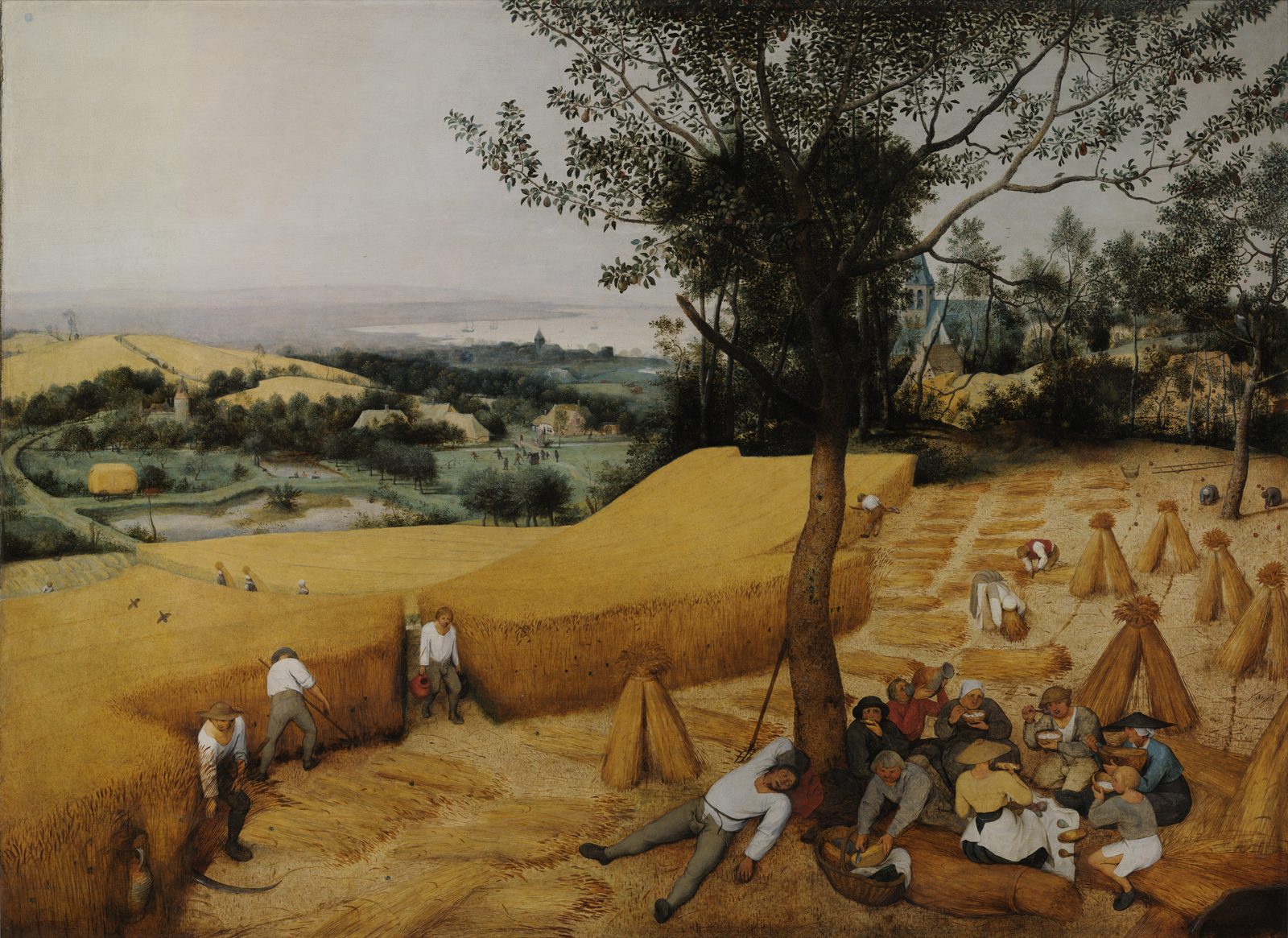
The Harvesters. Pieter Brueghel the Elder, 1565. Wikimedia Commons. Public domain.