
Psalm 11
7 verses · Psalm of trust
The LORD is in His holy temple; the LORD is on His heavenly throne. His eyes are watching closely; they examine the sons of men.
Introduction
David, the Refuge, Book 1: The book of David, Poetry, Psalms Overview.
David wrote this psalm while people close to him were urging him to run. It answers the advice of friends, and it gives its answer before it repeats the advice. He sets what the frightened can see, a society whose supports have given way, beside what they cannot see, the LORD enthroned in heaven and weighing every man. Listen for the two places the psalm stands in, the exposed hillside and the throne above it. Listen too for the word test, since the LORD examines the righteous as closely as the wicked. It is a short psalm of trust, and it ends on the hope of standing in His presence.
Context
- Who
- Israelites who had been told, sensibly, to run
- What
- A psalm of trust in which David refuses his friends' advice to run and answers it with the LORD on His throne.
- Where
- Judah, with the caves of the hill country as the refuge his advisers urged on him.
- When
- The reign of David, most likely the years he fled from Saul, about 1015 to 1010 BC, a date the superscription leaves unstated.
- Why
- To hold a believer steady when the order around him is collapsing and escape looks like the only sense.
Historical context
The advice to flee like a bird to the mountain was practical counsel. The hill country of Judah is cut with steep wadis and honeycombed with caves, it was the standard refuge for anyone the authorities wanted, and David lived in those caves for years. The threat the advisers describe is night archery, a bow drawn in shadow and aimed at a man in silhouette, which was assassination with nobody left to accuse. The foundations of verse 3 are building language used of civil order, so the complaint is that the structure of justice itself has gone. The answer of verses 4 and 5 sets a different building against it, the LORD in His holy temple with His throne in heaven, and the work He does there is testing, a verb that belongs to the assayer, who heats ore to see what is in it.
Significance
This is a psalm about refusing a reasonable escape, and its first line answers everything the advisers say, since the man who takes refuge in the LORD asks how they can speak to him that way. The closing picture carried a hard edge for Israelites who remembered Sodom, fire and sulphur and a scorching wind as the portion of the violent, with the upright left to see God's face.
This chapter in Jewish lifeWhat this chapter is in Jewish life and reading.
How it is read
Rashi is the only commentator the corpus carries with an English text on this chapter, and he sets it in the days when David was driven out. He is quoted here from the Judaica Press Tanach with Rashi. He reads the advice of the first verse against the complaint David made to Saul, that his enemies had driven him from the heritage of the Lord. The taunt in the psalm is the same push. "Pass over your mountain, you wandering bird" (Rashi on Psalms 11:1:1). Rashi adds that every wandering person is compared to a bird driven from its nest, and he proves it from Proverbs. He then notes that the masoretic spelling of the verb is plural, and that the verse is also expounded of Israel, with the nations speaking the taunt.
The wicked of the second verse Rashi names as Doeg and the informers of that generation, who set hatred between David and Saul (Rashi on Psalms 11:2:1). He explains the psalm's word for bending a bow from the work itself, since a stout bow has to be trodden with the foot (Rashi on Psalms 11:2:2). At the third verse he takes the destroyed foundations as the priests killed at Nob, "the righteous priests of the Lord, who are the foundation of the world" (Rashi on Psalms 11:3:1). David's question in the same verse he reads as a plea of innocence, with the guilt laid on Doeg (Rashi on Psalms 11:3:2). Ibn Ezra, Radak and Metzudat David all comment on this chapter, and the corpus carries their refs without English text. They stand here cited and unquoted at Ibn Ezra on Psalms 11:1:1, 11:3:1, 11:4:1 and 11:6:1, at Radak on Psalms 11:1:1, 11:3:1, 11:4:1 and 11:5:1, and at Metzudat David on Psalms 11:1:1.
The fifth verse carries the insight this chapter is worth reading for. The psalm says that the Lord tries the righteous, and Rashi answers the obvious objection head on. If the wicked boast that God has forsaken the sufferer, the answer is that God's custom is "to chasten and to test the righteous but not the wicked". Then he gives the reason in a picture from the workshop. A flax worker, "as long as he knows that his flax is of high quality, he beats it". When the flax is poor "he crushes it only a little because it breaks" (Rashi on Psalms 11:5:1). The beating is a mark of worth rather than of anger. Rashi adds that the wicked are spared the rod now because their recompense is laid away for the long world and paid in Gehinnom (Rashi on Psalms 11:5:2). A Christian reader will recognise the argument, which the letter to the Hebrews makes in its own way at Hebrews 12:6 to 11, and the two traditions are close together at this verse.
At the seventh verse Rashi reports a reading of the Sages that moves the whole psalm to another century. They took the wicked who tread the bow as Shebna and his company, and the upright of heart as Hezekiah and his company. Rashi names the three places the reading stands, and the corpus carries one of them among this chapter's locators at Sanhedrin 26b:3 (Rashi on Psalms 11:7:2). He then declines the reading in one sentence, because "the sequence of verses does not concur with the Midrash" (Rashi on Psalms 11:7:3). That is how a classical commentator handles a saying he respects and will not follow, and it is worth watching.
What the rabbis say
The corpus carries forty locators on this psalm and the text of none, so each is cited and linked here rather than quoted. Four are Talmudic. They stand at Sanhedrin 26b:3 on the third verse, with Jerusalem Talmud Pesachim 4:1:7 and Jerusalem Talmud Taanit 1:6:3 on the same verse, and Jerusalem Talmud Pesachim 10:1:7 on the sixth.
Seven entries of Learning to Read Midrash stand on the first and second verses, all in one chapter on David's heart after his sin. Five entries of Ein Yaakov stand beside them. In the Glick Edition they are Sanhedrin 11:104 on the first verse, Sanhedrin 3:4 on the second and Sanhedrin 3:5 on the third, with Pesakhim 10:24 and Yevamot 13:1 later in the chapter. Two more stand at Sanhedrin 3:7 and 3:8.
Bereshit Rabbah carries seven, anchored on the second, fifth, sixth and seventh verses. They stand at 75:11, 32:3, 34:2, 55:2, 51:3, 88:5 and 32:2. Four entries of the Mekhilta stand on the fourth and sixth verses, at Mekhilta DeRabbi Shimon Ben Yochai 15:17 and Mekhilta DeRabbi Yishmael, Shirah 10:5, 10:6 and 5:10. On the fourth verse the corpus also carries Midrash Mishlei 16:3 and Midrash Sekhel Tov on Exodus 15:17:4. On the fifth it carries Bamidbar Rabbah 15:12 and Bereshit Rabbati on Toldot 7. On the seventh it carries Midrash Aggadah on Leviticus 27:2:4, Midrash Lekach Tov on Deuteronomy 23:21:1, Midrash Tanchuma Buber, Noach 4:3 and Midrash Tannaim on Deuteronomy 11:22:33. What each of them teaches is a saying of the rabbis, and is reported as theirs wherever this site quotes one. The quotations wait on a fetch that carries the text.
Sources: Rashi, Rashi on Psalms 11:1:1 to 11:7:3, the Judaica Press complete Tanach with Rashi, translated by A. J. Rosenberg; Ibn Ezra, Ibn Ezra on Psalms 11:1:1, 11:3:1, 11:4:1 and 11:6:1, cited by ref because the corpus carries no English text; Radak, Radak on Psalms 11:1:1, 11:3:1, 11:4:1 and 11:5:1, cited by ref because the corpus carries no English text; Metzudat David, Metzudat David on Psalms 11:1:1, cited by ref because the corpus carries no English text; The Sefaria corpus, scripts/data/sources/sefaria/psalms/11.json, the 4 Talmud and 36 Midrash locators of this chapter.
Psalms 11:1-3
In the LORD I take refuge: answers the advice pressed on the psalmist, to flee like a bird to his mountain. Verse 3 asks what the righteous can do once the foundations are destroyed. Spurgeon reads that question as the counsel of despair.
Psalms 11:1
“These verses contain an account of a temptation to distrust God, with which David was, upon some unmentioned occasion, greatly exercised. It may be, that in the days when he was in Saul's court, he was advised to flee at a time when this flight would have been charged against him as a breach of duty to the king, or a proof of personal cowardice. His case was like that of Nehemiah, when his enemies, under the garb of friendship, hoped to entrap him by advising him to escape for his life.”
Charles Spurgeon · The Treasury of David, Vol. 1 (1869)Particular Baptist
2 more voices on this verseWhat preachers and commentators have said about this verse, in their own words.
Psalms 11:1
“What the phrase "unto the end" signifies — for which Symmachus rendered ἐπινίκιον (a song of victory), while Aquila and the sixth edition rendered τῷ νικοποιῷ (to the giver of victory) — has been discussed more fully above. Now let us return to the order of the tenth psalm: a number which is both an end and a beginning, in which every reckoning is rolled around, and to which the decalogue also — that is, the first law — is owed.”
Jerome · written before 420 · Homily 60, on Psalm 10 (Alternate Series)patristic
Psalms 11:1
“Even when they have other things to stay themselves upon, yet they do not, they dare not, stay upon them, but on God only. Gold is not their hope, nor are horses and chariots their confidence, but God only; and therefore, when second causes frown, yet their hopes do not fail them, because the first cause is still the same, is ever so.”
Matthew Henry · Commentary on the Whole Bible (1707-1721)puritan
the wicked bend their bows: Clarke suggested verse 2 may still be the advice to flee, the wicked bending the bow to shoot from hiding. Henry took the arrows as bitter words shot at the upright in heart, meant to discourage hope in the LORD. Spurgeon wrote David felt the force and kept his refuge.
Psalms 11:2
“For behold, the sinners have bent the bow, they have prepared their arrows in the quiver, that they may shoot in the dark the upright of heart. For which it is written in the Hebrew, "For behold, the impious have bent the bow, they have set the arrow upon the string, that they may strike in the dark the upright of heart." Therefore, he says, you wish me to migrate to the mountains, because the sinners, or the impious, burning, have prepared arrows, which must be repelled with the shield of faith.”
Jerome · written before 420 · Homily 60, on Psalm 10 (Alternate Series)patristic
2 more voices on this verse
Psalms 11:2
“For, lo, the wicked bend their bow - Perhaps these are more of the words of his advisers: Every thing is ready for thy destruction: the arrow that is to pierce thy heart is already set on the bow-string; and the person who hopes to despatch thee is concealed in ambush.”
Adam Clarke · Commentary on the Bible (1810-1826)evangelical
Psalms 11:2
“How forcibly the case is put! The bow is bent, the arrow is fitted to the string: "Flee, flee, thou defenceless bird, thy safety lies in flight; begone, for thine enemies will send their shafts into thy heart; haste, haste, for soon wilt thou be destroyed!" David seems to have felt the force of the advice, for it came home to his soul; but yet he would not yield, but would rather dare the danger than exhibit a distrust in the Lord his God.”
Charles Spurgeon · The Treasury of David, Vol. 1 (1869)Particular Baptist
If the foundations are destroyed: Barnes took the foundations as the truth and righteousness on which men rest, and the question as more of the advice to flee. Gill reports a Jewish reading of the priests of the LORD slain at Nob, the righteous who were the foundations destroyed.
Psalms 11:3
“If the foundations be destroyed,.... Or, "for the foundations are destroyed" (s); all things are out of order and course both in church and state; the laws, which are the foundations of government, are despised and disregarded; judgment is perverted, and justice stands afar off; the doctrines and principles of religion are derided and subverted; so that there is no standing, either in a political or religious sense. Jarchi interprets this of the priests of the Lord, the righteous, who are the foundations of the world, particularly the priests of Nob, slain by Doeg.”
3 more voices on this verse
Psalms 11:3
“It was equally correct that the very foundations of law and justice were destroyed under Saul's unrighteous government: but what were all these things to the man whose trust was in God alone? He could brave the dangers, could escape the enemies, and defy the injustice which surrounded him. His answer to the question, "What can the righteous do?" would be the counter-question, "What cannot they do?" When prayer engages God on our side, and when faith secures the fulfillment of the promise, what cause can there be for flight, however cruel and mighty our enemies?”
Charles Spurgeon · The Treasury of David, Vol. 1 (1869)Particular Baptist
Psalms 11:3
“For they have destroyed the things which you have perfected. And this too those who above still speak either to any just man or to the Lord: Therefore you must return to the heavenly things, because both the adversaries are so bravely prepared for the fight, and whatever you build up, they demolish. For daily they undermine your precepts and the law written in the hearts of believers, and by persuading diverse things they overturn them. But what did the just man do? This is understood in various ways.”
Jerome · written before 420 · Homily 60, on Psalm 10 (Alternate Series)patristic
Psalms 11:3
“If the foundations be destroyed - These are still to be regarded as the words of the psalmist’s advisers; or as an argument why he should make his escape. The word “foundations,” here, refers to those things on which society rests, or by which social order is sustained - the great principles of truth and righteousness that uphold society, as the foundations on which an edifice rests uphold the building.”
Psalms 11:4-5
The LORD is in His holy temple: and on His heavenly throne, above the ground verse 3 calls destroyed. His eyes examine the sons of men, and the same testing falls on the righteous and the wicked. John Gill reads that watching as a King's inspection.
Psalms 11:4
“Whence in what follows it is written: The Lord is in his holy temple, the Lord's seat is in heaven. By the seat — that is, the throne of God — let us, according to the custom of the Scriptures, understand the kingdom, as in that place: "God shall give him the throne of David his father." And elsewhere: "With justice is the throne of dominion prepared." And: "When a just king shall sit upon the throne." The Lord is in his holy temple, the Lord's seat is in heaven.”
Jerome · written before 420 · Homily 60, on Psalm 10 (Alternate Series)patristic
2 more voices on this verse
Psalms 11:4
“Or, He is in his holy temple, that is, in his church; he is a God in covenant and communion with his people, through a Mediator, of whom the temple was a type. We need not say, "Who shall go up to heaven, to fetch us thence a God to trust to?" No, the word is nigh us, and God in the word; his Spirit is in his saints, those living temples, and the Lord is that Spirit.”
Matthew Henry · Commentary on the Whole Bible (1707-1721)puritan
Psalms 11:4
“The Lord is in his holy temple - He is still to be sought and found in the place vhere he has registered his name. Though the priests be destroyed, the God in whose worship they were employed still lives, and is to be found in his temple by his upright worshippers. And he tries the heart and the reins of both sinners and saints. Nothing can pass without his notice. I may expect his presence in the temple; he has not promised to meet me in the mountain.”
Adam Clarke · Commentary on the Bible (1810-1826)evangelical
The LORD tests the righteous: The text Augustine read has the lover of violence hating his own soul. Henry cites Hammond for that sense, the violent man bringing ruin on himself. Jerome, from the Hebrew, made it the soul of the LORD that hates him, as the Berean does.
Psalms 11:5
The Lord questions the just and the impious: but he who loves iniquity hates his own soul. For which it is better written in the Hebrew: "The Lord tests the just, but the impious and the one who loves iniquity — his soul hates him."
Jerome · written before 420 · Homily 60, on Psalm 10 (Alternate Series)patristic
2 more voices on this verse
Psalms 11:5
“The Lord trieth the righteous - That is, he “proves” them, searches them, tests the reality of their piety. His dealings with them are such as to test the genuineness of their religion, and are designed to show their sincerity and the real power of their religious principles. It is not for the purpose of destroying them, or punishing them, that he deals with them as he does, but it is to show the reality of their attachment to him. This language seems here to be used to show the feeling of the persecuted and afflicted author of the psalm.”
Psalms 11:5
"The Lord trieth the righteous:" he doth not hate them, but only tries them. They are precious to him, and therefore he refines them with afflictions. None of the Lord's children may hope to escape from trial, nor, indeed, in our right minds, would any of us desire to do so, for trial is the channel of many blessings. Tis my happiness below Not to live without the cross; But the Saviour's power to know, Sanctifying every loss.
Charles Spurgeon · The Treasury of David, Vol. 1 (1869)Particular Baptist
Psalms 11:6-7
rain down fiery coals and sulfur: The LORD will rain down fiery coals and sulfur on the wicked, the judgment that fell on Sodom at Genesis 19:24. Verse 7 gives the ground of it, that the LORD is righteous and loves justice. Those who are upright will see His face.
Psalms 11:6
“Upon the wicked he shall rain - This is a manifest allusion to the destruction of Sodom and Gomorrah. Snares - Judgments shall fall upon them suddenly and unawares. Fire - Such as shall come immediately from God, and be inextinguishable. Brimstone - Melted by the fire, for their drink! This shall be the portion of their cup. A horrible tempest - רוח זלעפות roach zilaphoth, “the spirit of terrors.” Suffering much, and being threatened with more, they shall be filled with confusion and dismay. My old MS. has “gost of stormis.” See at the end, Psa 11:7 (note).”
Adam Clarke · Commentary on the Bible (1810-1826)evangelical
3 more voices on this verse
Psalms 11:6
He shall rain snares upon sinners. There is no doubt but that the Lord does this even for the sake of the sinners themselves, so that those who were badly abusing their liberty, being ensnared in the Lord's snares, may walk in the right path as if under his bridle, and may be able to advance through him who says, "I am the way."
Jerome · written before 420 · Homily 60, on Psalm 10 (Alternate Series)patristic
Psalms 11:6
“It shall be as snares upon them, to hold them fast, and keep them prisoners, till the day of reckoning comes. It is fire, and brimstone, and a horrible tempest, which plainly alludes to the destruction of Sodom and Gomorrah, and very fitly, for that destruction was intended for a figure of the vengeance of eternal fire, Jude 7 .”
Matthew Henry · Commentary on the Whole Bible (1707-1721)puritan
Psalms 11:6
"But the wicked and him that loveth violence his soul hateth:"why, then, shall I flee from these wicked men? If God hateth them, I will not fear them. Haman was very great in the palace until he lost favour, but when the king abhorred him, how bold were the meanest attendants to suggest the gallows for the man at whom they had often trembled! Look at the black mark upon the faces of our persecutors, and we shall not run away from them.
Charles Spurgeon · The Treasury of David, Vol. 1 (1869)Particular Baptist
For the LORD is righteous: Barnes read the opening as the LORD righteous Himself and so a friend to the righteous, who take refuge in Him without fear. In the Hebrew the face the upright will see is plural, a use Barnes found hard to account for.
Psalms 11:7
“For the righteous Lord loveth righteousness - This would be more correctly rendered, “For Jehovah is righteous; he loves righteousness.” The idea is, that God is himself righteous, and, consequently, he loves those who are righteous. He may be confided in, therefore, by the righteous as their friend, and being under his protection they have nothing to fear. His countenance doth behold the upright - The word rendered “countenance” is, in the Hebrew, in the plural number; literally,” his faces.” It is not easy to account for this use of the plural, though it is common in the Scriptures.”
3 more voices on this verse
Psalms 11:7
“For the Lord is just and has loved justices; his countenance has beheld equity. For which the Hebrew has: "For the Lord is just and loves justice; their faces shall behold equity." The Lord, he says, is just for the causes stated above: because he both, leaving the just man in the present age to temptations, does not punish but proves him, and his soul hates the impious man who loves injustice. For it is one thing to sin overcome by the necessity of the flesh, another to pass over into the disposition of the sinner.”
Jerome · written before 420 · Homily 60, on Psalm 10 (Alternate Series)patristic
Psalms 11:7
“He loves them and the work of his own grace in them. He is himself a righteous God, and therefore loves righteousness wherever he finds it and pleads the cause of the righteous that are injured and oppressed; he delights to execute judgment for them, Ps. ciii.”
Matthew Henry · Commentary on the Whole Bible (1707-1721)puritan
Psalms 11:7
“The delightful contrast of the last verse is well worthy of our observation, and it affords another overwhelming reason why we should be stedfast, unmoveable, not carried away with fear, or led to adopt carnal expedients in order to avoid trial. "For the righteous Lord loveth righteousness." It is not only his office to defend it, but his nature to love it. He would deny himself if he did not defend the just.”
Charles Spurgeon · The Treasury of David, Vol. 1 (1869)Particular Baptist
How this psalm is built
The form: A psalm of trust, spoken against counsel to flee, as Psalter classes it.
The patterns in this chapter
| Device | What it does | Where to see it |
|---|---|---|
| The counsel quoted inside the answer | The psalm opens with four words of its own, In the LORD I take refuge, and then hands the floor to the advisers for the rest of the first half. Albert Barnes reads verses 1 to 3 from the flight onward as the words of the psalmist's advisers, and Adam Clarke reads verse 2 the same way, as men telling him that everything is ready for his destruction. The reply begins only at verse 4, so the psalm is an argument with the quotation set down in full before it is answered.Albert Barnes, Notes, Explanatory and Practical, on the Old and New Testaments, 1832 to 1869, on Psalm 11:3. | Psalm 11:1, Psalm 11:2, Psalm 11:3 |
| The two seats of the LORD | Verse 4 says one thing twice, the LORD in His holy temple and the LORD on His heavenly throne. John Wesley reads the throne as the seat where He sits to examine every cause and to give sentence according to every man's works. The doubling is the psalm's answer to verse 3, since a throne stands above the foundations the counsel calls destroyed.John Wesley, Explanatory Notes upon the Old Testament, 1765, on Psalm 11:4. | Psalm 11:4 |
| The portion measured out to the wicked | Verse 6 names what falls on the wicked one item at a time, fiery coals, sulfur, and a scorching wind for their portion. Adam Clarke reads the fire as coming immediately from God and the tempest as the spirit of terrors, and takes the whole verse as an allusion to the destruction of Sodom and Gomorrah. Matthew Henry reads the same verse in the same direction and calls the judgments snares that hold the wicked prisoner until the day of reckoning comes.Adam Clarke, Commentary on the Bible, 1832, on Psalm 11:6. | Psalm 11:6 |
| The eyes that examine and the face that is seen | Seeing runs both ways through the psalm. Verse 4 has the eyes of the LORD watching closely and examining the sons of men, and verse 7 closes with the upright seeing His face. Albert Barnes records that the word rendered countenance in verse 7 stands in the plural in the Hebrew, literally his faces, a usage common in the Scriptures and hard to account for. The man advised to hide from arrows shot out of the shadows ends the psalm in the open sight of God.Albert Barnes, Notes, Explanatory and Practical, on the Old and New Testaments, 1832 to 1869, on Psalm 11:7. | Psalm 11:4, Psalm 11:7 |
What is debated
6 more paragraphs on the patterns
The first question is whose voice speaks in verses 1 to 3. Albert Barnes and Adam Clarke read the flight, the bent bows and the question about the foundations as the words of the psalmist's advisers, quoted so that the answer from verse 4 can stand against them. John Gill takes verse 3 as a statement of fact instead and renders it, for the foundations are destroyed, reading it of a time when laws are despised and judgment is perverted in church and state alike. John Wesley glosses the foundations as piety, justice, fidelity and mercy, the pillars of a state or a kingdom, and reads the question as saying that the condition of all righteous men is desperate. The two readings agree on what the words mean and differ on who is speaking them, which decides whether the psalm quotes despair or admits it.
The second question is where the holy temple of verse 4 stands. John Wesley reads it of heaven, named as the evidence of God's majesty and of His inspection into all men and their actions. Matthew Henry and John Gill read it of the church, the living temple where God dwells with His people through a Mediator, and Gill points out that the temple at Jerusalem had yet to be built when the psalm was written. Adam Clarke reads it of the place where God has registered His name, and holds that the God worshipped there still lives and is still found there by upright worshippers even when the priests are destroyed. The three readings agree that the throne is in heaven, which is the second half of the verse.
The occasion the commentators look for
The psalm names no event. Charles Spurgeon offers a possibility and marks it as one, that David was advised to flee during the days when he was in Saul's court, at an hour when flight would have been charged against him as a breach of duty to the king or as cowardice. Spurgeon adds that the foundations of law and justice were in fact destroyed under Saul's government, which gives the counsel of verse 3 something real to stand on. He compares the case to Nehemiah, whose enemies advised him to escape for his life under the appearance of friendship.
Where verse 6 points
The fire and sulfur of verse 6 are the judgment that fell on Sodom at Genesis 19:24, and the commentators follow the image forward as well as back. Matthew Henry names Jude 7, where that destruction is set out as an example of the vengeance of eternal fire, and reads the psalm's judgment as fitly described in the same terms. John Gill reads the verse of the man of sin and of all who worship the beast and his image, which carries the portion of the wicked into the judgment scenes of Revelation. The reading is the commentator's rather than an apostle's quotation, and it is offered here at that weight.
Keep studying
Studies2
Sources for this chapter
The summary
Jamieson, Fausset & Brown, Commentary Critical and Explanatory; John Calvin, Commentaries; John Wesley, Notes on the Old Testament and Matthew Henry, Complete Commentary.
The form and classifications
Charles Spurgeon, The Treasury of David, Vol. 1, 1869, on Psalm 11:1; Matthew Henry, Commentary on the Whole Bible, 1710, on Psalm 11:1 and This site's published structure of the Psalter, src/components/book/dossier-content/psalms-structure.ts, the kinds of psalm table, which groups the psalms of quiet confidence with the laments.
The exposition
Adam Clarke, Commentary on the Bible; Albert Barnes; Augustine of Hippo, Exposition on Psalm 11; Charles Spurgeon, The Treasury of David; Franz Delitzsch, Biblical Commentary on the Psalms; Jerome, Homily 60, on Psalm 10 (Alternate Series); John Gill, Exposition of the Old Testament and Matthew Henry, Commentary on the Whole Bible.
The painting
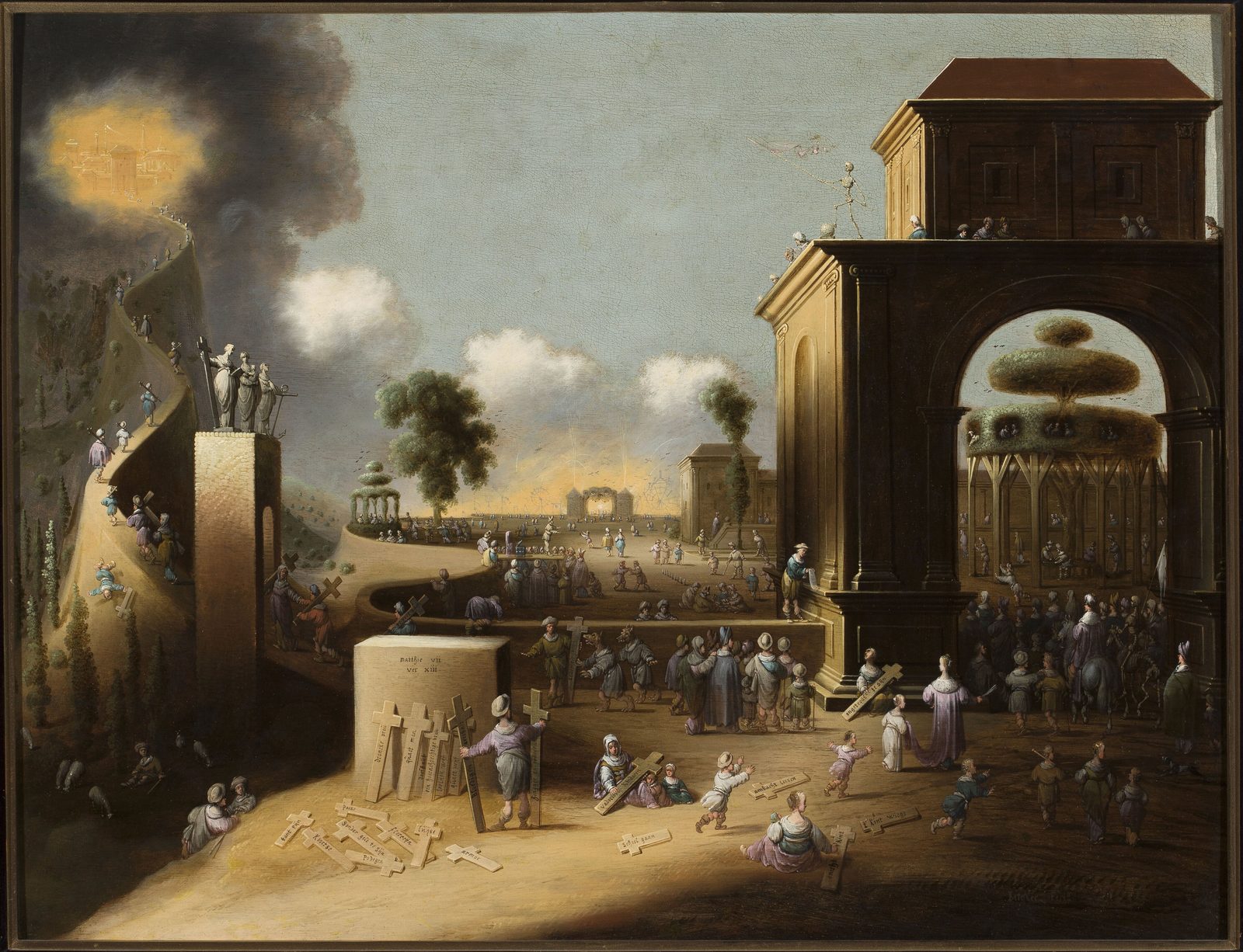
Narrow Road of Virtue and Wide Road of Sin. Jan Micker, not stated on the file page. National Museum in Warsaw. Public domain.