
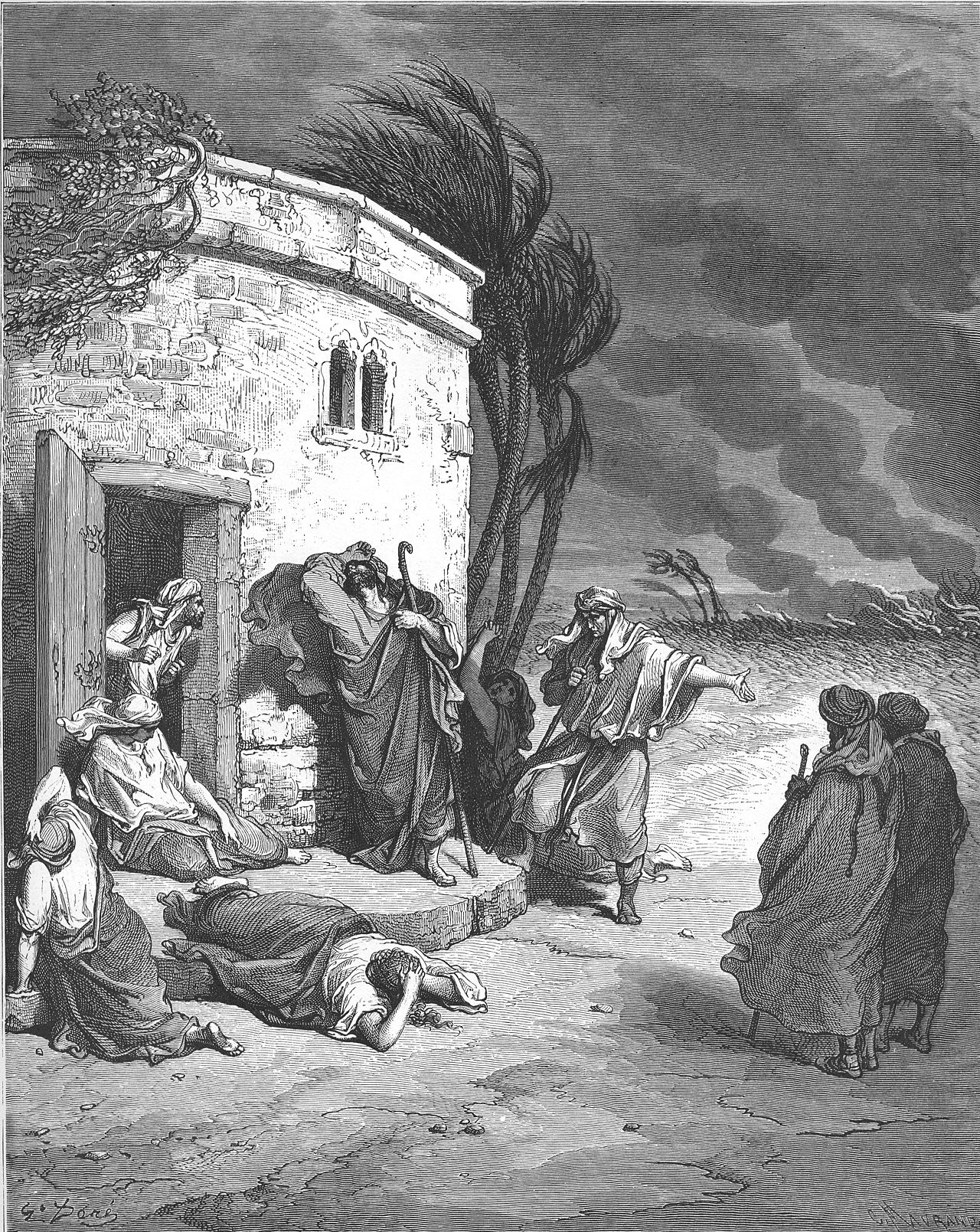
Jobchapter 17
16 verses · unknown · 10th century BC · Wisdom and poetry
Yet a righteous one holds to his way, and the one with clean hands grows stronger.
Introduction
unknown, Wisdom and poetry, Job Overview.
Job continues his answer to Eliphaz and brings the speech to its end. He speaks as a man who expects to die soon and has lost his good name in his own town. His hearers knew how a debt was secured, when a third man struck hands to stand as guarantor. They also buried their dead in family tombs cut in the rock. Listen for the pledge Job asks for and whom he asks to give it. Listen too for the family words he uses at the close, and to whom he gives them.
Context
- Who
- Hearers who had seen a respected man become the local joke
- What
- The close of Job's reply to Eliphaz, a plea for God to stand surety for him and a lament that only the grave waits for him.
- Where
- The ash heap outside Job's town, with the grave in view.
- When
- The second round of speeches, the end of Job's reply to Eliphaz.
- Why
- To show Job left with no one on earth to vouch for him, so that his hope must rest on God.
Historical context
Job asks for a surety, a guarantor. In ancient contracts a third party pledged himself for a debtor by striking hands, and Job's request, 'who is he that will strike hands with me?', is the formal gesture of that pledge. He can find no one on earth willing to stand for him, and asks God to do it.
Show the rest of the historical context, 3 more paragraphs
He says he has been made 'a byword of the people', the name a village used as a shorthand for disgrace, and that men strike him on the face, or in some renderings spit before him. Either way it is the public treatment given to a man everyone has decided is guilty.
The failing eyesight he mentions is medical, not poetic: his eye is dim by reason of sorrow, and his limbs are like a shadow. Prolonged illness and weeping did that, and hearers would not have read it as metaphor.
The last lines make the grave his household. If I wait, the grave is my house; I have made my bed in the darkness; I have said to corruption, You are my father, and to the worm, You are my mother and my sister. Family language for the pit is as bleak as the ancient world gets, the burial cave, where the bones of the family lay together, becomes the only kin he has left.
Significance
The chapter's point is that Job has no earthly place to stand. The friends will not vouch for him, the town has written him off, and his body is going.
Show the rest of the significance, 1 more paragraph
That emptiness is what makes the next chapter's answer land the way it does. The book is clearing the field of every other help before Job says the thing he says in chapter 19.
This chapter in Jewish lifeWhat this chapter is in Jewish life and reading.
What is done
No weekly portion, Haftarah or festival reading in the site's table draws on this chapter. The probe of src/lib/hebraic/readings.ts printed parashot total 0 and haftarah uses total 0 for Job, and festivalReadingForBook printed null.
The study settings the corpus gives it are few. It files the ninth verse under Pesikta DeRav Kahana 25:1 and under the entry for Nazir in Introductions to Amoraic Literature, Part I (Introductions to Tractates of the Babli), at 124. It files the second verse under the Jerusalem Talmud at Maaser Sheni 5:5:15 and Sotah 9:11:5.
How it is read
Rashi, quoted here from The Judaica Press complete Tanach with Rashi, translated by A. J. Rosenberg, which Sefaria reports as CC-BY, reads the chapter as Job's account of mockers around his sickbed. Job's opening words he reads plainly. "I am ready for the grave" (Rashi on Job 17:1:2). He takes the second verse as the scornful who "gathered with me in my consolations to mock me" (Rashi on Job 17:2:1). He traces the word for provocation through Ezekiel 20 and Deuteronomy 9:7 (Rashi on Job 17:2:2).
At the third verse Job turns to God. Rashi glosses the address as "O Creator." He reads the surety as a handshake to debate together, since none of these companions would shake Job's hand for his good (Rashi on Job 17:3:1 and 17:3:2).
The fourth verse is where the two commentators part, and a reader should hear both. Rashi reads it as God's act. God has hidden the friends' hearts from understanding, and so His glory will not be exalted through them (Rashi on Job 17:4:1). Malbim, in Malbim's Job, translated by Jeremy I. Pfeffer (Ktav, 2003), which Sefaria reports as CC-BY, reads it as the limit of human inquiry.
"No-one takes up Job’s challenge." The survival and recompense of the soul after death, he says, "defies inquiry" (Malbim on Job 17:4:1). Rashi places the failure in what God withheld from these men. Malbim places it in the reach of the understanding God gave to man.
The same entry reports that Malbim remarks that many hold the soul to be a force that dies with the body, an Aristotelian idea that many medieval thinkers adopted. Against it Malbim cites the Talmudic sage R. Yonah in Ecclesiastes Rabbah 2, who set the repose of the world to come above all the peace of mind of this world (Malbim on Job 17:4:1).
The fifth verse draws a second pair of readings. Malbim says the dying think only of the disposal of their possessions and not of the future life of their souls. Some leave their estates to lifelong friends and pass over their own children (Malbim on Job 17:5:1). Rashi reads the same verse as flattery spoken by each man to his friend, which comes back on their children (Rashi on Job 17:5:1).
The rest of Rashi's notes follow Job toward the grave. The days of prosperity he was used to have passed (Rashi on Job 17:11:1). He is a drum before the people (Rashi on Job 17:6:1 and 17:6:2). A righteous man who hears the mockery of these hypocrites will wonder at it, and every righteous man holds his way against their company (Rashi on Job 17:8:1, 17:8:2 and 17:9:1).
The mockers turn night into day for him, because he cannot sleep for their mocking (Rashi on Job 17:12:1). He calls the pit his father, to lodge there many days, and asks why his hope is deferred (Rashi on Job 17:14:1 and 17:15:1). His limbs will all rest on the dust (Rashi on Job 17:16:1).
The corpus carries one further note on this chapter without an English text, marked linked because Sefaria holds no English version of the ref. It stands cited and unquoted at Ibn Ezra on Job 17:7:1.
What the rabbis say
The corpus carries fourteen rabbinic locators on this chapter and the text of none, so each is cited and linked here by ref alone. On the second verse, the mockers, it holds Jerusalem Talmud Maaser Sheni 5:5:15, Jerusalem Talmud Sotah 9:11:5 and Mekhilta DeRabbi Shimon Ben Yochai 15:6, with Midrash Sekhel Tov at Bereshit 31:7:1 and Shemot 17:3:2. On the third, the surety, it holds Midrash Tehillim 119:30 and a passage of Otzar Midrashim, Midrash on Psalms, Addendum to Psalm 118, at 61. On the seventh it holds Midrash Sekhel Tov, Bereshit 26:35:2.
The ninth verse, where Rashi hears the righteous hold his way, draws four. The corpus holds Introductions to Amoraic Literature, Part I (Introductions to Tractates of the Babli), Nazir 124, Pesikta DeRav Kahana 25:1, and Yalkut Shimoni on Torah 743:22 and 743:23. On the thirteenth it holds Bereshit Rabbah 30:8, and on the fifteenth Midrash Sekhel Tov, Bereshit 27:33:3. What each of them teaches is a saying of the rabbis, and is reported as theirs wherever this site quotes one. The quotations wait on a fetch that carries the text.
Sources: Rashi, Rashi on Job 17:1:2 to 17:16:1, The Judaica Press complete Tanach with Rashi, translated by A. J. Rosenberg, reported CC-BY; Malbim, Malbim on Job 17:4:1 and 17:5:1, Malbim's Job, trans. Jeremy I. Pfeffer, Ktav, 2003, reported CC-BY; Ibn Ezra, Ibn Ezra on Job 17:7:1, cited by ref because the corpus carries no English text; The Sefaria corpus, scripts/data/sources/sefaria/job/17.json, the 14 Talmud and Midrash locators of this chapter; The site's own files, src/lib/hebraic/readings.ts, printing no portion, no Haftarah and no festival reading for this book.
The heads below are this chapter's scenes. The numbered points under each are its verses.
Job: He Hath Made Me a Byword of the People
Job 17:1-2
The chapter opens with three declarations of a man counting himself dead, ending with "the grave awaits me". Gill reads the opening as the words of a man near his last gasp. The two verses set the key: a man speaking from the edge of the grave.
Job 17:1
“My breath is corrupt - Margin or “spirit is spent.” The idea is, that his vital powers were nearly extinct; his breath failed; his power was weakened, and he was ready to die. This is connected with the previous chapter, and should not have been separated from it. There was no necessity of making a new chapter here, and we have one of those unfortunate breaks in the middle of a paragraph, and almost of a sentence, which are too common in the Scriptures.”
1 more voice on this verseWhat preachers and commentators have said about this verse, in their own words.
Job 17:1
“My breath is corrupt,.... Through the force of his disease, which made it have an ill smell, so that it was strange and disagreeable to his wife, Job 19:17; passing through his lungs, or other parts, which were affected with some disorder, or as frequently is the case of dying persons, and so Job thought himself to be.”
Surely mockers surround me: Wesley notes that Job returns here to the scoffing friends of 16:20 before his plea for a pledge. Barnes explains that the Hebrew verb means to lodge for the night, so the eyes rest on the mockers and their rebellion. His eyes find no rest.
Job 17:2
“Are there not mockers with me? - This has been variously translated. The Vulgate: “I have not sinned, and yet my eye dwells upon afflictions.” Septuagint: “I conjure you, laboring under afflictions, what evil have I done? Yet strangers have robbed me of my substance.” Mr. Good: “But are not revilers before me?”
Adam Clarke · Commentary on the Bible (1810-1826)evangelical
1 more voice on this verse
Job 17:2
“UMBREIT, more emphatically, "had I only not to endure mockery, in the midst of their contentions I (mine eye) would remain quiet." eye continue--Hebrew, "tarry all night"; a figure taken from sleep at night, to express undisturbed rest; opposed to (Job 16:20), when the eye of Job is represented as pouring out tears to God without rest.”
Jamieson, Fausset & Brown · Commentary Critical and Explanatory on the Whole Bible (1871)reformed
Give me, I pray, the pledge You demand: Job asks, "Give me, I pray, the pledge You demand", the figure of a surety who guarantees another man's debt with his goods or person. Clarke and Delitzsch read this as the mediator language of chapter 9, with God asked to be Job's guarantor against the friends' charge.
Job 17:3
“A presage of the "surety" (Heb 7:22), or "one Mediator between God and man" (see on Job 16:21). strike hands--"who else (save God Himself) could strike hands with me?" that is, be my security (Ps 119:122). The Hebrew strikes the hand of him for whom he goes security (Pr 6:1).”
Jamieson, Fausset & Brown · Commentary Critical and Explanatory on the Whole Bible (1871)reformed
Job 17:4-5
You have closed their minds to understanding: Job turns toward heaven again, "You have closed their minds to understanding", reading the friends' blindness as something God has withheld. He asks that they not triumph: "therefore You will not exalt them". The verses accuse the friends while leaving open that their blindness has a cause beyond themselves.
Job 17:4
“For thou hast hid their heart from understanding,.... That is, the hearts of his friends, and therefore they were unfit to undertake his cause, or be sureties for him, or be judges in it.”
1 more voice on this verse
Job 17:4
“For thou hast hid their heart - This address is to God; and here he is represented as doing that which in the course of his providence he only permits to be done. Shalt thou not exalt them - This was exactly fulfilled: not one of Job’s friends was exalted; on the contrary, God condemned the whole; and they were not received into the Divine favor till Job sacrificed, and made intercession for them.”
Adam Clarke · Commentary on the Bible (1810-1826)evangelical
denounces his friends for a price: The renderings differ widely. Noyes, cited by Barnes and by Jamieson, Fausset and Brown, reads it as a man who gives up his friends as prey. Job suggests his friends are ready to do this, and the price falls on his children, whose eyes fail.
Job 17:5
“The Hebrew for "flattery" is "smoothness"; then it came to mean a prey divided by lot, because a smooth stone was used in casting the lots (De 18:8), "a portion" (Ge 14:24). Therefore translate, "He that delivers up his friend as a prey (which the conduct of my friends implies that they would do), even the eyes," &c. [NOYES] (Job 11:20).”
Jamieson, Fausset & Brown · Commentary Critical and Explanatory on the Whole Bible (1871)reformed
Job 17:6-7
He has made me a byword among the people: With "He has made me a byword among the people" Job moves from private grief to public shame, his name now a proverb for ruin. The lines "My eyes have grown dim with grief, and my whole body is but a shadow" complete the wasting that mirrors his social fall.
Job 17:6
“My awful punishment makes my name execrated everywhere, as if I must have been superlatively bad to have earned it. aforetime . . . tabret--as David was honored (1Sa 18:6). Rather from a different Hebrew root, "I am treated to my face as an object of disgust," literally, "an object to be spit upon in the face" (Nu 12:14). So Raca means (Mt 5:22) [UMBREIT].”
Jamieson, Fausset & Brown · Commentary Critical and Explanatory on the Whole Bible (1871)reformed
1 more voice on this verse
Job 17:6
“He hath made me also a by-word - My afflictions and calamities have become a subject of general conversation, so that my poverty and affliction are proverbial. As poor as Job, As afflicted as Job, are proverbs that have even reached our times and are still in use. Aforetime I was as a tabret - This is not the translation of the Hebrew ותפת לפנים אהיה vethopheth lephanim eheyeh. Instead of לפנים lephanim, I would read לפניהם liphneghem, and then the clause might be translated thus: I shall be as a furnace, or consuming fire (Topheth) before them.”
Adam Clarke · Commentary on the Bible (1810-1826)evangelical
my whole body is but a shadow: Barnes and Clarke both trace the dim eyes to long weeping. Henry describes a man so worn by grief that his whole body is skin and bones. Jamieson, Fausset and Brown note that the Hebrew for body means figures, set against a shadow, which has a shape and no substance.
Job 17:7
“Mine eye is dim by reason of sorrow - Schultens supposes that this refers to his external appearance in general, as being worn down, exhausted, “defaced” by his many troubles; but it seems rather to mean that his eyes failed on account of weeping. And all my members are as a shadow - “I am a mere skeleton, I am exhausted and emaciated by my sufferings.” It is common to speak of persons who are emaciated by sickness or famine as mere shadows. Thus, Livy (L.”
Job 17:8-9
The upright are appalled at this: Between images of the grave stands one confidence, "a righteous one holds to his way, and the one with clean hands grows stronger". Gill sees it returning at 23:10. Henry notes the abrupt turn, comfort for one verse before the chapter returns to darkness.
Job 17:8
“Upright men shall be astonied - In several of these verses Job is supposed to speak prophetically of his future restoration, and of the good which religious society should derive from the history of his original affluence, consequent poverty and affliction, and final restoration to health, peace, and prosperity. The upright will receive the account with astonishment, and wonder at the dispensations of the Almighty; while hypocrites, false professors and the sour-headed, godly, shall be unmasked, and innocent men, whether in affliction or affluence, shall be known to be favourites of the Almighty.”
Adam Clarke · Commentary on the Bible (1810-1826)evangelical
a righteous one holds to his way: Barnes admits the connection is hard to see and takes the righteous one as Job himself, who holds to his way and grows stronger. Jamieson, Fausset and Brown read it of the upright, who take fresh courage from Job's example. Spurgeon preached on it more than once.
Job 17:9
“The righteous also shall hold on his way - The meaning of this verse is plain; but the connection is not so apparent. It seems to me that it refers to “Job himself,” and is a declaration that “he,” a righteous man, who had been so grievously calumniated, would hold on his way, and become stronger and stronger, while “they” would sink in the public esteem, and be compelled to abandon their position. It is the expression of a confident assurance that “he” would be more and more confirmed in his integrity, and would become stronger and stronger in God.”
1 more voice on this verse
Job 17:9
“THE man who is righteous before God has a way of his own. It is not the way of the flesh, nor the way of the world. It is a way marked out for him by the Divine command in which he walks by faith. It is the King's highway of holiness— the unclean shall not pass over it—only the ransomed of the Lord shall walk there and these shall find it a path of separation from the world.”
Job: If I Look for Sheol as My House, Where Is My Hope?
Job 17:10-11
But come back and try again, all of you: Job dismisses the friends' arguments as spent and gives his verdict plainly: "I will not find a wise man among you". With "my plans are broken off" he turns to his own ruined plans. Clarke reads the pairing as Job closing one argument before opening another.
Wesley hears Job answer the friends' hope of better days: his days are passed, so their promises are vain. Jamieson, Fausset and Brown see the plans broken off like threads cut from a loom. Clarke marks a relapse into gloom after verse 9.
Job 17:11
“Only do not vainly speak of the restoration of health to me; for "my days are past." broken off--as the threads of the web cut off from the loom (Isa 38:12). thoughts--literally, "possessions," that is, all the feelings and fair hopes which my heart once nourished.”
Jamieson, Fausset & Brown · Commentary Critical and Explanatory on the Whole Bible (1871)reformed
Job 17:12-14
They have turned night into day: With "If I look for Sheol as my home" the grave becomes his home. He gives corruption and the worm the names of father, mother and sister, the relations he has lost. Delitzsch notes the boldness of naming decay as kin.
Job 17:12
“They change the night into day - These purposes and thoughts are so very gloomy, that they change day into night. The light is short because of darkness - אור קרוב מפני חשך or karob mippeney choshek, “The light is near from the face of darkness.” I have scarcely any light: what is called light is so near akin to darkness, that it is scarcely severed from it. There is either no light, or merely such as is sufficient to render darkness visible.”
Adam Clarke · Commentary on the Bible (1810-1826)evangelical
1 more voice on this verse
Job 17:12
“Or better for "short," the Hebrew "near"; "and the light of new prosperity should be near in the face of (before) the darkness of death"; that is, they would persuade me that light is near, even though darkness approaches.”
Jamieson, Fausset & Brown · Commentary Critical and Explanatory on the Whole Bible (1871)reformed
spread out my bed in darkness: Jamieson, Fausset and Brown, after Umbreit, see the condition answered in verse 15: if Sheol is his home, where then is his hope? Sheol here is the grave. Henry notes that Job tries to make peace with the grave by calling it a house.
Job 17:13
“Rather, "if I wait for this grave (Sheol, or the unseen world) as my house, and make my bed in the darkness (Job 17:14), and say to corruption," rather, "to the pit" or "grave," &c. Where then is my hope? [UMBREIT]. The apodosis is at Job 17:15.”
Jamieson, Fausset & Brown · Commentary Critical and Explanatory on the Whole Bible (1871)reformed
2 more voices on this verse
Job 17:13
“Wait - For deliverance, I should be disappointed; for I am upon the borders of the grave, I expect no rest but in the dark grave, for which therefore I prepare myself. I endeavour to make it easy, by keeping my conscience pure, by seeing Christ lying in this bed, (so turning it into a bed of spices) and by looking beyond it to the resurrection.”
John Wesley · Explanatory Notes upon the Old Testament (1765)evangelical
Job 17:13
“If I wait - Or more accurately, “truly I expect that the grave will be my home.” The word rendered “if” (אם 'ı̂m) is often used in such a sense. The meaning is, “I look certainly to the grave as my home. I have made up my mind to it, and have no other expectation.” The grave - Hebrew שׁאול she'ôl. It may mean here either the grave, or the region of departed spirits, to which he expected soon to descend. Mine house - My home; my permanent abode.”
say to corruption: Job claims the grave's family as his own, calling the pit his father and the worm his mother and sister. The Hebrew word, Barnes notes, means a pit or grave. Henry explains the kinship: the body was formed from the earth and returns to it.
Job 17:14
“I have said to corruption - I came from a corrupted stock, and I must go to corruption again. The Hebrew might be thus rendered: To the ditch I have called, Thou art my father. To the worm, Thou art my mother and my sister. I am in the nearest state of affinity to dissolution and corruption: I may well call them my nearest relations, as I shall soon be blended with them.”
Adam Clarke · Commentary on the Bible (1810-1826)evangelical
Job 17:15-16
where then is my hope?: The closing question, "where then is my hope", gathers the pledge of verse 3 and the confidence of verse 9 into one final doubt. The last verse asks whether hope will "go down to the gates of Sheol". Wesley notes the gates as a figure for the grave's finality.
Job 17:15
“Who shall see it fulfilled? namely, the "hope" (Job 11:18) which they held out to him of restoration.”
Jamieson, Fausset & Brown · Commentary Critical and Explanatory on the Whole Bible (1871)reformed
the gates of Sheol?: Wesley, Barnes and Jamieson, Fausset and Brown take the subject to be the hope of verse 15. Job sees his hope go down to Sheol and the dust. Barnes likens it to a man who buries his hopes with an only son.
Job 17:16
“They--namely, my hopes shall be buried with me. bars-- (Isa 38:10). Rather, the wastes or solitudes of the pit (sheol, the unseen world). rest together--the rest of me and my hope is in, &c. The word "rest" implies that man's ceaseless hopes only rob him of rest.”
Jamieson, Fausset & Brown · Commentary Critical and Explanatory on the Whole Bible (1871)reformed
1 more voice on this verse
Job 17:16
“They shall go down to the bars of the pit - All that I have must descend into the depths of the grave. Thither are we all going; and there alone can I rest. בדי baddey, which we translate bars, signifies also branches, distended limbs, or claws, and may here refer either to a personification of the grave, a monster who seizes on human bodies, and keeps them fast in his deadly gripe; or to the different branching-off-alleys in subterranean cemeteries, or catacombs, in which niches are made for the reception of different bodies.”
Adam Clarke · Commentary on the Bible (1810-1826)evangelical
Keep studying
Studies1
Words7
Show the next 1 title
Sources for this chapter
The summary
Jamieson, Fausset & Brown, Commentary Critical and Explanatory; John Wesley, Notes on the Old Testament and Matthew Henry, Complete Commentary.
The exposition
Adam Clarke, Commentary on the Bible; Albert Barnes; Charles Spurgeon, The Metropolitan Tabernacle Pulpit, Sermon No. 749: “The Righteous Holding On His Way”; Franz Delitzsch, Biblical Commentary on the Book of Job; Jamieson, Fausset & Brown, Commentary Critical and Explanatory on the Whole Bible; John Gill, Exposition of the Old Testament; John Wesley, Explanatory Notes upon the Old Testament and Matthew Henry, Commentary on the Whole Bible.