
Psalm 113
9 verses · David and others · 10th to 5th century BC · Wisdom and poetry
Hallelujah! Give praise, O servants of the LORD; praise the name of the LORD.
Introduction
Author unstated, the Opening of the Hallel, Book 5: The return and the great Hallelujah, Poetry, Psalms Overview.
This psalm opens the six songs Israel sang at Passover, the songs Jewish custom sets at the meal Jesus kept with His disciples before His arrest. Its writer is not named. It begins with the praise of God's name and holds off on any deed until that praise is complete. Then it looks down from the height of heaven to the two people a village was most likely to overlook. Listen for the distance the psalm travels between those two places, and for the song of an earlier mother that it echoes at the end.
Context
- Who
- Israelites at a feast, among them the poor, the landless and the childless the psalm names
- What
- A hymn praising the LORD who is high above the nations and stoops to lift the poor and the childless.
- Where
- Jerusalem, at the Passover meal in the households and in the temple courts.
- When
- Sung at the feasts in the second temple period, with the author and the date of writing unnamed.
- Why
- To open the songs sung at Passover with praise of God's name and of His care for those at the bottom.
Historical context
This is the first of Psalms 113 to 118, the group sung at Passover and the other great feasts. Matthew 26:30 records Jesus and the disciples singing a hymn at the end of the Passover meal before going out to the Mount of Olives, and the hymn at that point of the meal came from this group. The ash heap of verse 7 is ashpoth in the Hebrew, the rubbish and dung heap outside a town where refuse was dumped and burned, and it was where the destitute slept. A woman without sons had no standing in her husband's household and no security in widowhood, which is why this psalm's last line names her. The last three verses are Hannah's song at 1 Samuel 2:5 and 2:8, so a hearer at the feast was singing a woman's private thanksgiving as a national one.
Significance
At a feast that remembered slaves being brought out of Egypt, this psalm said that the God who did that still works at the bottom of society, and it named the two people in any village least likely to be noticed. The name is praised three times before a single act is named, which told a congregation to praise God for who He is before asking what He has lately done for them.
This chapter in Jewish lifeWhat this chapter is in Jewish life and reading.
What is done
This psalm opens the Hallel, the block of Psalms 113 to 118 said as one unit at the appointed feasts (src/app/featured/the-hallel/page.tsx and src/components/book/dossier-content/psalms-structure.ts). In the Temple court those standing there said the Hallel while the Passover lambs were killed, group by group (Mishnah Pesachim 5:7, as this site records it on its Hallel page).
At the seder the set is split across the meal, and this psalm stands at the seam the Houses argued over. The House of Shammai ends the first part at the close of Psalm 113, and the House of Hillel at the close of Psalm 114 (Mishnah Pesachim 10:6-7). The Hallel is also said at Tabernacles, where the lulav is waved during it, and on the days of Dedication and at the New Moon (Mishnah Sukkah 3:9 and Mishnah Taanit 4:5). Eighteen days in the Land carry the whole Hallel and twenty one outside it (Babylonian Talmud Arakhin 10a).
How it is read
The corpus holds only three comments of Rashi on this chapter, and two of them read the last verse of Israel rather than of a household. The barren woman of verse 9 he reads as "Zion, which is like a barren woman", whom God will seat in her house, and the happy mother of children he reads with Isaiah 66:8, on Zion bearing her children (Rashi on Psalms 113:9:1 and 113:9:2, Rashi on Psalms, The Judaica Press complete Tanach with Rashi, translated by A. J. Rosenberg, CC-BY).
On verse 5 he holds the two halves of the psalm together, the God who dwells on high and lowers His eyes to see, and he notes the superfluous letter that five of the participles in the psalm carry (Rashi on Psalms 113:5:1, same edition).
Ibn Ezra, Metzudat David and Radak carry twenty one comments on this short chapter for which Sefaria holds no English version, one or more on every verse from 1 to 8, and they are cited by reference (Ibn Ezra on Psalms 113:1:1, Metzudat David on Psalms 113:1:1, Radak on Psalms 113:1:1 and the eighteen references beside them).
What the rabbis say
The corpus records forty places where the Midrash and the Talmud cite this psalm, twenty three under Midrash and seventeen under Talmud, which is the heaviest Talmud weight of any chapter in these thirty. It carries the locator for each one with no text, and the weight follows from the psalm's place in the Hallel, since the tractates that argue over the Hallel are the tractates that cite it.
The Jerusalem Talmud reads the first verse at Berakhot 8:8:4, Chagigah 2:1:15 and 2:2:6, Megillah 1:9:19 and 2:1:3, and Pesachim 5:5:2, and it reads verse 8 at Pesachim 10:5:1. The Babylonian Talmud cites verse 1 at Arakhin 10b:8, verse 2 at Megillah 17a:16, verse 3 at Megillah 17a:15 and 20b:11, verse 7 at Yoma 87a:14 and verse 9 at Bava Batra 120a:3.
Tractate Soferim cites verse 2 at 10:7 and 21:6, Vayikra Rabbah reads verses 5 and 6 at 1:5, and Bereshit Rabbah reads verse 9 at 53:5. The site reports where the rabbis cite the verse and reports no saying, because the locator carries none.
Sources: The Mishnah, Pesachim 5:7 and 10:6-7, Sukkah 3:9 and Taanit 4:5, as recorded at src/app/featured/the-hallel/page.tsx, about AD 200; Babylonian Talmud, Arakhin 10a, as recorded at src/app/featured/the-hallel/page.tsx; Rashi, Rashi on Psalms 113, in The Judaica Press complete Tanach with Rashi, translated by A. J. Rosenberg, CC-BY; Ibn Ezra, Metzudat David and Radak, their comments on Psalms 113, cited by reference; Sefaria holds no English version; The Midrash and the Talmud, the forty locators on Psalms 113 in scripts/data/sources/sefaria/psalms/113.json.
Psalms 113:1-3
O servants of the LORD: The servants of the LORD are told to praise His name, and blessed be that name both now and forevermore. Psalms 113 to 118 are the Hallel, sung at Passover, and Matthew 26:30 has Jesus and the disciples singing a hymn. The name is praised before any act is named.
Psalms 113:1
“Praise ye the Lord, or Hallelujah, praise to Jah Jehovah. Praise is an essential offering at all the solemn feasts of the people of God. Prayer is the myrrh, and praise is the frankincense, and both of these must be presented unto the Lord. How can we pray for mercy for the future if we do not bless God for his love in the past? The Lord hath wrought all good things for us, let us therefore adore him. All other praise is to be excluded, the entire devotion of the soul must be poured out unto Jehovah only.”
Charles Spurgeon · The Treasury of David, Vol. 5 (1878)Particular Baptist
1 more voice on this verseWhat preachers and commentators have said about this verse, in their own words.
Psalms 113:1
“And it is their business to praise him; that is the work required of them as his servants: it is easy pleasant work to speak well of their Master, and do him what honour they can; if they do not, who should? Some understand it of the Levites; but, if so, all Christians are a royal priesthood, to show forth the praises of him that has called them, 1 Pet. ii.”
Matthew Henry · Commentary on the Whole Bible (1707-1721)puritan
both now and forevermore: Verse 2 gives the praise its length. Now and forevermore reach past this life, and Matthew Henry saw a glimpse of heaven, where the name is blessed when time is done. Spurgeon added the silent side, the name blessed in the heart while the voice praises it aloud.
Psalms 113:2
“Blessed be the name of the Lord. While praising him aloud, the people were also to bless him in the silence of their hearts, wishing glory to his name, success to his cause, and triumph to his truth.”
Charles Spurgeon · The Treasury of David, Vol. 5 (1878)Particular Baptist
1 more voice on this verse
Psalms 113:2
“But perhaps there is more in it; as the former verse gave us a glimpse of the kingdom of glory, intimating that God's name shall be blessed for ever (when time shall be no more that praise shall be the work of heaven), so this verse gives us a glimpse of the kingdom of grace in the gospel-dispensation of it.”
Matthew Henry · Commentary on the Whole Bible (1707-1721)puritan
From where the sun rises to where it sets: Gill read where the sun rises and sets as place, the whole earth from east to west, and Spurgeon read it as time and place. Malachi 1:11 uses the same span for the name of the LORD great among the nations. Henry saw the gospel reaching the nations here.
Psalms 113:3
“From the rising of the sun unto the going down of the same the Lord'S name is to be praised. From early morn till eve the ceaseless hymn should rise unto Jehovah's throne, and from east to west over the whole round earth pure worship should be rendered unto his glory. So ought it to be; and blessed be God, we are not without faith that so it shall be. We trust that ere the world's dread evening comes, the glorious name of the Lord will be proclaimed among all nations, and all people shall call him blessed.”
Charles Spurgeon · The Treasury of David, Vol. 5 (1878)Particular Baptist
1 more voice on this verse
Psalms 113:3
“From the rising of the sun unto the going down of the same,.... Meaning not from morning tonight; for it designs not time, but place, even all the space from east to west, or that lies between the rising and setting sun; even all nations, and the inhabitants of them; and who ought to praise the Lord for the rising sun, and the benefit and advantages of it; and yet many of them have worshipped the sun, and served the creature more than and besides the Creator.”
Psalms 113:4-6
exalted over all the nations: , the LORD has His glory above the heavens. Verse 5 asks who is like Him, and verse 6 answers: the One enthroned on high humbles Himself to look at the heavens and earth. Verse 7 turns that stooping into lifting.
Psalms 113:4
“The Lord is high above all nations,.... He is the most High in all the earth; he is higher than the highest; he is King of kings and Lord of lords: all nations are made by him, and are under his government and dominion; he is the Governor among the nations; they are in comparison of him as the drop of a bucket, as the small dust of the balance; as nothing, yea, less than nothing, and vanity.”
1 more voice on this verse
Psalms 113:4
“The Lord is high above all nations. Though the Gentiles knew him not, yet was Jehovah their ruler: their false gods were no gods, and their kings were puppets in his hands. The Lord is high above all the learning, judgment, and imagination of heathen sages, and far beyond the pomp and might of the monarchs of the nations. Like the great arch of the firmament, the presence of the Lord spans all the lands where dwell the varied tribes of men, for his providence is universal: this may well excite our confidence and praise.”
Charles Spurgeon · The Treasury of David, Vol. 5 (1878)Particular Baptist
Who is like the LORD our God: The question echoes the song at the sea, where Exodus 15:11 asks who among the gods is like the LORD. Spurgeon called it a challenge that stands unanswered, since His godhead belongs to Him alone. Verse 4 set His glory above the heavens.
Psalms 113:5
“Another psalm that was read says, "Who is as the Lord our God who dwells on high and looks down on the low things in heaven and in earth?" God, no doubt, casts his eyes on the lowly, he who laid bare the relics of the holy martyrs of his church, lying hid under the lowly turf, their souls in heaven, their bodies in the earth: "Raising up the needy person out of the dust, lifting up the poor person out of the dunghill," placing him, as you see, with the princes of his people.”
Ambrose of Milan · written before 397 · LETTER 61patristic
1 more voice on this verse
Psalms 113:5
“Who is like unto the Lord our God? The challenge will never be answered. None can be compared with him for an instant; Israel's God is without parallel; our own God in covenant stands alone, and none can be likened unto him. Even those whom he has made like himself in some respects are not like him in godhead, for his divine attributes are many of them incommunicable and inimitable.”
Charles Spurgeon · The Treasury of David, Vol. 5 (1878)Particular Baptist
He humbles Himself to behold: Spurgeon read the stoop: God is so high that even looking at the heavens bends Him down, and looking at the earth bends Him lower. Mary sings of the same look at Luke 1:48, where God regards the humble state of His servant. The heavens are below Him too.
Psalms 113:6
Who humbleth himself to behold the things that are in heaven, and in the earth! He dwells so far on high that even to observe heavenly things he must humble himself. He must stoop to view the skies, and bow to see what angels do. What, then, must be his condescension, seeing that he observes the humblest of his servants upon earth, and makes them sing for joy like Mary when she said, "Thou hast regarded the low estate of thine handmaiden."
Charles Spurgeon · The Treasury of David, Vol. 5 (1878)Particular Baptist
1 more voice on this verse
Psalms 113:6
“Humbleth - Who is so high, that it is a wonderful condescention in him to take any notice of his heavenly host, and much more of sinful and miserable men upon earth.”
John Wesley · Explanatory Notes upon the Old Testament (1765)evangelical
Psalms 113:7-9
lifts the needy from the dump: Hannah's song at 1 Samuel 2:8 carries these lines, the poor lifted from the dust, and 1 Samuel 2:5 gives the barren woman her children. The Hebrew behind the dump is ashpoth, a heap of rubbish or filth. The man off the rubbish heap is seated with nobles.
Psalms 113:7
“He raiseth up the poor out of the dust. This is an instance of his gracious stoop of love: he frequently lifts the lowest of mankind out of their poverty and degradation and places them in positions of power and honour. His good Spirit is continually visiting the down trodden, giving beauty for ashes to those who are cast down, and elevating the hearts of his mourners till they shout for joy.”
Charles Spurgeon · The Treasury of David, Vol. 5 (1878)Particular Baptist
2 more voices on this verse
Psalms 113:7
“Some have applied this to the work of redemption by Jesus Christ, and not unfitly; for through him poor fallen men are raised out of the dust (one of the Jewish rabbies applies it to the resurrection of the dead), nay, out of the dunghill of sin, and set among princes, among angels, those princes of his people.”
Matthew Henry · Commentary on the Whole Bible (1707-1721)puritan
Psalms 113:7
“Daniel, the prophet, says to Nebuchadnezzar, that the most High rules in the kingdom of humankind, and he will give it to whomsoever it shall please him, and he will appoint the lowest and the basest person over it.”
Jerome · written before 420 · Against the Pelagians 2.3patristic
to seat them with nobles: The lift of verse 7 ends in a seat. Spurgeon said the LORD does nothing by halves: He raises the poor and stops only when they sit with the princes of His people. Henry records that one Jewish rabbi applied the lines to the dead raised from the dust.
Psalms 113:8
“That he may set him with princes. The Lord does nothing by halves: when he raises men from the dust he is not content till he places them among the peers of his kingdom. We are made kings and priests unto God, and we shall reign for ever and ever. Instead of poverty, he gives us the wealth of princes; and instead of dishonour, he gives us a more exalted rank than that of the great ones of the earth. Even with the princes of his people.”
Charles Spurgeon · The Treasury of David, Vol. 5 (1878)Particular Baptist
He settles the barren woman in her home: Gill read it as the LORD who gives the barren woman children, as Rachel and Leah built up the house at Ruth 4:11. Henry heard Isaiah 54:1 in it, the barren woman told to sing over her children, and Paul applies it at Galatians 4:27. The psalm ends with Hallelujah.
Psalms 113:9
“He maketh the barren woman to keep house, and to be a joyful mother of children. The strong desire of the easterns to have children caused the birth of offspring to be hailed as the choicest of favours, while barrenness was regarded as a curse; hence this verse is placed last as if to crown the whole, and to serve as a climax to the story of God's mercy. The glorious Lord displays his condescending grace in regarding those who are despised on account of their barrenness, whether it be of body or of soul.”
Charles Spurgeon · The Treasury of David, Vol. 5 (1878)Particular Baptist
2 more voices on this verse
Psalms 113:9
“This, therefore, may be applied to the gospel-church among the Gentiles (the building of which is illustrated by this similitude, Isa. liv. 1 , Sing, O barren! thou that didst not bear, and Gal. iv. 27 ), for which we, who, being sinners of the Gentiles, are children of the desolate, have reason to say, Praise you the Lord.”
Matthew Henry · Commentary on the Whole Bible (1707-1721)puritan
Psalms 113:9
“On this special case, compare 1Sa 2:21. Barrenness was regarded as a disgrace, and is a type of a deserted Church (Isa 54:1). the barren woman . . . house--literally, "the barren of the house," so that the supplied words may be omitted.”
Jamieson, Fausset & Brown · Commentary Critical and Explanatory on the Whole Bible (1871)reformed
How this psalm is built
The form: The opening psalm of the Hallel, sung at Passover, in which the servants of the LORD are called to praise His name, as Spurgeon classes it.
A The LORD is exalted over all the nations, His glory above the heavens
Psalm 113:4
B Who is like the LORD our God, the One enthroned on high
Psalm 113:5
C He humbles Himself to behold the heavens and the earth, and raises the poor from the dust
Psalm 113:6-7
B′ He seats the lifted man with princes, the princes of His people
Psalm 113:8
A′ He settles the childless woman in her home as a joyful mother
Psalm 113:9
The patterns in this chapter
| Device | What it does | Where to see it |
|---|---|---|
| Praise the name, three times over | Verses 1 to 3 say the name of the LORD three times in three lines, praise it, bless it, and praise it again from the rising of the sun to its setting. The name is praised before any act of His is named.Augustine of Hippo, Exposition on Psalm 113, c. 430, on Psalm 113:2. | Psalm 113:1, Psalm 113:2, Psalm 113:3 |
| High above, stooping down | The psalm climbs and then descends. Verses 4 and 5 put the LORD above the nations and above the heavens and ask who is like Him. Verse 6 has Him stoop to look. Verses 7 to 9 have Him reach the dust, the ash heap and the childless house. The height is what makes the descent worth saying.John Calvin, Commentary on the Book of Psalms, 1557, on Psalm 113:5. | Psalm 113:4, Psalm 113:6, Psalm 113:7, Psalm 113:9 |
| From the dust and from the ash heap | Verse 7 pairs the poor raised from the dust with the needy lifted from the ash heap. The Hebrew behind the second is ashpoth, a heap of rubbish or filth outside a town, so the two halves name the lowest ground a person could be found on.Adam Clarke, Commentary on the Bible, 1832, on Psalm 113:7. | Psalm 113:7 |
| Hannah's lines | Verses 7 to 9 carry 1 Samuel 2:8 almost word for word, the poor lifted from the dust and the needy from the ash heap and seated with princes, and 1 Samuel 2:5 gives the barren woman her children. The psalm is Hannah's song turned into a congregation's.John Gill, Exposition of the Old Testament, 1748 to 1763, on Psalm 113:7. | Psalm 113:7, Psalm 113:8, Psalm 113:9 |
| From the rising of the sun to its setting | Verse 3 measures the praise by the whole course of a day and the whole width of the earth. It is the psalm's way of saying that the call of verse 1 has no boundary in time or place.Augustine of Hippo, Exposition on Psalm 113, c. 430, on Psalm 113:3. | Psalm 113:3 |
Why the order matters
7 more paragraphs on the patterns
The psalm's argument depends on where its parts fall. If the stooping came first it would read as kindness. Coming after the height it reads as something stranger, because the God who has to lower His eyes to see the heavens is the one who notices a man on a rubbish heap.
The three songs
The last three verses are Hannah's. Her song at 1 Samuel 2:8 has the poor raised from the dust and the needy from the ash heap and set among princes, and 1 Samuel 2:5 gives the barren woman her children. The psalm takes a woman's private thanksgiving and gives it to the whole congregation to sing. Mary's song at Luke 1:46 to 55 works the same ground, bringing down rulers from their thrones, exalting the humble and filling the hungry with good things. The three stand in a line and this psalm is the middle of it.
What the psalm claims about God
Nine verses carry one of the Bible's central claims about God's character in the shortest possible form. He is higher than the heavens, and He looks at the dust. Everything the Gospels say about the incarnation works the same ground, and the psalm states the pattern centuries before the event.
A rule for praise
The psalm praises the name three times over in verses 1 to 3 before it names a single act, which puts who God is ahead of what He has lately done for the singer. Augustine reads verse 3, from the rising of the sun to its setting, as the psalm's way of saying the call has no boundary in time or in place.
Keep studying
Words8
Sources for this chapter
The summary
Jamieson, Fausset & Brown, Commentary Critical and Explanatory; John Calvin, Commentaries; John Wesley, Notes on the Old Testament and Matthew Henry, Complete Commentary.
The form and classifications
Charles Spurgeon, The Treasury of David, Vol. 5, 1878, on Psalm 113:1; John Gill, Exposition of the Old Testament, 1748 to 1763, on Psalm 113:7 and John Wesley, Explanatory Notes upon the Old Testament, 1765, on Psalm 113:6.
The exposition
Charles Spurgeon, The Treasury of David; Franz Delitzsch, Biblical Commentary on the Psalms; John Calvin, Commentary on the Book of Psalms; John Gill, Exposition of the Old Testament and Matthew Henry, Commentary on the Whole Bible.
The painting
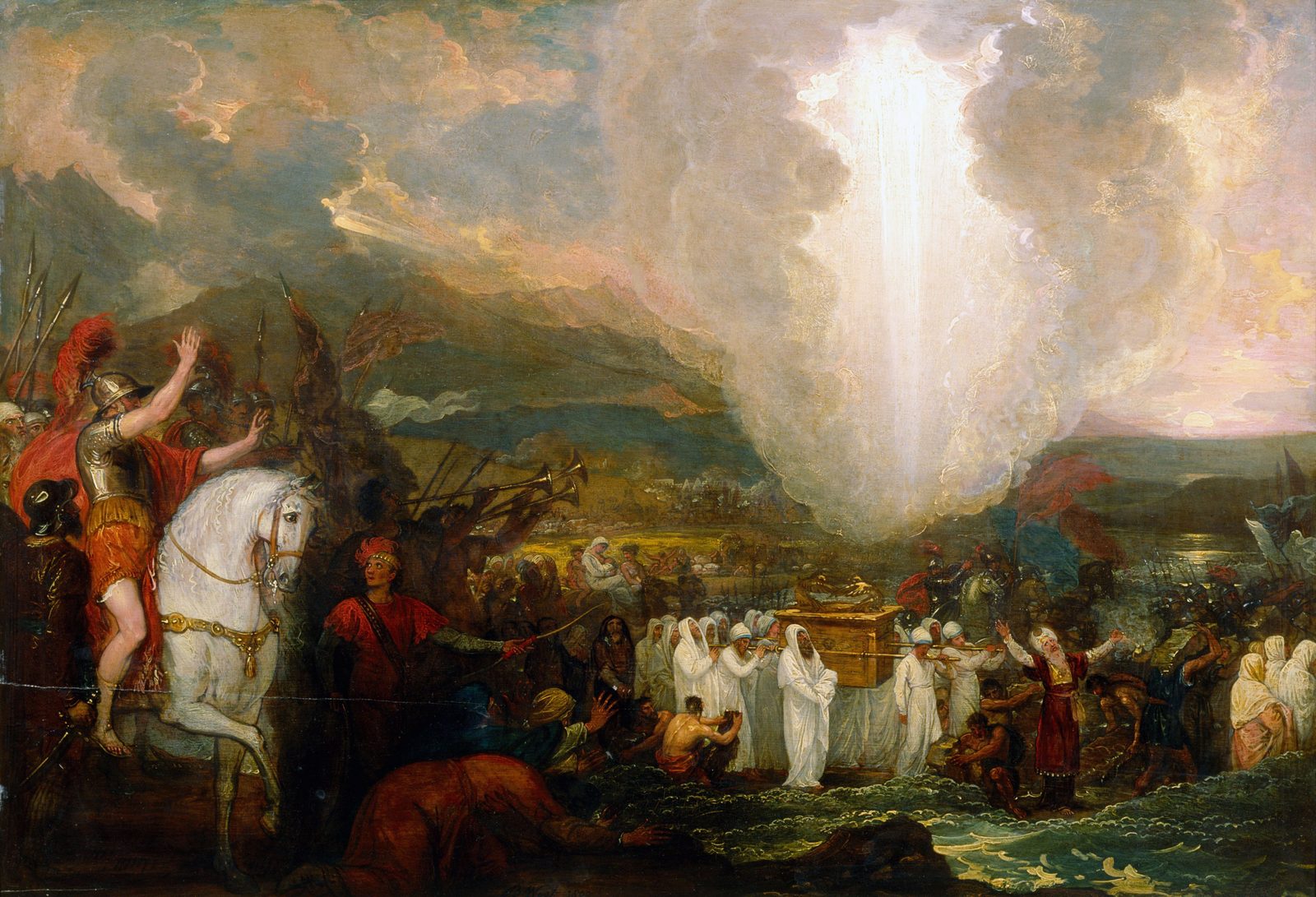
Joshua passing the River Jordan with the Ark of the Covenant. Benjamin West, 1800. Wikimedia Commons. Public domain.